Amalfi Coast First-Time Visitor Guide: Mistakes to Avoid
What do first-time visitors get wrong about the Amalfi Coast?
Most first-time mistakes come from three false assumptions: that the beaches are white sand, that the coast road is a relaxed scenic drive, and that trains connect the villages. In reality the coast has pebble coves and paid lidos, a narrow one-lane-alternating road (the SS163), and no railway at all — Amalfi, Positano, and Ravello are reached by SITA bus, ferry, or car from Salerno or Sorrento.
The gap between the postcard and the reality
Photos of the Amalfi Coast circulate so widely that most first-time visitors arrive with an image built from someone else’s highlight reel rather than the geography itself. That gap is where the disappointment lives, not in the coast itself, which remains one of the most striking stretches of coastline in Italy. Almost every frustrated review from a first trip traces back to one of a handful of assumptions that simply do not match how this stretch of the Campania coast is built, served, and run. This guide works through the most common ones before you book anything, starting with the beaches.
Mistake #1: expecting white sand and Caribbean-style beaches
The single most common letdown for a first visit is the beach. The Amalfi Coast is not a white-sand destination. It is a limestone cliff face dropping almost straight into the sea, and the coves that exist between the rock are lined with pebbles or coarse, dark sand rather than fine white sand. That is simply the geology, and no amount of searching will turn up a hidden Caribbean-style cove.
The second part of the same mistake is assuming those beaches are free and open. In Positano, the two best-known stretches, Spiaggia Grande and Fornillo, are largely divided into paid lidos: rows of sunbeds and umbrellas operated by private concessions, with a day rate that climbs in July and August. Free public sections do exist at both beaches, but they are narrower, fill up early in the morning, and offer none of the sunbed infrastructure. If a relaxed, low-cost beach day is the priority, Minori and Maiori have longer, more open stretches of shoreline than Positano or Amalfi, and are worth checking before assuming Positano is the default beach town. Our Positano beaches guide breaks down which sections are free and which require a lido booking.
Mistake #2: treating the SS163 as a relaxed scenic drive
The coast road, the SS163 Amalfitana, looks glorious in photographs and drone footage, and it is genuinely beautiful to ride along. What the photographs do not show is that it is a single carriageway, cut into a cliff, with hairpin bends and almost no shoulder. In the high season, from Easter through October and peaking in July and August, traffic on the busiest sections is regulated with one-lane alternation: a light or a traffic officer lets cars from one direction move at a time. Amalfi, Positano, and Ravello also enforce ZTL zones, restricted traffic areas where only residents and permitted vehicles may enter, so a rental car often cannot simply drive into the historic center.
The practical result is that most visitors do not rent a car for the coast itself. The SITA bus network runs the length of the SS163 and is the workhorse of local transport, while seasonal ferries connect the main harbor towns by sea, often faster and always less stressful than driving in August traffic. If you are still weighing whether to self-drive, our guide to the SS163 and our guide to visiting without a car lay out both options in detail, and the SITA bus guide covers routes, tickets, and stops.
For a first trip, letting someone else handle the driving removes a real source of stress. A guided scooter tour of the coast from Salerno or a full-day private tour with free time built in both let you see Positano, Amalfi, and Ravello without hunting for parking or navigating the alternation lights yourself.
Mistake #3: assuming a train connects the villages
This is the mistake that causes the most missed connections and rebooked plans. There is no railway on the Amalfi Coast. Amalfi, Positano, Ravello, Praiano, Minori, Maiori, and the other coastal villages have no train station, and none is planned, because the terrain simply does not allow it.
The confusion usually comes from the Circumvesuviana, the commuter line that runs between Naples and Sorrento, stopping at Pompei and Herculaneum along the way. That line serves the Sorrentine Peninsula, not the Amalfi Coast itself, and Sorrento is its final stop. From Sorrento, or from Salerno at the other end of the coast (reachable by regular rail from Naples and Rome), you switch to a SITA bus or a ferry to actually reach Amalfi, Positano, or Ravello. Our Circumvesuviana guide and ferry guide map out both halves of that journey, and if you’re planning the airport leg specifically, see Naples airport to the Amalfi Coast.
Ferries are worth a specific warning of their own: they run frequently in high season between the coastal villages, Capri, Naples, and Sorrento, but schedules thin dramatically or stop altogether in winter. Never build a November-to-March itinerary around the assumption that a ferry will be running; check the operator schedule for your travel month before relying on one.
Mistake #4: counting Naples as part of the Amalfi Coast
Because most international flights land in Naples, it is easy to assume the city is somehow part of the Amalfi Coast trip. It is not. Naples sits on its own gulf, is a major city in its own right, and is more than an hour’s drive or train-and-bus combination from Amalfi, Positano, or Ravello. It is the practical gateway, the place most visitors land and pass through, but treating it as a coastal stop rather than a separate leg of the trip throws off a lot of first-time itineraries built around a single tight loop.
Naples is worth its own time, whether for the historic center, the archaeological museum, or a genuinely excellent pizza, and pairing it with the ruins nearby is one of the most efficient uses of a gateway day. A guided day tour from Naples covering Pompeii and the Amalfi Coast is built specifically around that reality: it treats Naples as the starting point of a day out, not a coastal town in itself. If you’d rather plan the connection yourself, Naples to Sorrento transport and the Naples-Pompeii-Vesuvius two-day itinerary are good starting points, and our 3-day Amalfi Coast itinerary shows how to sequence the gateway city against the coast proper.
Mistake #5: expecting the same coast in every season
The Amalfi Coast does not offer a consistent experience across the calendar, and assuming it does leads to mismatched expectations either way. High season runs from Easter to late October, with the sharpest crowds and prices in July and August: the SS163 is at its most congested, lidos are full, and popular restaurants need reservations days in advance. Shoulder months such as May, June, and September tend to combine warm weather with noticeably lighter crowds, which is why many repeat visitors prefer them to peak summer.
Winter, from November to March, is a different destination altogether. The pace slows sharply, a meaningful share of restaurants, shops, and hotels close for the season, and ferry routes are reduced or suspended. It can still be a rewarding, quieter visit, but it should be planned as its own kind of trip rather than a cheaper, emptier version of a summer one. For the specifics of each stretch of the calendar, see when to visit, our month-by-month weather guide, and the dedicated pages for May, August, October, and winter.
Mistake #6: underestimating how spread out the coast is
First-time visitors often plan a single base and expect to see the whole coast as day trips, then discover how much time bus and boat transfers actually take on a corniche route. Amalfi, Positano, and Ravello are close on a map but far apart in travel time once the SS163’s speed limits and summer traffic are factored in. Ravello sits roughly 350 meters above sea level on a ridge above Amalfi and Minori, with no beach of its own; reaching the shoreline from Ravello means a steep road or a long staircase down to Amalfi or Minori, not a stroll. Deciding where to stay with this in mind, and comparing options like Positano versus Amalfi or Sorrento versus the Amalfi Coast, saves a lot of unnecessary backtracking once you’re there.
Capri deserves its own planning slot rather than being squeezed into a half-day. It is reached by ferry or hydrofoil from Naples, Sorrento, or the coast itself, then a funicular from Marina Grande up to Capri town, with Anacapri reached separately by bus or by the Monte Solaro chairlift. A private boat trip is one of the more relaxed ways to combine the island’s coastline with a full sense of pace: a private guided boat trip from Positano covers grottoes and coves that are hard to reach on foot, without the fixed schedule of a public ferry.
Mistake #7: packing for a flat destination
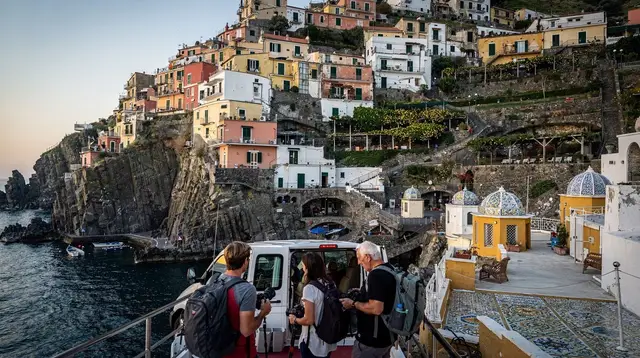
Photos of the coast rarely show the thing that shapes daily life there most: stairs. Because the villages are built into a cliff face rather than along a flat shoreline, moving between a hotel, the harbor, and the town center often means climbing or descending long flights of steps rather than walking a level street. Ravello’s position on a ridge above Amalfi and Minori is the clearest example, but the pattern repeats in Positano, Praiano, and the smaller hamlets along the SS163, where a “sea view” room can sit well above the water with no lift to reach it. Wheeled suitcases struggle badly on this terrain, and sandals or dress shoes that are fine for a flat Italian city can turn a short walk into a slow, uncomfortable one here.
The practical fix is simple and often skipped in the excitement of packing for a coastal trip: bring shoes with real grip and a sole built for uneven stone, and pack lighter than you would for a city break, since you may be the one carrying the bag up the last flight of steps rather than a bellhop. A sun hat and a reusable water bottle matter more here than on a flat itinerary too, since shade is uneven on the cliffside paths and between climbs there is rarely a chance to stop for water on demand. None of this requires special or expensive gear, but assuming the coast behaves like a flat resort town is one more mismatch between the postcard and the walk you will actually do.
A first-time itinerary logic that actually works
Rather than fighting the geography, most successful first trips follow it. Base in Sorrento, Positano, Amalfi, or Praiano depending on budget and how much nightlife or quiet you want, then treat Capri, Naples, Pompeii, and Ravello as separate excursion days rather than stops on a single loop. A combined audio-guided day covering the coast by train and ferry is a useful low-effort way to get oriented on your first full day, before deciding where you want to spend more time.
For the archaeological sites, remember that Pompeii and Herculaneum are two distinct towns destroyed by different mechanisms: ash and pumice fall at Pompeii, a fast-moving pyroclastic flow that preserved organic material at Herculaneum. Both are worth visiting, but neither substitutes for the other, and both are separate again from Vesuvius itself, an active volcano with numbered-ticket access limited to the crater rim path. A guided tour of the Pompeii ruins from the Amalfi Coast is a practical way to fit this into a coast-based trip without managing the logistics yourself. See our dedicated guides on Pompeii’s ruins, Herculaneum versus Pompeii, and the Vesuvius crater hike for the details.
If you have extra time, the day trips to Paestum and Salerno reward the effort with Greek temples that predate the Roman ruins most visitors focus on, and a guided tour of Paestum from Salerno covers the site without needing your own transport. For a broader sense of how much ground is realistic, see how many days on the Amalfi Coast and is the Amalfi Coast worth it for an honest read on what to expect from a first visit.
Getting the basics right before you land
A handful of practical points round out the list of first-trip mistakes worth avoiding. The Amalfi Coast is not an island and carries Italy’s standard 22% VAT, not a reduced island rate. Electricity is 220V on the Italian type F/L plug, driving is on the right, and the time zone is the same CET/CEST used across the rest of Italy, not a separate coastal zone. None of these trip people up as often as the beaches or the road, but they are easy to get wrong when a destination feels this distinct from the rest of the country.
Limoncello, the coast’s signature product, is another point of confusion worth correcting: traditional limoncello is made from the Sfusato Amalfitano lemon, a protected variety grown along this coast, and it is a liqueur at roughly 25-32% alcohol, not a wine. And while Amalfi is known for its historic papermaking tradition, the coast’s ceramic tradition, the bright majolica tilework seen everywhere in photos, actually comes from Vietri sul Mare, not from Positano or Amalfi itself.
Getting these expectations right before you arrive changes very little about the itinerary itself, but it changes the experience of it considerably. Visitors who arrive expecting pebble coves, a bus-and-boat transport network, and a genuinely active volcano tend to enjoy the Amalfi Coast on its own terms, rather than measuring it against a version of the coast that was never accurate to begin with.
Best Amalfi Coast Tours on GetYourGuide
Verified deep-linked GetYourGuide tours. Book through these links and we earn a small commission at no cost to you.
GetYourGuide does not provide a product photo for this activity — the image shows the meeting point, photographed by us.