Pompeii Ruins: The Complete Guide to Visiting the Ancient City
Can you see Pompeii in one hour between two Circumvesuviana trains?
No. Pompeii's excavated area covers streets, houses, and public buildings on a scale closer to a small city than a single monument. Most visitors need at least half a day to see the highlights properly, and many of the finest frescoes and artifacts found here are no longer on site — they were moved to the Naples Archaeological Museum.
Why “Pompeii in an hour” is the wrong plan
Ask around and you’ll hear some version of the same idea: hop off the Circumvesuviana, walk through Pompeii, catch the next train to Sorrento, all inside sixty minutes. It sounds efficient. It also badly underestimates what Pompeii actually is.
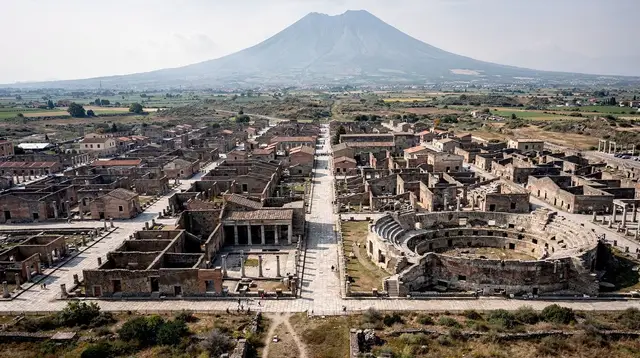
Pompeii is not a single ruin or a compact monument you circle once. It is the excavated remains of a working Roman city — roughly 44 hectares uncovered so far, with paved streets, multi-room houses, shops, temples, a forum, theaters, and a full amphitheater still standing in outline. Walking from one end of the site to the other takes a meaningful chunk of time on its own, before you’ve stopped to look at anything. Treating it like a photo-op you can knock out between two train departures means seeing a fraction of the site and none of the context that makes it worth visiting in the first place.
If you’re weighing how this fits into a wider trip, our guide to day trips to Pompeii from the Amalfi Coast lays out realistic timing, and the Naples, Pompeii, and Vesuvius in two days itinerary shows how to pair it with the volcano itself.
How Pompeii actually got buried
The eruption of Mount Vesuvius in 79 CE didn’t destroy Pompeii in a single instant. The city was buried gradually, over roughly two days, under successive layers of volcanic ash and pumice raining down from the eruption column above the volcano. As the layers accumulated, roofs collapsed under the weight, streets filled in, and the city was sealed under several meters of light, porous debris.
That slow, accumulating burial is exactly why Pompeii looks the way it does today: streets and building outlines are largely intact, because the ash settled around structures rather than violently flattening them. It’s also why the famous body casts exist — as ash compacted around the remains of people who didn’t escape in time, it left cavities that archaeologists later filled with plaster, capturing their final postures.
Pompeii vs. Herculaneum: two different disasters
It’s tempting to lump Pompeii and Herculaneum together as “the two cities Vesuvius destroyed,” but the mechanism behind each site’s burial was different, and that difference explains why they look so unlike each other today.
Pompeii, as described above, was buried under a slow accumulation of ash and pumice. Herculaneum, a smaller coastal town closer to the volcano, was hit instead by a pyroclastic flow — a fast-moving, superheated surge of gas and volcanic material that swept through the town in minutes rather than days. That speed and heat had a strange preserving effect: instead of just collapsing empty spaces, the flow carbonized organic material in place. Wooden roof beams, furniture, doors, and even carbonized food have survived at Herculaneum in a way they simply didn’t at Pompeii, where slower burial and later decay destroyed most organic matter.
The result is two sites with genuinely different character. Pompeii is vast and gives you a sense of an entire city’s layout. Herculaneum is much smaller and more intensely preserved in detail. If you want the fuller comparison, see Herculaneum vs. Pompeii — and if time allows, doing both rather than treating them as interchangeable is worth the extra hour.
Where Pompeii sits, and why it’s not “on the way” from the Amalfi Coast
Pompeii sits inland, near the base of Mount Vesuvius, on the Circumvesuviana railway line that connects Naples to Sorrento. That line also serves Herculaneum, which makes it easy to combine both sites in a single day by train from Naples.
What the Circumvesuviana does not do is touch the Amalfi Coast itself. Amalfi, Positano, Ravello, and the other coastal villages have no railway station at all — the coast is served by the SS163 road, SITA buses, and seasonal ferries, not trains. If you’re planning from a base in Amalfi, Positano, or Ravello, getting to Pompeii means first reaching Sorrento or Salerno and picking up transport from there, not stepping onto a train that happens to pass through your village. Our guides on the Circumvesuviana train and transport between Naples and Sorrento cover the practical routing in detail, and Amalfi Coast without a car is useful if you’re not renting a vehicle for the trip.
From Sorrento, Pompeii is a short and direct ride. From Positano, Amalfi, or Ravello, factor in the initial bus or ferry leg to Sorrento or Salerno before the train or transfer even starts — a detail that trips up visitors who assume the coast and the ruins are practically neighbors.
What’s actually still standing at the site
Despite two centuries of excavation and plenty of removals to museums, an enormous amount remains on site at Pompeii. Highlights that most visitors build a route around include:
| Area | What you’ll see |
|---|---|
| The Forum | The city’s civic and religious center, framed by the Temple of Jupiter and public buildings |
| Terme Stabiane | One of Pompeii’s best-preserved bath complexes, with intact vaulted ceilings |
| House of the Faun | One of the largest private homes in Pompeii, known for its mosaic floors |
| The Amphitheater | Among the oldest surviving Roman amphitheaters, still structurally whole |
| Villa of the Mysteries | Outside the main walls, home to a rare, largely intact fresco cycle |
| Garden of the Fugitives | Plaster body casts displayed in the position ash preserved them |
That list alone is enough to fill several hours if you actually stop and look rather than walk past. The site is large enough that many visitors miss the Villa of the Mysteries entirely simply because it sits at the far edge of the excavated area, past where a rushed visit naturally turns back.
What’s missing: the frescoes and objects now in Naples
Here’s the part that surprises first-time visitors most: a significant share of Pompeii’s most celebrated frescoes, mosaics, and small finds are not at Pompeii anymore. Since the early excavations began in the 18th century, many of the best-preserved and most valuable pieces — fine wall paintings, sculptures, jewelry, and everyday objects — were removed and are now held at the Naples Archaeological Museum.
This isn’t a minor footnote. The original mosaic of the Battle of Issus from the House of the Faun, for instance, is a museum piece today, with a replica left in situ. If your image of Pompeii comes from photographs of vivid, richly colored frescoes and you expect to find them all on the walls where they were painted, you’ll come away thinking the site is more stripped-down than it is — when really, the missing pieces went a specific place, and that place is worth visiting too if your itinerary allows for it.
Realistic timing: how long you actually need
a VIP guided tour from Naples typically runs a half day and covers the forum, main houses, and amphitheater with a guide filling in the history as you walk — a reasonable benchmark for how long a proper visit takes even with expert pacing.
If you’re visiting independently, budget at minimum three to four hours for the core route, and closer to a full day if you want to include the Villa of the Mysteries and slower stretches through residential streets. Trying to compress this into an hour means picking two or three stops and skipping the rest of the city, which defeats the point of coming at all.
For a coordinated day that also includes the volcano itself, a private guided tour pairing Pompeii with a Vesuvius hike is a practical way to see both without duplicating transport legs. And if you’re staying on the coast rather than in Naples, a guided day trip to the ruins departing from Positano handles the transfer logistics described above rather than leaving you to piece together buses and trains on your own.
Combining Pompeii with Mount Vesuvius
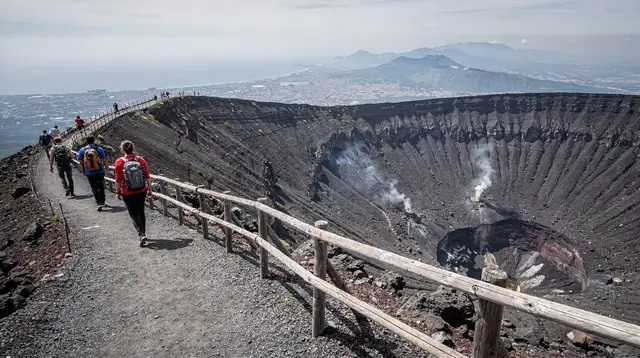
Vesuvius itself is visible from nearly every part of the Pompeii site, and the two are often paired in a single day. It’s worth remembering that Vesuvius is an active volcano under permanent monitoring, last erupting in 1944 — access to the crater rim is by numbered ticket only, along a defined trail, with no access into the crater itself. Our Mount Vesuvius crater hike guide covers what that visit involves, and the pompeii-vesuvius category page rounds up other ways to combine the two.
If you’d rather approach the volcano on two wheels after your ruins visit, a vintage Vespa tour departing from Pompeii that loops beneath Vesuvius is a lighter, scenic alternative to a straight hike.
Practical tips before you go
A few points worth knowing ahead of time, covered in more depth in our Pompeii archaeological tips guide:
- Wear real walking shoes. The site’s ancient paving stones are uneven, and there’s very little shade across most of the excavated area.
- Bring water, especially outside the cooler months — shops inside the site are limited.
- Some houses rotate in and out of public access for conservation work, so a must-see house on your list may occasionally be closed.
- The ticket entrance and exit points are spread across a large perimeter; plan your route before you start rather than backtracking across the site.
Planning the rest of your day
Many visitors pair Pompeii with Herculaneum in the same day, since both sit on the same Circumvesuviana line. Others extend the day further south to Paestum’s Greek temples or treat Pompeii as one stop within a broader loop through Naples and the Sorrentine Peninsula. Whichever you choose, building in enough time for Pompeii itself — rather than treating it as a quick add-on — is what makes the difference between a rushed walk-through and an understanding of what this city actually was.
Frequently asked questions about visiting the Pompeii ruins
How long does it really take to visit Pompeii?
Plan for a minimum of three to four hours to see the main houses, the forum, and the amphitheater without rushing. A full day allows time for the Villa of the Mysteries and quieter side streets, and most guides recommend against treating it as a brief stopover.
Is Pompeii on the Amalfi Coast?
No. Pompeii sits inland near the base of Mount Vesuvius, on the Circumvesuviana train line between Naples and Sorrento. No village on the Amalfi Coast itself — Amalfi, Positano, or Ravello — is on this rail line.
How do you get to Pompeii from the Amalfi Coast?
There is no direct train from Amalfi Coast towns, since none of them has a railway station. Most visitors reach Pompeii via Sorrento’s Circumvesuviana connection, by organized tour, or with a private driver.
What is the difference between Pompeii and Herculaneum?
Pompeii was buried gradually under layers of volcanic ash and pumice over about two days, collapsing roofs and filling spaces with fine debris. Herculaneum was struck by a fast-moving pyroclastic flow that carbonized organic material such as wood, furniture, and food instead of simply burying empty rooms.
Are the famous Pompeii frescoes and mosaics still at the site?
Many of the best-preserved frescoes, mosaics, and small artifacts were removed from Pompeii over the past two centuries and are displayed at the Naples Archaeological Museum. What remains on site is still substantial, but visitors expecting every notable piece in place will be surprised.
Can you visit Pompeii without a guide?
Yes, independent visits are possible with a map and audio guide, but the site has no posted narrative connecting what you’re seeing to how the city functioned. A guided tour typically covers the same ground with far more context in the same amount of time.
Is Pompeii suitable for a half-day trip from Naples?
A half day is workable if you focus on a defined route through the forum, the amphitheater, and a handful of well-preserved houses, but it means skipping large parts of the excavated city, including the Villa of the Mysteries outside the main walls.
Pompeii & Vesuvius Tours on GetYourGuide
Verified deep-linked GetYourGuide tours. Book through these links and we earn a small commission at no cost to you.
GetYourGuide does not provide a product photo for this activity — the image shows the meeting point, photographed by us.