Naples to Sorrento Transport: Train, Road, and Transfer Options
What is the best way to get from Naples to Sorrento?
The Circumvesuviana train is the standard rail link between Naples and Sorrento, stopping along the way near Pompeii and Herculaneum. Travelers who want more flexibility, luggage space, or a door-to-door option typically choose the road route or a private transfer instead.
Getting from Naples to Sorrento: the options at a glance
Naples is the main air and rail gateway for anyone visiting this part of southern Italy, and Sorrento is the one town in the wider area that is directly connected to Naples by rail. That single fact shapes almost every transport decision travelers make on this route. Unlike Amalfi, Positano, or Ravello — none of which have a train station — Sorrento sits at the end of a suburban railway line that starts in central Naples, which makes it the natural first stop for travelers heading south before continuing on to the Amalfi Coast by other means.
This guide compares the three realistic ways to cover the distance between Naples and Sorrento: the Circumvesuviana train, the road route, and a private or shared transfer. It also explains why Sorrento itself is not part of the Amalfi Coast, and how that distinction affects the onward leg of a trip toward villages such as Amalfi or Positano.
The Circumvesuviana: the standard rail link
The Circumvesuviana is a suburban railway that connects Naples with Sorrento, running along the base of Mount Vesuvius and through the towns that sit between the two cities. It is the reference rail connection for this route, and for many travelers without a rental car, it is also the default way to reach Sorrento from Naples.
What makes the Circumvesuviana particularly useful is that its route passes directly by two of the region’s most visited archaeological sites. The line has a stop that serves Pompeii and another that serves Herculaneum, which means travelers heading to Sorrento can break their journey to visit either site without needing a separate transport arrangement. This is one of the most practical reasons travelers choose the train over the road: it turns a transit day into an opportunity for a day trip to Pompeii or a stop at Herculaneum on the way through.
It’s worth being precise about what the Circumvesuviana does and doesn’t do. It links Naples to Sorrento and to towns on the Sorrentine Peninsula side of the line — it does not extend to the Amalfi Coast itself. Amalfi, Positano, Ravello, and the other coastal villages further east have no railway station at all, a fact covered in more detail in our Circumvesuviana guide. Travelers sometimes assume a train ride will carry them all the way to Amalfi or Positano; it will not. The train’s usefulness ends at Sorrento, and the coastal villages are reached afterward by other means.
For travelers who want a qualitative sense of what to expect: the Circumvesuviana is a commuter-style line, not a high-speed or long-distance service. It is a workable, widely used option for the Naples–Sorrento leg, and its main advantages are that it avoids road traffic entirely and offers a fixed, weather-independent schedule. Its main drawbacks are the ones typical of a suburban railway — carriages can be crowded at peak times, and it is not designed with large luggage in mind.
The road route: SS163 and other roads toward Sorrento
The alternative to the train is the road. Travelers driving themselves, or being driven, from Naples to Sorrento can take one of several road routes, including sections of the coastal SS163 further along the peninsula and inland roads connecting Naples to the Sorrentine Peninsula. The road option offers a flexibility the train cannot: a door-to-door journey, no need to carry luggage between platforms, and the ability to set your own departure time rather than working around a train schedule.
That flexibility comes with a trade-off. The road route toward Sorrento and the wider peninsula is exposed to dense traffic in high season, which runs roughly from Easter through October and peaks in July and August. Anyone who has read about the SS163 road knows that this coastal route can slow to a crawl during the busiest weeks of summer, and the approach to Sorrento from Naples is not immune to the same seasonal congestion, even though it does not carry the more severe restrictions found further along the coast.
It’s an important distinction: the ZTL (limited traffic zone) restrictions that affect villages like Amalfi and Positano in high season are a separate issue from the Naples–Sorrento road itself. Sorrento and the road leading to it are not subject to the same ZTL regime that governs the more constrained coastal villages further east. The concern on the way to Sorrento is traffic volume rather than access restriction — a distinction worth keeping in mind when comparing this leg of the journey to the road further along the coast, described in our guide to driving without a car on the Amalfi Coast.
Private and shared transfers
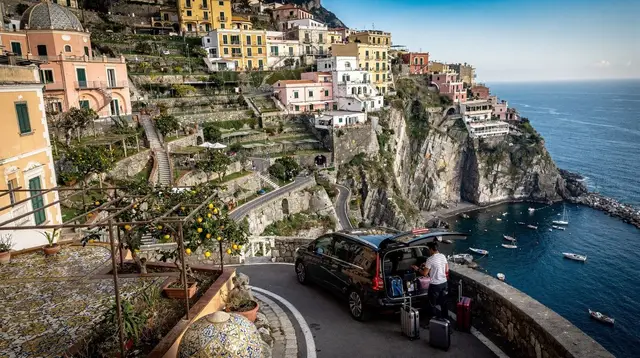
Between the fixed schedule of the train and the flexibility (and traffic exposure) of self-driving sits a third option: a private or shared transfer. This is a car or minivan service, typically booked in advance, that takes travelers directly from Naples — often from Naples Airport — to Sorrento, without the need to navigate the Circumvesuviana with luggage or to rent and drive a car in an unfamiliar road system.
A private transfer such as the private transfer from Naples Airport to Sorrento is generally chosen by travelers who want a direct, door-to-door option immediately after landing, without transferring between transport modes. For those traveling in the other direction, the same kind of service can also be booked as a transfer between Naples Airport and Sorrento in either direction, which is useful for planning a round trip without worrying about matching train timetables to a flight.
Travelers looking to split the cost with other passengers can consider a shared transfer service from Naples to Sorrento instead of a private car. A shared transfer costs less than a private one but follows a shared schedule and may include additional pickups or drop-offs along the way, so it suits travelers with some flexibility in their timing rather than those who need to match a specific flight or train connection.
Combining the journey with a stop along the way
Because the Naples–Sorrento corridor passes so close to major archaeological sites, many travelers choose to treat the transfer itself as part of the day’s itinerary rather than a simple point-to-point trip. A tour such as the day trip from Naples covering Positano, Sorrento, and Pompeii folds the Naples–Sorrento leg into a guided day that also touches the Amalfi Coast side of the region, which suits travelers who have limited time and want to see several highlights without arranging separate transport for each stop.
Cruise passengers arriving in the Naples area face a related but distinct need: getting from the port to Sorrento and back within a single day, without the flexibility of an overnight stay. A shore excursion such as the shore excursion to Sorrento and Pompeii from Naples is built around that constraint, combining the transport leg with a stop at Pompeii in a timeframe designed to return travelers to the port before their ship departs.
Comparing the options
| Option | Flexibility | Traffic exposure | Best suited to |
|---|---|---|---|
| Circumvesuviana train | Fixed schedule | None (rail, not road) | Travelers without heavy luggage who want to combine the trip with a stop at Pompeii or Herculaneum |
| Self-drive road route | High | Exposed to high-season congestion | Travelers with a rental car and flexible timing |
| Private transfer | High, door-to-door | Exposed to high-season congestion, but no need to navigate it yourself | Travelers arriving by flight, or with heavy luggage |
| Shared transfer | Moderate (shared schedule) | Exposed to high-season congestion, handled by the driver | Budget-conscious travelers with flexible timing |
| Guided day trip / shore excursion | Low (fixed itinerary) | Handled by the tour operator | Travelers who want sightseeing built into the transport day |
Why Sorrento is the logical first stop, not the destination itself
It bears repeating because it is easy to get wrong when planning: Sorrento is not on the Amalfi Coast. It sits on the Sorrentine Peninsula, a separate stretch of coastline that shares some geography with the Amalfi Coast but is administratively and geographically distinct from villages like Amalfi, Positano, and Ravello. This is precisely why Sorrento functions so well as a first stop for travelers coming from Naples — it is the only town in the wider area reachable directly by rail, and once there, travelers continue on to the Amalfi Coast proper by SITA bus or by ferry, both of which run from Sorrento onward to the coastal villages.
This two-step structure — train (or transfer) to Sorrento, then bus or ferry onward — is the pattern followed by most travelers who arrive in the region without a car. It also explains why so many guides to reaching the Amalfi Coast without a car treat Sorrento as a waypoint rather than a final destination. Travelers planning a longer stay sometimes choose to spend a night or two in Sorrento itself before continuing, using it as a base to explore the Sorrento old town or as a jumping-off point for a ferry to Capri, before making the shorter onward hop to the Amalfi Coast villages.
Planning your route
For most travelers arriving by air, the sequence looks like this: land at Naples Airport, reach Sorrento either by private or shared transfer or by taking the Circumvesuviana from central Naples, then continue eastward toward the Amalfi Coast by bus or ferry. Travelers who prefer to see Pompeii or Herculaneum along the way can use the Circumvesuviana’s intermediate stops to do so without adding a separate excursion day.
Those without a strict schedule, or who are traveling with a rental car, can consider the road route instead, keeping in mind that traffic is heaviest during the Easter-to-October season and peaks in July and August. Whichever option is chosen, it’s worth remembering that the road and rail constraints that apply further along the coast — narrow lanes, ZTL zones, seasonal ferry suspensions — are specific to the Amalfi Coast villages themselves, not to the Naples–Sorrento leg, which is a more conventional transport corridor by comparison.
Frequently asked questions about Naples to Sorrento transport
Is there a direct train from Naples to Sorrento?
Yes. The Circumvesuviana suburban railway runs directly between Naples and Sorrento, with intermediate stops that serve Pompeii and Herculaneum. It does not require a change of train.
Does the Circumvesuviana go to the Amalfi Coast?
No. The Circumvesuviana connects Naples to Sorrento and the Sorrentine Peninsula only. It does not serve Amalfi, Positano, Ravello, or any other Amalfi Coast village, none of which have a railway station.
Can I stop at Pompeii on the way from Naples to Sorrento?
Yes. Pompeii and Herculaneum both have stops along the Circumvesuviana line between Naples and Sorrento, which makes it straightforward to break the journey for a visit to either archaeological site.
Is it better to drive from Naples to Sorrento?
Driving offers more flexibility and can suit travelers with heavy luggage or an early or late arrival, but the road is exposed to dense traffic in high season, especially between Easter and October. Many travelers prefer the train or a private transfer for this reason.
Is Sorrento on the Amalfi Coast?
No. Sorrento sits on the Sorrentine Peninsula, a separate geographic area from the Amalfi Coast itself. It is a common and logical stop before continuing to the Amalfi Coast by SITA bus or ferry.
What is the best way to travel from Naples Airport to Sorrento?
Travelers arriving at Naples Airport can reach Sorrento by private transfer, shared transfer, or by first reaching Naples city and connecting to the Circumvesuviana train. A private or shared transfer avoids the need to change transport modes with luggage.
Are there traffic restrictions on the road from Naples to Sorrento?
The stretch to Sorrento itself does not carry the ZTL restrictions found further east on the Amalfi Coast, in villages such as Amalfi and Positano. High-season traffic congestion is the main road-related concern on the way to Sorrento, rather than access restrictions.
Transfers on the Amalfi Coast on GetYourGuide
Verified deep-linked GetYourGuide tours. Book through these links and we earn a small commission at no cost to you.
GetYourGuide does not provide a product photo for this activity — the image shows the meeting point, photographed by us.