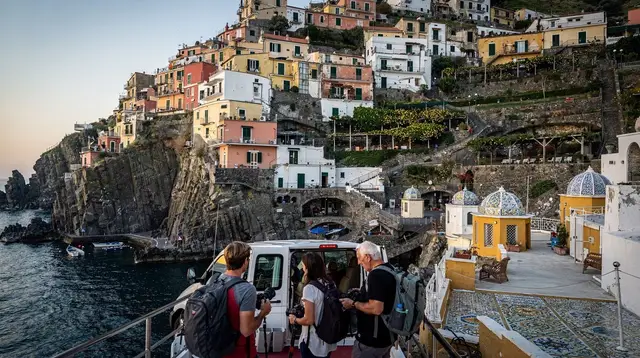
The one fact that explains why Sorrento is the base everyone recommends
Ask why so many visitors choose to sleep in Sorrento instead of Positano, Amalfi, or Ravello, and the answer comes down to a single piece of infrastructure: the train. Sorrento is the only town in this entire coverage area — the Amalfi Coast, the Sorrentine Peninsula, and Capri combined — connected to Naples by rail, via the Circumvesuviana line. No village on the Amalfi Coast itself has a station. Positano, Amalfi, and Ravello are reached only by the narrow, cliff-hugging SS163 road, by SITA bus, or by seasonal ferry. For a visitor who lands at Naples airport, or arrives by high-speed train into Naples Centrale, Sorrento is the only stop on this stretch of coast that a regional train can reach directly.
That single logistical fact reshapes how most people plan a trip. Rather than renting a car to navigate the SS163 — a route most visitors are actively advised to avoid — travelers ride the Circumvesuviana from Naples straight to Sorrento, unpack once, and use buses, ferries, and organized day tours to reach everywhere else: Pompeii, Herculaneum, the Amalfi Coast villages, and Capri. If you’re weighing where to sleep for the whole trip, see our comparison of Sorrento versus staying directly on the Amalfi Coast.
Sorrento is not on the Amalfi Coast — a distinction worth getting right
This is the correction most guidebooks skip. Sorrento does not sit on the Costiera Amalfitana in the strict geographic sense. It belongs to the Sorrentine Peninsula, the landmass that separates the Bay of Naples from the Gulf of Salerno, on the opposite, northern side of the peninsula from the Amalfi Coast’s cliffside villages. Amalfi, Positano, and Ravello face south toward the Gulf of Salerno; Sorrento faces north toward Naples and Vesuvius across the bay.
The confusion is understandable, since Sorrento is almost always marketed alongside the Amalfi Coast, and for a visitor the two areas blur into one continuous stretch of southern Italian coastline. But administratively and geographically, Sorrento is the peninsula’s rail gateway to the coast, not one of the coast’s own villages. To actually reach Positano or Amalfi from Sorrento, you still need a SITA bus along the SS163 or a seasonal ferry — there is no direct rail link, because no railway serves the Amalfi Coast itself at any point. That gap is exactly what makes Sorrento valuable: it is the closest point where train travel ends and coastal bus-and-boat travel begins.
Getting around from a Sorrento base
By train: Naples, Pompeii, and Herculaneum
The Circumvesuviana connects Sorrento to Naples in roughly 60-70 minutes, stopping along the way at Pompeii and Herculaneum. This is the backbone of Sorrento’s appeal as a base: a single train line puts three major sights within easy reach without a rental car. For the full route and timing details, see our Circumvesuviana train guide, and if you’re arriving from the airport, our guide to getting from Naples airport to the Amalfi Coast covers the connection into Sorrento specifically.
By bus: the Amalfi Coast villages
SITA buses run from Sorrento along the SS163 to Positano, Amalfi, and on to Salerno, with journey times of roughly 45 minutes to Positano and up to 90 minutes to Amalfi town, depending on traffic and season. Buses can run at reduced frequency or face delays during the busiest summer weeks, when the SS163 operates under ZTL restrictions and alternating traffic flow in the villages. See the SITA bus guide for schedules and ticketing.
By ferry: the Amalfi Coast, Capri, and Naples
From Marina Piccola, Sorrento’s harbor, seasonal ferries and hydrofoils connect to Positano, Amalfi, Capri, and Naples. This is often the more scenic and less crowded way to reach the coast in high season, though services are considerably reduced or suspended outright in winter — never assume a ferry crossing is guaranteed year-round. Full schedules and route details are in our ferries guide for Sorrento, Amalfi Coast, and Capri.
Reaching Capri from Sorrento
Capri is one of the most popular half-day or full-day trips from Sorrento, and the crossing from Marina Piccola typically takes only 20 to 25 minutes by hydrofoil. Once on the island, a funicular links Marina Grande to Capri town, while Anacapri is reached separately, by bus or by the Monte Solaro chairlift. For a full day plan, see our day trip to Capri from Sorrento and the Capri highlights in one day itinerary.
A number of boat tours depart directly from Sorrento and combine the crossing with time on the water around the island. A half-day guided tour to Capri from Sorrento covers the ferry crossing and a guided look at the island’s highlights in a single outing, while a boat tour circling Capri’s coastline from Sorrento spends more time on the water, passing the Faraglioni rock formations from the sea. Travelers hoping to see the Blue Grotto specifically should note it depends on tide and sea conditions and can close without notice; a day tour from Sorrento pairing Capri with an attempt at the Blue Grotto builds in time for both, though entry is never guaranteed in advance.
Day trips to Pompeii, Herculaneum, and Vesuvius
Because the Circumvesuviana stops at both archaeological sites, Sorrento works as a base for visiting Pompeii and Herculaneum on separate days, or for pairing one of them with a hike up Mount Vesuvius. Pompeii and Herculaneum are two distinct sites and two distinct ancient towns, destroyed by different mechanisms during the 79 AD eruption — ash and pumice fall buried Pompeii, while a pyroclastic flow at Herculaneum preserved organic material like wood and carbonized food. Our guides to Pompeii’s ruins and Herculaneum compared with Pompeii lay out what each site actually offers.
Vesuvius itself remains an active volcano under continuous monitoring, last erupting in 1944. Access is limited to a numbered-ticket trail around the crater rim — there is no free access and no path down into the crater. A guided day trip from Sorrento combining Pompeii’s ruins with a hike to the Vesuvius crater rim handles both stops in one organized outing, which is often simpler than coordinating the train and the numbered volcano access separately. For travelers who’d rather add a food element, a Pompeii tour from Sorrento that includes a local wine tasting is also available. Planning a longer loop through the archaeological sites and the volcano together is covered in our Naples, Pompeii, and Vesuvius two-day itinerary and Pompeii day trip from the Amalfi Coast guide.
Sorrento’s historic center: what to actually see
Sorrento’s old town sits on a plateau above the sea, with a flatter, more walkable layout than the stepped, vertical villages of the Amalfi Coast proper. The center is known for lemon-scented gardens, narrow lanes lined with limoncello producers, and a long local tradition of marquetry (intarsio) woodworking, sold in workshops throughout the old town. Piazza Tasso anchors the center, and cliffside terraces along Via Marina Grande give views across the bay toward Vesuvius.
Food culture runs deep here too. A hands-on pizza-making class in Sorrento is a popular way to spend an evening in town, and it pairs naturally with a stroll through the old town’s lemon groves and limoncello shops afterward. For a fuller look at the center, see our Sorrento old town walking tour, and for the food scene specifically, our cooking class guide and lemon groves guide.
Sorrento versus a village directly on the Amalfi Coast
| Sorrento | Positano / Amalfi / Ravello | |
|---|---|---|
| Train access from Naples | Yes, direct (Circumvesuviana) | No, none |
| Walkability | Mostly flat historic center | Steep stairs and terraces |
| Reach Amalfi Coast villages | Bus or ferry, 45-90 min | Already there |
| Reach Capri | Ferry, 20-25 min | Ferry or bus + ferry via Sorrento |
| Reach Pompeii/Herculaneum | Direct train | Bus/ferry to Sorrento, then train |
| Best for | First-timers, no car, mixed itineraries | Coastal scenery, resort atmosphere |
If you’re still deciding between the two approaches, the fuller breakdown is in Sorrento vs. Amalfi Coast: where to stay, and for a car-free trip generally, Amalfi Coast without a car walks through the logistics in more depth.
Sailing and boat trips beyond Capri
Sorrento’s harbor is also a departure point for broader sailing trips around the Gulf of Naples and the smaller islands nearby, not just Capri itself. A sailboat trip from Sorrento toward Capri offers a quieter, wind-powered alternative to a motorized hydrofoil crossing, while travelers wanting a more private experience can arrange a private yacht tour from Sorrento to Capri with a smaller group. For those more interested in marine life than sightseeing stops, a sailing trip from Sorrento focused on marine life around the gulf islands covers different ground than a standard Capri run.
Practical notes for planning around Sorrento
- Seasonality matters more than people expect. High season, from Easter through late October and peaking in July and August, brings full ferry schedules and heavy SS163 traffic. In winter (November to March), ferry routes are sharply reduced or suspended, and several coastal businesses close for the season. Check our best time to visit the Amalfi Coast guide before locking in dates.
- No island tax quirks. The Sorrentine Peninsula and the Amalfi Coast are not islands, so standard Italian VAT of 22% applies, along with standard 220V power and right-hand driving, the same as the rest of Italy.
- Currency and payments. Italy uses the euro, and most hotels, restaurants, and tour operators in Sorrento accept cards, though small shops and market stalls often prefer cash.
- Budgeting a day in Sorrento. A comfortable day covering meals, a museum or two, and local transport typically runs in the range noted in the quick facts above; the Amalfi Coast budget guide breaks this down by category across the wider region.
- Combine with an itinerary rather than winging it. Because Sorrento sits at the junction of rail, road, and ferry networks, it works well as the anchor point for a broader loop. See the Amalfi Coast in 5 days or Capri and Sorrento in 2 days itineraries for ready-made structures.
Frequently asked questions about basing yourself in Sorrento
Is Sorrento part of the Amalfi Coast?
No. Sorrento sits on the Sorrentine Peninsula, a separate geographic area from the Amalfi Coast (Costiera Amalfitana). It functions as the region’s rail gateway, not as one of the Amalfi Coast’s own villages.
How do you get from Sorrento to Positano or Amalfi?
By SITA bus along the SS163, or by seasonal ferry from Marina Piccola. There is no train connection, since no railway reaches the Amalfi Coast villages themselves.
Can you reach Capri from Sorrento without a car?
Yes. Ferries and hydrofoils leave from Marina Piccola on a seasonal schedule, running frequently from Easter through October but sharply reduced or suspended in winter, with the crossing typically taking 20 to 25 minutes, making Capri an easy half-day or full-day trip in season.
Why do people choose Sorrento over staying in Positano or Amalfi?
Sorrento is the only town in the entire area served by train, the Circumvesuviana from Naples. That single fact makes it far easier to arrive without a car and to combine Pompeii, Herculaneum, and the Amalfi Coast in one trip.
Is Sorrento walkable?
Yes, more so than most Amalfi Coast villages. The historic center sits on a flat clifftop plateau, so most sights, restaurants, and the train station are reachable on foot, unlike the steep stairways typical of Positano or Amalfi town.
What is Sorrento known for besides transport links?
A cliffside historic center with lemon-scented gardens, limoncello production, and a long-standing marquetry (intarsio) woodworking tradition, alongside views over the Bay of Naples toward Vesuvius.
Do you need a car to use Sorrento as a base?
No. Sorrento’s entire appeal as a base rests on not needing a car: trains reach Naples, Pompeii, and Herculaneum, buses and ferries reach the Amalfi Coast, and ferries reach Capri.