Cooking Class in Sorrento: What to Expect
Is a Sorrento cooking class the same as an Amalfi Coast cooking class?
No. A Sorrento cooking class draws on Sorrento's own culinary identity, built around its own lemon (a separate IGP from the Amalfi Coast's Sfusato Amalfitano), fresh pasta and seafood, usually in a small family-run setting. It is a neighboring tradition to Amalfi Coast cooking, not the same one, even though both regions share the Campania coastline.
Sorrento cooking, not Amalfi Coast cooking
It’s tempting to book a cooking class in Sorrento and assume it delivers “authentic Amalfi Coast cuisine.” That phrase shows up often enough in marketing copy that it’s worth stopping on: Sorrento sits on the Sorrentine Peninsula, a separate geographic area from the Amalfi Coast itself, even though both belong to the same stretch of Campania coastline and share a broad Mediterranean pantry of lemons, tomatoes, olive oil and seafood.
The distinction matters most around citrus. Sorrento has its own lemon, protected under its own IGP designation, distinct from the Sfusato Amalfitano IGP tied specifically to towns along the Amalfi Coast such as Amalfi, Minori and Maiori. A cooking class built around “the local lemon” in Sorrento is built around the Sorrento lemon — not the Sfusato Amalfitano you’d find in a class taught in Amalfi or Minori. Both are excellent, both are used heavily in regional cooking, but they are not the same fruit, and a class that blurs the two is glossing over a distinction locals take seriously.
The same logic applies further down the list of “Amalfi Coast specialties.” Cetara’s anchovy colatura is a product of that specific fishing village, not something you should expect to be the centerpiece of a Sorrento class. Vietri sul Mare’s reputation is built on ceramics, not on a signature dish that travels well into a Sorrento kitchen. None of this means a Sorrento class is a lesser experience — it means it’s a different one, rooted in its own peninsula rather than borrowing the coast’s marketing shine.
What a Sorrento cooking class actually looks like
There’s no single standardized program across every listing in Sorrento. Classes are run by a mix of small cooking schools, agriturismi, and — often the most memorable option — individual families teaching out of a home kitchen, terrace, or villa garden. Because of that variety, it’s more useful to describe the ingredients and techniques that recur across most classes than to promise a fixed menu.
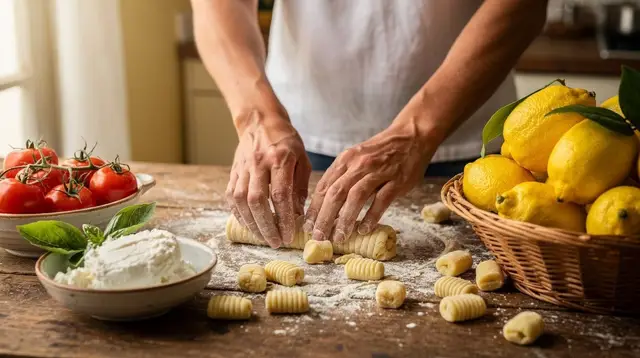
Fresh pasta is close to a constant. Most classes include hands-on pasta-making — kneading dough, rolling it by hand or with a machine, and shaping it into a simple form like tagliatelle, gnocchi or ravioli. This is usually the most hands-on segment of the class and the one visitors photograph most.
Lemon-based dishes show up in a large share of classes, given the Sorrento lemon’s local prominence. This might mean a lemon risotto, a lemon-dressed seafood dish, or a lemon dessert such as delizia al limone. Some classes end with a limoncello tasting, since limoncello made from local lemons is a common closing note, though it isn’t universal — check the specific listing rather than assuming it’s included.
Seafood appears in classes that lean toward the coastal side of Sorrentine cooking, often a simple pasta with clams or a light seafood second course, reflecting the town’s position on the Bay of Naples rather than any specific Amalfi Coast fishing tradition.
Dessert rounds out most sessions — tiramisu is a frequent choice on top of citrus desserts, since it travels well as a teaching dish and lets a class finish on something guests can recreate at home.
None of this is a fixed curriculum. A class booked as a “pasta and tiramisu” experience will focus tightly on those two components; a broader “cook like a local” format may range across appetizer, pasta, main and dessert in a single session. Reading the specific class description matters more here than assuming a generic template applies.
A realistic format, hour by hour
Most Sorrento cooking classes run somewhere between three and five hours, and the shape tends to follow a similar arc even when the dishes differ:
| Stage | What typically happens | Approximate time |
|---|---|---|
| Welcome | Meeting the host, brief introduction to ingredients, sometimes a glass of prosecco or limoncello | 15–20 minutes |
| Market or garden stop | Some classes begin at a local market or a private lemon grove; not all include this | 30–45 minutes, when included |
| Pasta making | Hands-on kneading, rolling and shaping fresh pasta dough | 45–60 minutes |
| Main dish preparation | Cooking sauces, seafood or a lemon-based dish alongside the pasta | 45–90 minutes |
| Dessert | Assembling tiramisu or a lemon dessert | 30–45 minutes |
| Shared meal | Sitting down to eat everything cooked during the class, often with wine | 45–60 minutes |
Group sizes vary widely, from intimate sessions of four to six guests in a family’s home kitchen to larger classes of fifteen or more in a dedicated cooking school. Smaller, family-run settings tend to feel less scripted and allow more conversation with the host, while larger schools can offer more consistent scheduling and English-language instruction.
Why Sorrento works as a base for this
Sorrento holds a logistical advantage that towns further along the Amalfi Coast don’t: it’s the only town in the area connected to Naples by train, via the Circumvesuviana line. That makes it straightforward to combine a cooking class with a walk through Sorrento’s old town or a day trip to Pompeii and Herculaneum, all without needing a rental car or booking a bus reservation days in advance.
This connectivity is also exactly why Sorrento is not a substitute for visiting the Amalfi Coast itself. There’s no train line from Sorrento to Amalfi, Positano or Ravello — those towns are reached by SITA bus, seasonal ferry, or by driving the SS163 coastal road, which is narrow, cliff-hugging and subject to summer traffic restrictions. If a cooking class experience is genuinely important to you and you specifically want an Amalfi Coast tradition rather than a Sorrentine one, that calls for booking a class in a town like Amalfi or Minori directly, not assuming Sorrento covers the same ground.
For most visitors, though, Sorrento’s easy access to Naples plus its own strong culinary identity is a reasonable trade-off. You get a hands-on, often family-run class centered on genuinely local ingredients, a walkable town center, and a straightforward return to Naples or onward connections toward Pompeii, without adding a coastal bus transfer to the day.
Choosing among the available classes
Several operators run cooking classes from Sorrento, and the differences between them are mostly about setting, group size and how much emphasis falls on lemons versus pasta versus a full multi-course meal.
For a straightforward, well-reviewed introduction, the standard Sorrento cooking class covers the core fresh-pasta-and-local-ingredients format without extra flourishes. If citrus is the draw, the lemon-focused cooking class paired with a grove visit puts the Sorrento lemon front and center rather than treating it as a side ingredient.
Travelers who want a tightly scoped, two-dish session might prefer the pasta and tiramisu class served with wine, which keeps the format simple and predictable. For a more technique-focused visit, the dedicated pasta-making class spends the full session on dough and shaping rather than splitting time across courses, while the pizza-making class is the better pick for visitors more interested in dough and oven technique than in a multi-course lemon-and-seafood menu.
None of these classes should be booked expecting an “Amalfi Coast” menu — they are Sorrentine experiences, built on Sorrento’s own lemon and its own version of coastal Campania cooking.
Practical details before you book
A few logistical points come up often enough to be worth settling before you commit to a class rather than discovering them on the day.
Dietary restrictions are usually manageable but not automatic. Because most classes are small and run by families or small schools rather than large commercial kitchens, hosts can often adapt a dish for a vegetarian guest or swap an ingredient for someone with a specific allergy — but this depends on advance notice. A class built around a seafood course, for instance, may need a substitute pasta dish worked out ahead of time rather than improvised on arrival. Flagging dietary needs at the time of booking, rather than showing up and mentioning it, gets a better result.
What to wear rarely needs much thought. These are hands-on classes involving flour, dough and occasionally hot oil or boiling water, so closed shoes and clothing you don’t mind getting a little messy make sense. Most hosts provide an apron, but few provide a change of clothes.
Timing your class within the day matters more than it might seem. A morning class that includes a market or lemon grove stop effectively becomes a half-day commitment once travel time to and from the venue is factored in, which can affect whether you can still fit in a walk through Sorrento’s old town or a trip toward Pompeii on the same day. An evening class, by contrast, pairs naturally with a day spent elsewhere and leaves the class as the day’s closing activity rather than its centerpiece.
Group versus private format is worth checking on the listing rather than assuming. A shared class with other travelers is usually the more affordable and more social option, while a private class — sometimes offered by the same host — trades a higher cost for a schedule built entirely around your group and more one-on-one time with the person teaching.
How a Sorrento class compares to other Campania food experiences
Sorrento’s cooking class is one of several hands-on food experiences available across this part of Campania, and it’s worth being clear about how it differs from the others rather than treating them as interchangeable.
A Naples pizza experience is a different tradition entirely — Neapolitan pizza-making is its own specialized craft, tied to Naples itself rather than to Sorrento or the Amalfi Coast, and a pizza-focused class (including the pizza-making option available in Sorrento) leans on technique with a single dish rather than the broader multi-course format typical of a full Sorrento cooking class.
A limoncello tasting on the Amalfi Coast is a narrower, shorter experience than a cooking class — usually a guided sampling rather than a hands-on cooking session — and it draws on the Sfusato Amalfitano lemon rather than the Sorrento lemon. It’s worth remembering, too, that limoncello itself is a liqueur, not a wine, a distinction that occasionally trips up visitors reading tasting menus. If your main interest is learning to cook rather than sampling a finished product, a Sorrento cooking class covers more ground; if you just want to taste and compare, a dedicated tasting is the lighter option.
None of these experiences replaces the others. A visitor with time for both a Sorrento cooking class and a Naples pizza class, for example, comes away with a genuinely broader picture of Campania’s food culture than someone who assumes one class stands in for the whole region.
Planning around the rest of your visit
A cooking class pairs naturally with the kind of half-day itinerary that keeps you based in Sorrento rather than adding a coastal transfer. Many visitors combine it with time in Sorrento’s lemon groves earlier in the day, or a relaxed evening walk through the old town afterward. If you’re staying longer, it’s worth reading how Sorrento compares to basing yourself directly on the Amalfi Coast before deciding where to book accommodation, since the train connection to Naples is a real practical advantage that towns like Positano and Amalfi simply don’t have.
If the Amalfi Coast towns are still on your list, treat the cooking class as a Sorrento-specific addition to the trip rather than a way to check off “Amalfi Coast food” — you’ll get a more accurate picture of the region’s culinary range by treating Sorrento, the Amalfi Coast proper, and Capri as three related but distinct culinary neighborhoods rather than one interchangeable brand.
Building a food-focused day or two around Sorrento
Travelers planning their trip around food rather than sightseeing tend to get the most out of Sorrento by stretching the cooking class across a longer stay rather than treating it as a single stand-alone booking squeezed between other activities.
A common pattern is to arrive in Sorrento with a day to spare before or after the class itself, using that time for a slower walk through the lemon groves that supply the very citrus a class will use, or simply wandering Sorrento’s old town for the small produce shops, delis and limoncello producers that don’t require a booking at all. Because Sorrento’s town center is compact and walkable, this kind of unstructured food-focused browsing costs little more than a free afternoon.
Travelers based on the Amalfi Coast itself rather than in Sorrento can still fit a cooking class into the trip, but it takes more planning given the lack of a direct rail link. Coming from Positano, Amalfi or Praiano, the realistic options are a SITA bus connection through Sorrento, a seasonal ferry where the schedule allows it, or hiring a private driver for the day — any of which turns the class into a half-day or full-day commitment once travel time is added, rather than the simple local outing it is for someone already staying in Sorrento. For that reason, visitors based further along the coast in towns like Ravello or Minori might reasonably decide the trip isn’t worth it purely for a cooking class, and instead look for a similar hands-on food experience closer to their own base — while someone already planning a stop in Sorrento, for a day trip to Capri or otherwise, will find fitting in a class much more straightforward.
Ultimately, the value of a Sorrento cooking class comes from treating it as exactly what it is: a genuine, locally rooted food experience specific to the Sorrentine Peninsula, worth doing on its own terms rather than as a proxy for Amalfi Coast cuisine you haven’t actually tasted yet.
Cooking Classes on the Amalfi Coast on GetYourGuide
Verified deep-linked GetYourGuide tours. Book through these links and we earn a small commission at no cost to you.
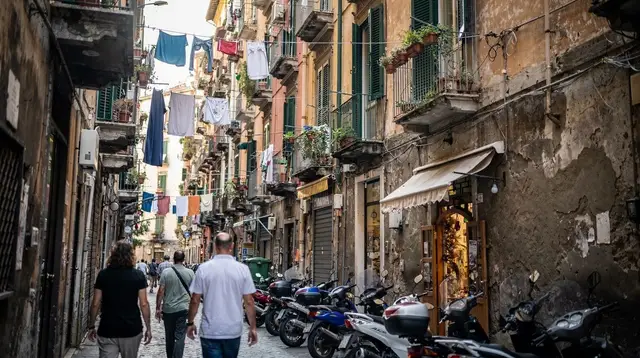
GetYourGuide does not provide a product photo for this activity — the image shows the meeting point, photographed by us.