The Circumvesuviana Train: What It Actually Connects (and Doesn't)
Does the Circumvesuviana train go to the Amalfi Coast?
No. The Circumvesuviana connects Naples to Sorrento, stopping near Pompeii and Herculaneum along the way, but it does not serve any Amalfi Coast village. Amalfi, Positano, and Ravello have no railway station at all, so travelers continue from Sorrento by SITA bus or ferry.
A common mix-up worth clearing up first
The name “Circumvesuviana” sounds like it should circle the whole Bay of Naples region, and that leads a lot of first-time visitors to assume it must reach the Amalfi Coast too. It doesn’t. The Circumvesuviana is a regional railway that connects Naples to Sorrento, passing close to Pompeii and Herculaneum along the way. It does not run to Amalfi, Positano, Ravello, or any other village on the Amalfi Coast itself. None of those towns have a railway station at all — a fact that surprises visitors used to planning trips around train timetables.
Understanding what this train actually does — and where it stops — makes it much easier to plan a realistic route from Naples toward the coast, and to use the line for what it’s genuinely good for: reaching Pompeii, Herculaneum, and Sorrento without a rental car.
What the Circumvesuviana connects
The Circumvesuviana is a separate regional network from Trenitalia, Italy’s national rail operator. Its main line relevant to Amalfi Coast travel runs between Naples and Sorrento, with stops along the base of Mount Vesuvius and through towns on the Bay of Naples. Two stops matter most for travelers heading toward the Amalfi Coast:
- A stop serving the Pompeii archaeological site
- A stop serving Herculaneum, a separate site with its own distinct history
Both can be visited by train without driving the SS163 coastal road or renting a car, which makes the line a genuinely useful option for day-tripping from Naples or Sorrento. For a closer look at how these two disaster sites differ, see the guide on Herculaneum vs. Pompeii and the complete Pompeii ruins guide.
The line terminates in Sorrento, on the Sorrentine Peninsula — and that terminus is the detail most worth remembering.
Sorrento: the only rail link to the peninsula
Of all the towns on or near the Amalfi Coast, Sorrento is the single one connected to Naples by rail. Every other Amalfi Coast village — Amalfi, Positano, Ravello, Praiano, Minori, Maiori — has no train station whatsoever. This isn’t a gap in the network; the coastal road that links these villages, the SS163, was never paired with a rail line, and the terrain of the cliffside coast makes one impractical.
That makes Sorrento a natural pivot point. Travelers arriving from Naples by Circumvesuviana reach Sorrento by rail, then switch to a different mode of transport to continue toward the Amalfi Coast proper:
- A SITA bus along the coastal road (see the SITA bus guide)
- A seasonal ferry connecting Sorrento to Amalfi Coast towns and Capri (see the ferry guide)
- A private transfer or driver
For a full comparison of how these pieces fit together on a Naples-to-Amalfi-Coast trip, see Naples to Sorrento transport and getting around the Amalfi Coast without a car.
Connecting onward to Capri from Sorrento
Sorrento’s role as a transport hub doesn’t stop at the Amalfi Coast. It’s also one of the main departure points for Capri, and travelers who ride the Circumvesuviana all the way to its terminus often use Sorrento as a jumping-off point for the island rather than continuing straight to the coast. The Sorrento to Capri ferry guide covers that crossing in detail, including how it fits alongside the SITA bus and coastal ferry options already mentioned above. For travelers building a wider loop that takes in both the island and the peninsula, the Capri and Sorrento in two days itinerary shows how the Circumvesuviana leg to Sorrento slots into that plan before the ferry crossing.
This matters for trip planning because it means Sorrento isn’t just a pivot toward Amalfi and Positano — it’s a three-way junction between the train back to Naples, the bus or ferry toward the Amalfi Coast villages, and the ferry out to Capri. Deciding which of those three legs comes first (or last) shapes the whole itinerary more than the train ride itself does.
Tickets, luggage, and etiquette on board
The Circumvesuviana is a working commuter line as much as a tourist route, and it’s worth setting expectations accordingly. Trains can get crowded, especially on the Naples–Pompeii segment during peak season and at commuting hours, and carriages are not designed with large suitcases in mind. Travelers moving between Naples and Sorrento with full luggage — rather than just a day bag for Pompeii or Herculaneum — often find a private transfer more comfortable for that specific leg, even if they use the train for shorter, lighter hops. The Amalfi Coast packing list has more on traveling light enough to make regional trains and buses practical for the rest of the trip.
As with any busy urban and regional line, it’s sensible to keep bags close and valuables secured, particularly around Naples’s stations and on crowded carriages — standard advice for any dense city transit system, not something specific to this line. Tickets need to be validated before boarding (a step separate from simply buying one), and it’s worth confirming the current validation process at the station, since ticketing systems on regional Italian lines are updated from time to time.
When a private transfer makes more sense than the train
The Circumvesuviana is a genuinely useful, low-cost way to link Naples, Pompeii, Herculaneum, and Sorrento — but it isn’t the only option, and it isn’t always the most practical one. Groups traveling with heavy luggage, families with young children, or anyone arriving on a tight connection between a flight and a tour departure may prefer to skip the regional line entirely for one or more legs of the trip. A private driver for the Amalfi Coast can cover the same Naples-to-Sorrento corridor door to door, without transfers or standing room, at the cost of a fixed fare rather than a train ticket. Weighing the trade-off between the two comes down to luggage, group size, and how tightly the rest of the day is scheduled — the train wins on cost and frequency, a private transfer wins on comfort and predictability.
What the Circumvesuviana is not
It’s worth being explicit about what this train does not do, since the name invites confusion:
- It does not run along the Amalfi Coast itself.
- It does not stop in Amalfi, Positano, Ravello, Praiano, Minori, Maiori, or any other coastal village between Sorrento and Salerno.
- It is not the same railway that serves Salerno — Salerno is reached via Trenitalia’s national network, on a different route from the opposite side of the peninsula.
- It is not a scenic coastal railway. Its route runs through the towns at the base of Mount Vesuvius and across the base of the Sorrentine Peninsula, not along any cliffside.
Using the line for Pompeii and Herculaneum day trips
Because the Circumvesuviana connects Naples directly to stops near both archaeological sites, it’s a practical way to visit either — or both — without a car. A guided approach removes the guesswork of matching train stops to site entrances:
a train-and-audio-guide combination covering both Pompeii and Herculaneum bundles transport logistics with skip-the-line entry, which is useful for travelers who want to see both sites in a single outing without researching timetables themselves.
For those approaching from the other direction, starting the day on the Amalfi Coast side, a Salerno-departure train and audio guide package to Pompeii covers the return leg from Salerno rather than Naples — useful for anyone already staying near Amalfi or Salerno.
Travelers based in Sorrento have a similar option: a guided train excursion from Sorrento to Pompeii that also includes Mount Vesuvius, which pairs the archaeological visit with a look at the volcano responsible for both sites’ preservation. For background on the volcano itself, including the numbered-ticket access system for the crater rim, see the Mount Vesuvius crater hike guide.
For a broader two-day plan that strings Naples, Pompeii, and Vesuvius together, see the Naples, Pompeii, and Vesuvius in two days itinerary.
Arriving in Naples and getting to the train
Visitors typically land at Naples airport or arrive by long-distance rail before picking up the Circumvesuviana. For a guided transfer straight from the airport or a Naples train station, a private van transfer service connecting Naples airport and train stations is one way to skip navigating Naples’s transit system with luggage before boarding a regional train. Full routing detail — including how this fits into a wider trip toward the coast — is covered in the Naples airport to Amalfi Coast guide.
Travelers heading toward Castellammare di Stabia, a stop along the same corridor used for connections toward the Sorrentine Peninsula, can also arrange a direct transfer between the airport or train station and Castellammare di Stabia rather than relying solely on the regional line.
What we won’t promise: frequency and journey time
It’s tempting to publish a specific “trains run every X minutes” or “the journey takes Y minutes” figure, but those numbers shift with season, time of day, and service changes on the line. What can be said reliably is that the Circumvesuviana operates as a regular regional connection between Naples and Sorrento, running throughout the day rather than as a limited or seasonal service. For current departure times, check the operator’s timetable directly before travel rather than relying on a fixed figure printed months or years earlier.
Planning the rest of the journey
Once in Sorrento, the practical question becomes how to continue. The SITA bus guide covers the bus route along the SS163 toward Amalfi and Positano, including the road’s ZTL restrictions in high season. The ferry guide explains the seasonal boat connections between Sorrento, the Amalfi Coast villages, and Capri — useful context given that ferry schedules shrink considerably outside the Easter-to-October season.
For those weighing whether to rely on public transport for an entire Amalfi Coast trip, the Amalfi Coast by public transport itinerary lays out a full plan built around exactly this kind of train-to-bus-to-ferry sequencing, starting from Naples.
If a day trip to Pompeii is planned from a base further along the coast, the day trip to Pompeii from the Amalfi Coast guide walks through the return logistics — including the fact that reaching Pompeii from Amalfi or Positano means backtracking through Sorrento or Salerno rather than a direct route.
Frequently confused: Circumvesuviana vs. the Salerno line
A second, less common mix-up is confusing the Circumvesuviana with the Trenitalia line that serves Salerno. These are two different operators and two different routes, approaching the coast from opposite ends. The Circumvesuviana reaches Sorrento from the north side of the Sorrentine Peninsula; Salerno is reached by national rail from the south, near Paestum and Salerno. Both serve as gateways to the Amalfi Coast, but neither train reaches the coastal villages themselves — the same bus-or-ferry pivot applies whichever end you approach from. For more on why no direct rail option exists at all, see why there’s no train on the Amalfi Coast.
Frequently asked questions about the Circumvesuviana train
Does the Circumvesuviana go to Positano or Amalfi?
No. The line ends in Sorrento. From there, reaching Positano or Amalfi requires a SITA bus along the coastal road or a seasonal ferry — there is no rail link to either town.
What is the Circumvesuviana train?
It is a regional railway connecting Naples to Sorrento, passing through towns on the Bay of Naples including stops used for visiting Pompeii and Herculaneum. It is separate from Italy’s national Trenitalia network.
Can I use the Circumvesuviana to visit Pompeii and Herculaneum?
Yes. Both archaeological sites have stops on the line, making them accessible without a rental car or driving the SS163 coastal road.
Why is it called Circumvesuviana if it doesn’t reach the Amalfi Coast?
The name refers to the area it circles around Mount Vesuvius, not to the Amalfi Coast. Its route runs between Naples and Sorrento on the Sorrentine Peninsula side of the bay, well north of the Amalfi Coast villages.
Is Sorrento part of the Amalfi Coast?
No. Sorrento sits on the Sorrentine Peninsula, a separate but neighboring area. It is commonly used as a gateway to the Amalfi Coast because it is the only town in the area with a train connection to Naples.
How do I get from Sorrento to Amalfi or Positano after the train?
From Sorrento, travelers typically continue by SITA bus along the coastal road, by seasonal ferry, or by private transfer. There is no direct train service beyond Sorrento.
Is the Circumvesuviana the same as a train to Salerno?
No. Salerno is reached by Trenitalia, Italy’s national rail operator, on a different line that approaches the Amalfi Coast from the opposite direction, south of Salerno rather than through Sorrento.
Transfers on the Amalfi Coast on GetYourGuide
Verified deep-linked GetYourGuide tours. Book through these links and we earn a small commission at no cost to you.
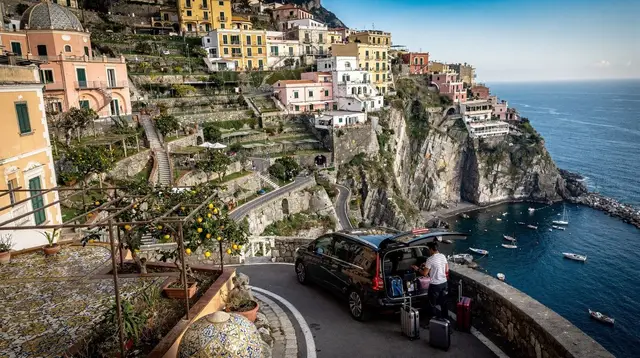
GetYourGuide does not provide a product photo for this activity — the image shows the meeting point, photographed by us.