Why There Is No Train on the Amalfi Coast
The first time I tried to plan a trip to Positano, I did what most people do: I opened a map app, typed in “Naples to Positano,” and expected a train result. I got walking directions to a bus stop instead, and I remember thinking the app was broken. It wasn’t. There simply is no railway station in Positano. Or in Amalfi. Or in Ravello, Praiano, Minori, Maiori, Atrani, or any other village strung along this coast. If you’re staring at a map wondering which station serves the town you’re staying in, I can save you the search: none of them do.
Why the map keeps failing you
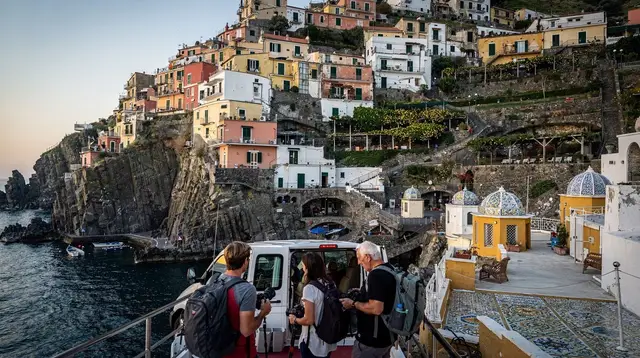
This isn’t a gap in a booking website or an outdated map layer. It’s geography. The Amalfi Coast is a roughly 50-kilometer ribbon of cliffside villages clinging to the side of a mountain that drops almost straight into the Tyrrhenian Sea. Laying track along a coastline like that, with hairpin turns and near-vertical rock faces, was never a realistic project, and it still isn’t one today. There’s no partially built line, no shelved 1960s plan quietly waiting for funding, no station foundation hidden under a parking lot in Amalfi. If you read a claim online that a train to Positano or Amalfi is “in the works” or “coming soon,” treat it as unverified — I’ve never found a credible source backing that up, and I’m not going to invent one here.
What the coast has instead is a single narrow road, the SS163, plus SITA buses that run along it, and seasonal ferries that hop between the harbor towns. That’s the whole transport backbone. No rails anywhere on it. It’s also worth saying plainly that the Amalfi Coast is not one town — Amalfi, Positano, Ravello, Praiano, Minori and Maiori, and Vietri, Cetara, and Atrani are separate villages with separate centers, and every single one of them is missing the same railway station.
If the absence of track along a cliff edge sounds obvious once you say it out loud, it’s worth reading how the SS163 itself is not a highway either — it’s a two-lane road with hairpins, and that’s the actual reason nothing has ever run rails alongside it.
The train that almost gets you there, but doesn’t
Here’s where a lot of confusion comes from, and where I got tripped up myself early on: there IS a train in the area. It’s called the Circumvesuviana, and it runs between Naples and Sorrento, stopping at Ercolano (the modern town next to the ruins of Herculaneum) and Pompei along the way. It’s a genuinely useful, cheap regional train, and if you’re coming from Naples it’s often the first leg of your journey. I’ve written a full Circumvesuviana train guide if you want the stops and practicalities in one place.
But — and this is the part worth underlining — the Circumvesuviana ends in Sorrento. It does not continue onto the Amalfi Coast. Sorrento sits on the Sorrentine Peninsula, which is its own separate geographic area, distinct from the Amalfi Coast proper. It’s an easy mix-up because Sorrento gets marketed alongside Amalfi and Positano constantly, and because it genuinely is a common base for exploring the region. But administratively and geographically, Sorrento is not an Amalfi Coast village. It’s the last stop before you have to change transport entirely.
That same confusion shows up in the other direction too: people assume Naples is part of the Amalfi Coast because it’s the gateway everyone flies into, when it’s actually a separate city entirely, connected by the same train line that stops short at Sorrento.
So when people say “just take the train to the Amalfi Coast,” what usually happens is one of two things: they take the Circumvesuviana to Sorrento and then transfer to a SITA bus or a ferry for the rest of the way, or they take a regional train to Salerno, at the coast’s other end, and transfer there instead. Either way, the train gets you to the edge, never into the coast itself.
What actually gets you from the train to the village
Once you’re off the train, in Sorrento or Salerno, you have three realistic options for the last stretch.
| Option | Where it works from | What to know |
|---|---|---|
| SITA bus | Sorrento or Salerno to any coastal village | Runs the full SS163, but seats fill fast in summer and the coastal road is slow |
| Car / private driver | Either end, or Naples direct | Flexible, but the SS163 is narrow with ZTL restrictions in Amalfi, Positano, and Ravello in high season |
| Ferry (seasonal) | Salerno, Sorrento, or between villages | Fast and scenic April to October; sharply reduced or suspended in winter |
I want to be clear about that ferry caveat, because I’ve seen people plan entire winter itineraries around boat connections that simply aren’t running. Ferries on this coast are a warm-season convenience, not a year-round guarantee. If you’re visiting between November and March, assume the bus or a car, and treat any ferry schedule you find as something to double-check close to your travel date, not something to lock in months ahead — I go into more detail on exactly why Amalfi Coast ferries stop in winter elsewhere on the site. For the routes that do run, the ferries between the Amalfi Coast, Sorrento, and Capri guide covers which harbors connect to which.
For a first visit, I generally point people toward the SITA bus for at least one leg of the trip, just so they see the coast road properly — even if it means standing for part of the ride. It’s slower than it looks on a map, but that’s kind of the point of not having a train here: the road forces you to actually look at the place instead of tunneling under it. The SITA bus guide covers routes, tickets, and where to catch it from Sorrento or Salerno. If you’d rather drive yourself, the SS163 driving guide walks through the ZTL restrictions and the parts of the road that catch people out. And if the idea of managing any of this without a car sounds daunting, the Amalfi Coast without a car guide lays out a full plan built entirely on buses, ferries, and the occasional taxi.
Why Sorrento ends up being a hub, not a destination
Because it has the only working train station in the immediate area, Sorrento naturally becomes a transfer point for a lot of travelers, whether or not they intend to spend time there. You’ll often see it used as a base precisely because it’s reachable by train from Naples, with the Amalfi Coast villages treated as day trips reached by bus or boat from there. That’s a reasonable strategy, and one I’ve used myself. Just keep the distinction straight in your head: staying in Sorrento is staying on the Sorrentine Peninsula, with the Amalfi Coast as a separate excursion, not staying “on the Amalfi Coast with train access.”
If you’re weighing whether to base yourself in Sorrento versus a village further along the coast, it’s worth thinking through the trade-off before you book anything, since it changes how much of each day you spend in transit — I lay out both sides in Sorrento vs. the Amalfi Coast for where to stay. And once you’re actually in Naples, getting from Naples to Sorrento or straight from Naples airport to the Amalfi Coast are the two legs most people need sorted before anything else.
Sorrento’s train access also makes it a natural base for the archaeological sites on the other side of Vesuvius. A day trip to Naples from Sorrento or a day trip from the Amalfi Coast to Pompeii both use that same Circumvesuviana line, and if you’re trying to decide between the two ruin sites, Herculaneum vs. Pompeii explains how they differ — they’re often assumed to be the same disaster site, which they’re not. For a longer version of that day, the Naples, Pompeii, and Vesuvius in two days itinerary strings the train, the ruins, and the volcano together properly.
Planning around the absence of a train
None of this makes the Amalfi Coast hard to reach — Naples’ airport and train station put you within a couple of hours of any village here. It just means the last leg is never a train, and no schedule change is going to alter that. Once you accept the SS163, the SITA bus, and the seasonal ferry as the actual toolkit, rather than something to route around, planning gets a lot simpler.
That’s true whether you’re staying a short weekend or building a full week around it. A 3-day Amalfi Coast itinerary or the Amalfi Coast by public transport itinerary both assume exactly this bus-and-boat toolkit from the start, while the Amalfi Coast with a rental car itinerary is the version for people who’d rather drive the SS163 themselves. And once you’re actually out at Ravello, it’s worth knowing that Ravello has no beach either — another case of the map implying something the geography doesn’t deliver.
If a full day trip from Naples covering the coast, Pompeii, and the surrounding area sounds easier than juggling connections yourself, a guided day tour to the Amalfi Coast from Naples handles the transfers for you. For a longer look that includes an overnight, I’ve also seen people do well with a two-day trip covering Sorrento, the Amalfi Coast, and Pompeii. And if you’re just trying to get from the airport or your hotel toward Salerno with a stop at the ruins along the way, a private transfer from Naples or Salerno with a Pompeii stop skips the station transfers entirely.
I still remember standing at that first “no results” map search feeling like I was missing something obvious. I wasn’t. There’s just no train down here — and once you plan around the bus, the road, and the boat instead, the coast stops feeling like a logistics puzzle and starts feeling like the reason you came.
tours.Explainer
Verified deep-linked GetYourGuide tours. Book through these links and we earn a small commission at no cost to you.
GetYourGuide does not provide a product photo for this activity — the image shows the meeting point, photographed by us.