The Amalfi Coast Is Not One Town
The first time I tried to plan a trip here, I typed “how many days do I need for the Amalfi Coast” into a search bar as if I were asking about a single address. I pictured one town — maybe with a harbor, maybe with some cliffs — and I imagined I’d land somewhere, drop my bag, and start exploring outward from there. That’s not what happened, and it’s not really what the Amalfi Coast is.
The Amalfi Coast is a stretch of coastline in Campania, in southern Italy, roughly 50 km long, hugging cliffs above the Tyrrhenian Sea. Along that stretch sit a string of villages: Amalfi, Positano, Ravello, Praiano, Conca dei Marini, Minori, Maiori, Vietri sul Mare, Cetara, and Atrani, with a few smaller hamlets tucked between them. None of these is “the” Amalfi Coast. They’re all part of it, at the same time, and none of them sits at the center of the others.
I think the confusion comes from how we talk about destinations most of the time. A city has a downtown. An island might have one main port town where everything funnels through. The Amalfi Coast doesn’t work that way. There’s no single square you arrive at and then branch out from. Instead, there’s a road — the SS163 — that threads along the cliffside connecting every one of these villages, one after another, with the sea usually somewhere below and the rock face somewhere above.
No village is “the” one
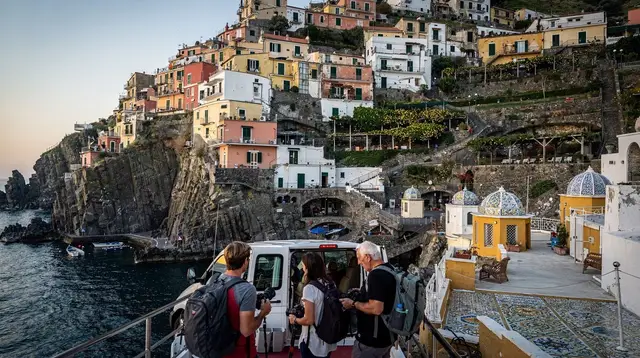
I used to think Amalfi itself, since it gives the whole coast its name, must be the main event — the place everyone means when they say “Amalfi Coast.” It isn’t, or at least not more than any other village here. Amalfi has its own particular character: a working harbor, a cathedral square that dominates the town, and a history tied to the old Maritime Republic. But Positano, further along, looks and feels completely different — steep, vertical, built almost straight up the hillside, with narrow stairways instead of flat streets in a lot of places. Ravello is different again: it sits high above the water, around 350 meters up on a ridge, and doesn’t have direct beach access at all. You’d need to go down to Amalfi or Minori and back up if you wanted the shoreline.
Praiano feels quieter than either. Conca dei Marini is smaller still. Minori and Maiori sit closer to sea level and have a different rhythm than the villages perched higher up. Vietri sul Mare, at one end of the coast, is known for its ceramics tradition rather than for the same postcard cliffside views. Cetara is a fishing village with its own food culture. Atrani, tucked right next to Amalfi, is easy to miss entirely if you’re not looking for it, and yet it’s its own separate place with its own square and its own pace.
None of this is a ranking. I’m not going to tell you Ravello is more worth your time than Cetara, or that Positano earns its fame more than Praiano does. They’re just different, and the coast is built out of that difference rather than out of one dominant center with satellite attractions.
The road that holds it together
What actually connects these villages is the SS163, a narrow coastal road that follows the contour of the cliffs. SITA buses run along it, stopping in each village in turn, and in season there are ferries linking the port towns together and out toward Capri, Sorrento, and Naples. That’s the infrastructure of the place: a road and a shoreline, not a hub-and-spoke system with one center of gravity.
I mention this partly because it changes how you should think about visiting. If you assume there’s a main town and everything else is a side trip from it, you’ll end up planning your days as short excursions out and back. If you understand instead that you’re moving along a chain of villages, you start thinking differently — about which one or two you’ll actually stay in, and how you’ll spend your time getting to and along the coast itself, not just at the destination.
No, there’s no train
This is the detail that trips up almost everyone, myself included the first time. None of the villages along this stretch of coast — not Amalfi, not Positano, not Ravello, not any of the others — has a train station. There’s no rail line running along the cliffs here. The nearest stations sit outside the coast proper, in Salerno at one end and Sorrento at the other, and from either of those you’d continue by road or by boat.
It’s an easy assumption to make, especially if you’re used to coastal regions elsewhere where a rail line often threads along the shore linking towns together. Here, that infrastructure simply doesn’t exist along this particular stretch. The geography — steep cliffs dropping straight into the sea — is part of why. There was never a practical way to lay track along it the way roads eventually were cut into the rock.
Why this matters for planning
I don’t say all this to be pedantic about geography. It matters practically. If you think of the Amalfi Coast as one town, you might book a single night somewhere and expect to see “it” the next morning before moving on. If you understand it as a run of separate villages joined by a single road and some seasonal boats, you start asking better questions: which village suits how I like to travel, how much time do I actually want to spend on that road, and how many of these places do I actually want to visit rather than just pass through.
I’ve learned not to pretend any of the villages here is a stand-in for the whole coast, and not to treat any of them as more essential than the rest. They’re each their own place, joined by geography and by that one narrow road, and that’s really the whole picture. If someone still asks me which town to visit to “see the Amalfi Coast,” my honest answer now is that there isn’t a way to reduce it to one.
For a broader look at the region beyond the coast itself — Naples, Capri, and the day-trip destinations nearby — a tour like a guided day trip from Naples to the Amalfi Coast can be a useful way to get an overview of several villages in one outing rather than trying to plan transport between each one yourself. If you’re staying in Naples and want a shorter introduction, a day visit to the coast from Naples covers some of the same ground.
For those who also want to combine the coast with the archaeological sites nearby, a two-day tour linking Sorrento, the Amalfi Coast, and Pompeii stitches together several of these separate pieces at once. And for a more flexible option, a Naples-based Amalfi Coast tour is worth comparing against the others before you decide.
If you’re still working out your plan, it helps to start with how many days to allow for the Amalfi Coast before deciding where to base yourself. Comparing Positano against Amalfi or Ravello against Positano is a more useful exercise than looking for one “best” village, since none of them is a substitute for the others. If you’re weighing Sorrento against staying directly on the coast, that’s a related but separate question, since Sorrento sits on the neighboring peninsula rather than on the coast itself.
It’s also worth reading about getting around without a car early, since the absence of a train line makes bus and ferry planning more important here than in a lot of other coastal destinations. The SITA bus guide and the ferry guide between the coast, Sorrento, and Capri both go into how the villages actually connect to each other and to the wider area. If you do want more detail on why there’s no train along this stretch, or on why the SS163 isn’t really a highway, those pieces dig into the geography behind both facts.
For the villages themselves, it’s worth looking at each on its own terms: an Amalfi town walking tour, a look at why Ravello has no beach, or the case for Vietri, not Positano, being the coast’s ceramics town — small distinctions that only make sense once you stop treating the coast as a single place. If a full week feels like too much or too little, Amalfi Coast in 5 days or Amalfi Coast in 3 days both lay out ways to move between a handful of these villages without trying to see all of them at once.
None of these villages needs to stand in for the whole coast, and none of them will. Once that clicks, the planning gets a lot easier.
tours.Explainer
Verified deep-linked GetYourGuide tours. Book through these links and we earn a small commission at no cost to you.
GetYourGuide does not provide a product photo for this activity — the image shows the meeting point, photographed by us.