Why Ravello Has No Beach
I remember standing on the terrace of Villa Cimbrone in Ravello, looking straight down at a sliver of blue sea, and thinking: that looks so close. It wasn’t. It took me another hour, a bus, and a fair bit of leg-burning descent before I actually touched water that day. Nobody had warned me, and I felt a little foolish for assuming otherwise.
The view that fools everyone
Ravello sits on a ridge roughly 350 meters above the Tyrrhenian Sea. That altitude is exactly why people fall in love with it — the panoramas from Villa Rufolo and Villa Cimbrone are the reason Ravello has hosted composers, writers, and a concert season that draws people from across Europe. But the same elevation that makes those views possible also means there is no beach tucked below the town, no cove you can wander down to in ten minutes, nothing waiting at the bottom of a short staircase.
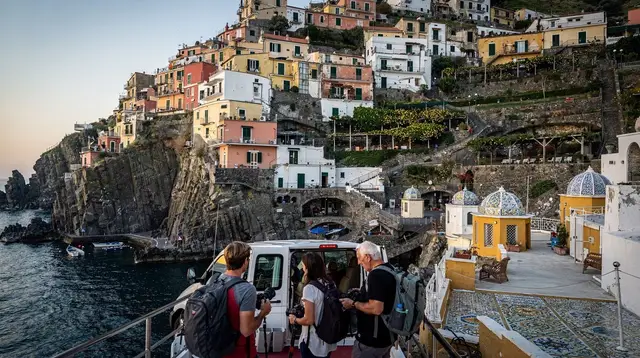
I think this is the single most common misunderstanding first-time visitors bring to Ravello. Photos of the coast make every town look interchangeable — cliffside, colorful, sea-adjacent. But “sea-adjacent” on the Amalfi Coast can mean sea-level, like Amalfi or Minori, or it can mean perched on a mountain shelf, like Ravello. The two are not the same kind of stay.
So where does the water actually go?
It doesn’t disappear, obviously — it’s just not underneath the town. Ravello has no shoreline of its own. If you want to swim, you have two realistic options, and both involve leaving Ravello and coming back.
The first is dropping down to Amalfi. It’s the nearest coastal town with real infrastructure — a working harbor, boats, a proper stretch of accessible waterfront, and connections onward toward Positano or Capri. Buses run this route, and there are also paths and stairways that cut more directly down the hillside for people who’d rather walk than wait for a bus. I won’t pretend to know exactly how long that walk takes or how many steps it involves — it depends entirely on your pace, the heat, and which route you take — but it is a genuine downhill hike, not a stroll, and it deserves to be treated that way when you’re planning your day.
The second option is Minori, on the other side of the ridge from Amalfi. It’s smaller and quieter, with its own little beach and a much more local feel than Amalfi’s harbor — see the Minori and Maiori beaches guide if that’s the direction you’re leaning. Getting there from Ravello also means a descent — again by road or by stepped paths — and again without a fixed, easy number I can hand you. What I can say is that both routes share a family resemblance: steep, scenic, and not something you want to attempt in flip-flops with a full daypack if you can help it.
If you’re the type who’d rather hike than wait for a bus, it’s worth knowing that Ravello sits close to one end of the Path of the Gods, the coast’s best-known trail, which connects the ridge towns above Positano and Praiano. It’s not a direct route down to Amalfi or Minori, but it’s a good example of how hiking and public transport can be combined into a single day out on this stretch of coast rather than treated as separate trips.
Ravello as a lookout, not a beach town
Once I stopped expecting Ravello to behave like a seaside resort, I actually enjoyed it more. It’s built for slow mornings with a coffee overlooking the gardens, for wandering into the Ravello Duomo, for catching a concert if the Ravello concert season lines up with your visit, and for a proper Ravello walking tour through the lanes between Villa Rufolo and Villa Cimbrone. It’s a place to look at the coast, not to swim off of it directly.
That’s a different kind of vacation day than what you get lower down. In Amalfi you can walk out of your hotel and be in the water within minutes. In Ravello, swimming is a planned excursion — you decide in the morning whether today is a beach day, and if it is, you build the descent and the return climb into your schedule rather than treating the sea as something you can dip into on a whim.
I’d also push back gently on the idea that this is a flaw. Plenty of people come to the Amalfi Coast for exactly this contrast: a few nights up high for the views and the quiet, mixed with time down at sea level for swimming and boat trips. If you’re staying in Ravello for multiple nights, you don’t have to choose — you can do both, just not in the same ten minutes.
Comparing the descent routes
| Option | What you’ll find | Getting there |
|---|---|---|
| Amalfi | Harbor, town beach area, ferry and boat connections | Bus down the hillside, or a steep path/staircase route |
| Minori | Smaller beach, quieter and more local | Bus around the ridge, or a steep path/staircase route |
Neither is a shortcut. Both require you to actually leave Ravello and come back up later, which is worth factoring into how you plan a day that includes swimming.
Getting up and down without the stress
However you choose to make the descent, it helps to understand the transport options along this coast before you commit to one. The SITA bus guide covers how the local bus network connects Ravello to the towns below, while the driving the SS163 guide explains why self-driving the coast road isn’t always the relaxing option it looks like on a map. If you’d rather hand the driving to someone else, a private driver can handle the up-and-down on your schedule instead of the bus timetable’s, and the Amalfi Coast without a car guide is worth a read if you’re planning the whole trip around buses, ferries, and your own feet.
Ravello versus a sea-level base
Because the altitude changes the day-to-day rhythm this much, it’s worth thinking about early on whether Ravello should be your only base or just part of the trip. The Ravello vs Positano comparison lays out the tradeoff directly, and the broader where to stay on the Amalfi Coast guide covers how Ravello compares to Positano and the coast’s other bases. If you’re weighing the coast against the Sorrentine Peninsula more generally, Sorrento vs Amalfi Coast: where to stay is the place to start. And if you’re still shaping the itinerary, the how many days on the Amalfi Coast guide and a sample 3-day Amalfi Coast itinerary both show how a stretch in Ravello can sit alongside nights down at sea level rather than instead of them.
Booking around the altitude
If you’d rather not manage the descent and return climb on your own schedule, day tours are a reasonable way to see Ravello and the coastline below it without doing the legwork of transfers yourself. I’ve found a full day combining a boat crossing with a bus loop through Amalfi and Ravello takes care of exactly this problem — someone else handles the up-and-down.
There’s also a version that strings together Positano, Amalfi, and Ravello in one outing from Naples, which is useful if you’re based further away and want the ridge-top views alongside sea-level time in a single day. And if what you really want is time on the water itself rather than looking at it from above, a catamaran cruise across the Gulf of Naples gives you the swimming and the coastal perspective without any climbing at all.
Frequently Asked Questions About Ravello and the Sea
Does Ravello have a beach?
No. Ravello sits on a ridge at roughly 350 meters above sea level and has no shoreline or beach of its own. To swim, visitors descend to a coastal town such as Amalfi or Minori.
How do I get from Ravello to the sea?
The two main options are descending to Amalfi or to Minori, either by bus along the road or via steeper paths and staircases that cut down the hillside more directly. Both require an equivalent climb back up afterward.
Is Ravello close to the water?
Visually, yes — the sea is clearly visible from Ravello’s terraces and gardens. Physically, it’s a genuine descent of several hundred meters in elevation, not a short walk.
Should I stay in Ravello if I want beach time every day?
If daily, low-effort access to the water matters most, a sea-level base like Amalfi or Minori will suit you better. Ravello works well as part of a longer stay where you split time between the ridge and the coast below.
Which is better for swimming, Amalfi or Minori?
Amalfi has a larger, busier waterfront with more infrastructure and onward ferry connections. Minori is smaller and quieter with a more local beach. Neither is directly beneath Ravello — both require the same kind of descent.
Can I walk down from Ravello instead of taking the bus?
Yes, there are paths and stairways connecting Ravello to both Amalfi and Minori. They’re steep and scenic, but expect a real hike in each direction rather than a short stroll.
Why is Ravello built so high above the sea in the first place?
Like much of the Amalfi Coast, Ravello grew up on defensible, cultivable terrain along the cliffs rather than directly on the shoreline, which historically was more exposed. The elevation is now what gives the town its famous panoramic views.
tours.Explainer
Verified deep-linked GetYourGuide tours. Book through these links and we earn a small commission at no cost to you.
GetYourGuide does not provide a product photo for this activity — the image shows the meeting point, photographed by us.