Ravello Walking Tour: Duomo, Villa Rufolo and Villa Cimbrone
Can a Ravello walking tour end with a swim in town?
No. Ravello sits about 350 meters above the coast with no beach of its own, so a walking tour of the historic center stays entirely uphill. Reaching the sea at Amalfi or Minori means a separate downhill trip by road or steep stairs, not a continuation of the town walk.
No, Ravello does not end at the water
A walking tour of Ravello does not lead down to a beach, and it never was going to. The town sits on a ridge roughly 350 meters above the Tyrrhenian Sea, and its whole identity comes from that height, not from any stretch of shoreline. Anyone who lays out a Ravello itinerary as a warm-up before a swim is describing two separate outings stitched together, not one continuous day. If a beach afternoon is the goal, Amalfi or Minori is where that happens, reached afterward by road or by a long flight of stairs, not by continuing past Villa Cimbrone.
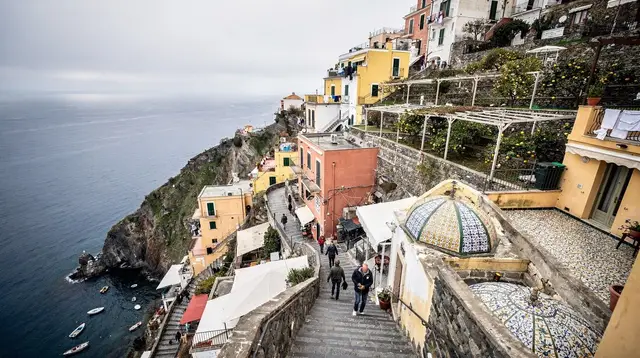
This matters for planning because it changes what “a day in Ravello” actually looks like. The town rewards a slow walk among gardens, a cathedral square, and cliffside terraces — not a rush to find sand that isn’t there. Visitors who come expecting a Positano-style beach town leave confused; visitors who come for the views, the Ravello Festival season, and the architecture leave satisfied. This guide follows the walk itself, from the main square to the Duomo, into Villa Rufolo, and out along the lane to Villa Cimbrone, with the elevation changes noted at each stage, plus the transport logistics that decide when to arrive and when to leave.
Getting to Ravello: no train, no direct coastal road shortcut
Ravello has no railway station, and none of the villages along the coast do either. The nearest stations are in Salerno or Sorrento, both well outside the Amalfi Coast proper. The practical way up to Ravello is the SITA bus from Amalfi, a climb of about 25 minutes on a narrow road that switches back repeatedly as it gains height. A taxi covers the same route faster but at a materially higher price, especially in summer. There is no ferry option: Ravello has no coastline to dock against, unlike Amalfi, Positano, or Capri.
This bus dependency should shape the day’s timing. SITA buses run frequently but not constantly, and in high season they fill up at the Amalfi stop before reaching the following villages. Arriving in Ravello by mid-morning avoids both the midday crowds around the Duomo and the risk of a long wait for a seat back down. For a broader sense of how the buses fit into a coast-wide day, the SITA bus guide covers routes, tickets, and timing beyond Ravello specifically. Anyone considering a rental car should also know that the road up is one lane in each direction with limited passing space; parking near the square is scarce and priced accordingly, and it does not connect onward to a coastal loop — the same road is the only way back down.
Starting point: Piazza Duomo
The walk begins at Piazza Duomo, Ravello’s central square, reached directly from the SITA bus stop or the small parking area at the town’s edge with no further climb needed. This is the flattest section of the whole visit, and a good place to get oriented before the elevation changes begin.
The Duomo di Ravello, dedicated to Saint Pantaleone, faces the square directly. The cathedral’s bronze doors and pulpit inlaid with mosaic are worth the short time it takes to see them, and the adjoining museum in the crypt holds Roman-era fragments found beneath the church. This stop takes 20 to 30 minutes for most visitors and involves only a handful of steps at the entrance — no meaningful climb yet.
Villa Rufolo: the first uphill stretch
Villa Rufolo sits just off the square, reached by a short lane and a modest set of steps — the first real elevation change of the day, though a gentle one compared to what follows. The villa’s terraced gardens, framed by Moorish-influenced cloisters, open onto one of the coast’s most photographed views: a wall of cypress trees and flowerbeds with the sea drop far below.
Villa Rufolo is also where the Ravello Festival stages its summer concerts, on a terrace built out over the cliff edge specifically for that purpose. Visiting outside a concert means the terraces are open to walk at leisure, with places to sit and take in the view without a program running. Allow 45 minutes to an hour here, more if the gardens are uncrowded enough to linger.
For visitors who want the historical framing filled in on-site rather than from a placard, a guided option covers this stretch of the walk in more depth:
a guided walk through Ravello’s historic center, including the Duomo and Villa RufoloVilla Cimbrone: the longer, steeper leg
From Villa Rufolo, the lane toward Villa Cimbrone runs 15 to 20 minutes on foot, mostly along a narrow paved path between garden walls and private villas. It is not as steep as the initial approach into Ravello from the coast, but it is not flat either — expect a steady, moderate incline the whole way, with no shade for stretches of it in midday sun.
Villa Cimbrone itself adds another layer of climbing once inside: paths wind through wooded gardens, past a crypt, a small temple, and a rose garden, before arriving at the Terrace of Infinity — a balustraded ledge lined with marble busts, looking out over open sea with no framing structure to interrupt the view. This is widely considered the single best vantage point on this stretch of coast, and it is also the point furthest from the bus stop, so visitors should budget the return walk into their schedule rather than treating the terrace as the trip’s endpoint.
Two hours is a reasonable minimum for Villa Rufolo, the connecting lane, and Villa Cimbrone together, and three hours allows time to sit at the Terrace of Infinity without rushing back. Those who prefer a private pace over a fixed group schedule can book it that way directly:
a private two-hour walk covering both villas at your own paceTable: the walk stage by stage
| Stage | Distance/time on foot | Elevation change | What’s there |
|---|---|---|---|
| SITA bus stop to Piazza Duomo | 2–5 minutes | Flat | Orientation, cafes, town entrance |
| Piazza Duomo (Duomo di Ravello) | 20–30 minutes on site | Flat, a few entrance steps | Cathedral, crypt museum |
| Piazza Duomo to Villa Rufolo | 3–5 minutes | Short, gentle climb | Entrance lane and ticket gate |
| Villa Rufolo gardens | 45–60 minutes on site | Terraced, moderate steps | Cloisters, concert terrace, sea view |
| Villa Rufolo to Villa Cimbrone | 15–20 minutes | Steady, moderate incline | Narrow lane past private villas |
| Villa Cimbrone gardens | 45–75 minutes on site | Wooded paths, some stairs | Terrace of Infinity, crypt, rose garden |
| Return to Piazza Duomo | 20–25 minutes | Downhill, same lane | Back to bus stop or parking |
What the walk does not include
It is worth restating plainly what does not belong on this itinerary: there is no beach stop, no seafront promenade, and no boat dock within the walk itself. Ravello’s terraces look down at the water; they do not lead to it. Travelers who want to combine the town with time in the sea should plan it as two distinct legs of the day — Ravello on foot in the morning, then the SITA bus or a car back down to Amalfi or Minori in the afternoon, where the actual swimming options are. Trying to fold both into a single loop without a return trip down the mountain does not work, since the road to Ravello is also the only road out of it.
This same logic applies to comparisons with other coastal towns. Positano organizes its day around Spiaggia Grande; Amalfi has its harbor front; Ravello has neither, and a fair comparison of the two approaches is covered in the Ravello versus Positano guide for anyone deciding where to base a stay.
Beyond the two villas
Visitors with extra time after Villa Cimbrone sometimes extend the walk toward quieter residential lanes on the town’s edges, though these add distance without adding must-see stops, and most travelers are better served returning to the square and catching an earlier bus rather than a later, more crowded one. For a version of the walk built specifically around the town’s connection to art and design history, one option threads in the Villa Rufolo cloisters and Escher’s documented visits to the area:
a guided walk linking Ravello’s architecture to Escher’s Amalfi Coast sketchesCouples timing the walk around sunset, when the Terrace of Infinity empties out toward evening, often prefer a smaller, unhurried group:
a private, slower-paced walk timed for the evening light over the coastPractical notes before heading up
Ravello’s elevation means weather and temperature differ noticeably from the coast below — cooler in the evening, and prone to cloud cover that the villages at sea level don’t share. Comfortable, closed shoes matter more here than in flatter coastal towns, given the stairs inside both villas and the uneven paving on the connecting lane. Bags large enough to need a locker are uncommon at either villa entrance, so travel light rather than counting on storage.
Because the SS163 and the SITA network are the only ways up, day-of scheduling should build in buffer time for both the ride up and the ride back down, particularly from late morning through late afternoon in July and August when buses run at capacity from Amalfi. Anyone building a wider coastal itinerary around this stop can see how it fits against the rest of the region in the three-day Amalfi Coast itinerary or the guide to visiting without a car.
Ravello walking tour: frequently confused points
Does Ravello have a beach?
No. Ravello sits roughly 350 meters above the coastline with no waterfront of its own. Reaching the sea means descending by road or by stepped paths to Amalfi or Minori, a separate trip from the town walk itself.
How do you get to Ravello without a car?
Ravello has no train station. The standard route is the SITA bus from Amalfi, roughly 25 minutes up a winding hillside road, or a taxi covering the same climb at a higher cost.
How long does the Ravello walking tour take?
Walking from the main square through the Duomo, Villa Rufolo, and on to Villa Cimbrone and back typically takes two to three hours at an unhurried pace, including time inside both villas.
Is the walk from Villa Rufolo to Villa Cimbrone flat?
No. The connecting lane is mostly level to gently sloped, but both villas involve stairs and terraced paths once inside, so grippy flat shoes work better than sandals.
Can you combine Ravello with a swim on the same day?
Yes, but only as two separate legs: walk Ravello in the morning, then take the bus or drive back down to Amalfi or Minori in the afternoon, since Ravello itself has no shoreline to swim from.
What is the difference between Villa Rufolo and Villa Cimbrone?
Villa Rufolo sits just off the main square with terraced gardens and hosts the Ravello Festival concerts. Villa Cimbrone is a further 15 to 20 minute walk, centered on the Terrace of Infinity with wider, uninterrupted coastal views.
Is Ravello worth visiting on a single day trip from Amalfi?
It can be, but the bus climb and the walking time at the top add up, so most visitors find it easier to give Ravello its own half-day rather than combining it with another full village on the same trip.
For a version of the walk narrated by a local guide who can point out details easy to miss on a self-guided pass — the crypt beneath the Duomo, the specific cloisters Escher sketched, the boundary markers of the old Rufolo estate — the guided walking option covers the same route with that context built in:
a private walking tour of Ravello’s UNESCO-listed historic center
Town Walking Tours on the Amalfi Coast on GetYourGuide
Verified deep-linked GetYourGuide tours. Book through these links and we earn a small commission at no cost to you.
GetYourGuide does not provide a product photo for this activity — the image shows the meeting point, photographed by us.