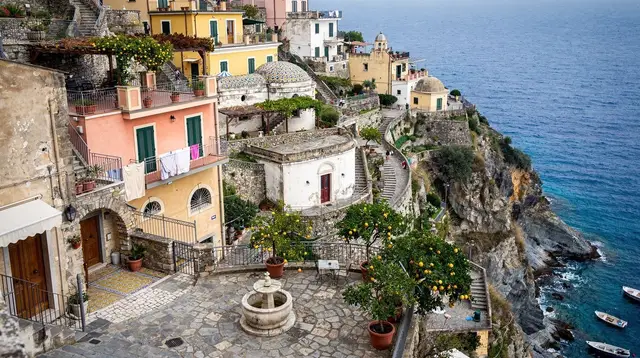
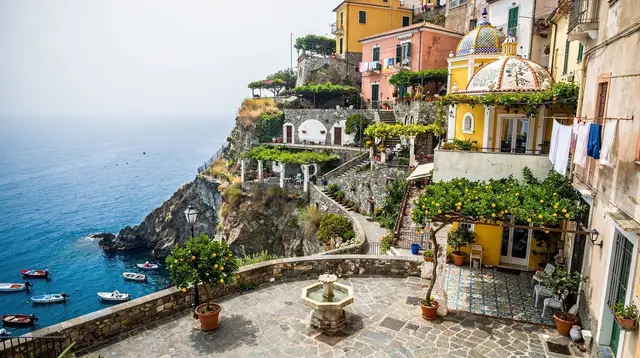
Villa Rufolo, Ravello: Medieval Gardens, Not Just a Pretty View
What makes Villa Rufolo different from a typical garden visit?
Villa Rufolo is a fortified medieval complex blending Norman and Arab-Sicilian architecture, not a purpose-built ornamental garden. Its cliffside terrace also serves as the main stage of the Ravello Festival, so the site functions as both a historic monument and an active concert venue, unlike the more purely landscaped Villa Cimbrone next door.
More Than a Garden With a View
It’s easy to walk into Villa Rufolo expecting nothing more than a flowery terrace with a famous photo spot, snap the shot of the sea framed by cypress trees, and move on. That reading misses most of what the site actually is. Villa Rufolo is a fortified medieval residence, one of the oldest and most important private complexes ever built on this stretch of coast, and its architecture mixes Norman defensive structures with Arab-Sicilian decorative details you won’t find replicated anywhere else in Ravello. The gardens layered on top in the 19th century are real and beautiful, but they sit on top of nearly a thousand years of building history, not the other way around.
The villa is also a working cultural venue. Its main terrace, overlooking the Gulf of Salerno, has been the primary stage of the Ravello Festival since the event’s founding, which means the site shifts personality depending on when you arrive: a quiet historic monument most of the year, and a packed open-air concert hall for much of the summer. Treating it purely as a garden to photograph and leave skips both the medieval structure underfoot and the performance tradition that has defined the villa for over a century.
A Brief History: Normans, Arab-Sicilian Craftsmen, and a Family Fortune
Villa Rufolo takes its name from the Rufolo family, wealthy Ravello merchants whose trading fortune in the 13th century financed one of the most ambitious private residences on the Amalfi Coast. The family’s wealth and connections brought in craftsmen trained in the Arab-Sicilian tradition then flourishing in southern Italy, which is why the villa’s cloister and tower details show pointed arches, interlacing patterns, and decorative brickwork more commonly associated with Palermo than with a Campanian hill town. Layered onto that is a defensive Norman structure, with a fortified tower and thick stone walls reflecting the coast’s exposure to raids in earlier centuries.
Over the following centuries the property passed through various owners and periods of neglect before being restored in the 19th century by Scottish botanist Sir Francis Neville Reid, who added much of the garden planting visitors see today. That restoration is also what drew composer Richard Wagner to the villa in 1880; he is said to have found in its garden the visual inspiration for the magic garden of Klingsor in his opera Parsifal. That single visit became the founding reference point for the Ravello Festival, launched decades later specifically to honor the Wagner connection, and it’s the reason the villa’s terrace still opens each festival season with a concert tied to that opera.
Understanding this layered history matters because it explains features that otherwise look purely decorative. The crenellated tower isn’t an aesthetic flourish, it’s a genuine defensive structure. The cloister’s interlaced arches aren’t generic “Mediterranean style,” they’re a specific Arab-Sicilian architectural import. A visit that only registers “pretty garden” misses the reason this particular villa, rather than any other property on the coast, became both a protected monument and a music festival’s permanent home.
What You’ll Actually See Inside
A visit to Villa Rufolo moves through several distinct spaces, each reflecting a different phase of the site’s history.
The entrance tower and courtyard greet visitors first, with thick medieval walls that make clear this was originally a fortified residence rather than a leisure property. From here, a path leads into the interior courtyard bordered by the villa’s most photographed architectural feature.
The Moorish cloister is the clearest example of Arab-Sicilian influence on the property, with a two-tiered arcade of interlacing pointed arches around a small courtyard. It’s compact but architecturally dense, and worth slowing down for rather than walking straight through toward the gardens.
The main tower offers the closest thing to a defensive lookout point on the property, with narrow windows and thick stonework that contrast sharply with the ornamental gardens surrounding it.
The terraced gardens are what most visitors come for, and they earn the reputation: descending paths lined with palms, cypress, and seasonal flowering plants lead toward the cliffside terrace, with the coastline and Gulf of Salerno opening up below at each turn.
The Terrace of Infinity (Belvedere) is the villa’s signature viewpoint and its concert stage rolled into one. A stone balustrade lined with classical busts frames an open view over the sea, and during festival season this same platform holds a full audience seating setup, orchestra, and lighting rig. Photographing it as an empty garden terrace in July would be unusual; in winter, it reverts to a quiet lookout with no trace of the summer’s staging.
Villa Rufolo vs. Villa Cimbrone: Two Different Visits
Ravello has two celebrated villas within a short walk of each other, and treating them as a single combined attraction undersells both. Villa Cimbrone is built around a long garden walk, structured as a sequence of paths, statuary, and shaded corners culminating in its own famous belvedere, the Terrace of Infinity (a name that, confusingly, both villas’ viewpoints are sometimes loosely referred to by locals, though each is architecturally distinct). Villa Cimbrone rewards unhurried strolling and works well as a quiet, contemplative visit at almost any time of year.
Villa Rufolo is different in both scale and purpose. It’s more compact, more architecturally layered with medieval and Arab-Sicilian elements, and far more tied to a specific calendar of events through the Ravello Festival. Where Villa Cimbrone is a walk, Villa Rufolo is closer to a historic monument that periodically transforms into a concert venue.
| Villa Rufolo | Villa Cimbrone | |
|---|---|---|
| Character | Medieval complex, Norman/Arab-Sicilian architecture | Landscaped garden estate |
| Signature feature | Moorish cloister, tower, festival terrace | Long garden avenue, statuary, belvedere |
| Event use | Main Ravello Festival concert stage | Primarily a garden and hotel grounds walk |
| Typical visit length | 45–60 minutes | 45–75 minutes |
| Best for | History, architecture, festival atmosphere | Slow walks, photography, quiet views |
If your schedule allows only one, choose based on what you want: architecture and cultural history at Villa Rufolo, or an extended garden walk at Villa Cimbrone. Many visitors do both in a single Ravello walking tour, since the town center connects them within about ten minutes on foot.
The Ravello Festival: Why the Terrace Matters
The Ravello Festival is not a side note to a Villa Rufolo visit, it’s a defining part of what the site is. Since its founding in the mid-20th century in tribute to Wagner’s 1880 visit, the festival has used the villa’s cliffside terrace as its primary open-air stage, hosting orchestral concerts, chamber music, and occasional dance performances against the backdrop of the Gulf of Salerno.
This has a direct, practical effect on when and how you should plan a visit. During the festival’s core season, generally running from early summer through September, the terrace hosts evening events that require ticketed access separate from the standard daytime garden entry, and the town around the villa fills with a different rhythm: restaurants stay busier later, accommodation books up around performance dates, and daytime garden visits can feel more crowded as festival-goers combine sightseeing with their evening plans. Outside that window, particularly from November through March, Ravello reverts to a quiet hill town, several of its restaurants and some services scale back, and the villa itself is a calm, uncrowded historic site with no performance infrastructure in view.
If seeing a concert on the terrace is part of your plan, book well ahead: seating is limited by the terrace’s physical footprint, and popular evenings sell out. If you’re visiting purely for the daytime architecture and gardens, avoid the compressed midday hours in July and August when the SS163 corridor and Ravello’s own access roads see their heaviest traffic, and consider an early morning or later afternoon visit instead.
Getting to Ravello and Villa Rufolo
Ravello has no train station and no direct coastal road access at sea level: it sits on a ridge roughly 350 meters above the water, connected to Amalfi and the coast below by a switchback road rather than any waterfront route. Most visitors reach it in one of a few ways.
By bus, SITA buses run from Amalfi up to Ravello on a frequent schedule in season, with the trip taking about 25 minutes depending on traffic. By car, the drive up from Amalfi follows a narrow, winding road with limited parking near the historic center, so most visitors park at the edge of town and walk in. There is no ferry option, since Ravello has no working harbor of its own; anyone arriving by boat lands first in Amalfi or Minori and continues uphill from there. Travelers without a rental car can find further detail in Amalfi Coast without a car, since the logistics here mirror the rest of the coast’s public transport patterns.
Once in Ravello, Villa Rufolo sits directly on the town’s main square, a short, flat walk from the bus stop and well within reach even for visitors who’ve just come up a steep road to get there.
No Beach, and That’s Expected
One detail that catches first-time visitors off guard: despite the sweeping sea views from Villa Rufolo’s terrace, there is no way to reach the water from the villa itself, and Ravello as a town has no beach of its own. The panorama is entirely visual. To actually swim or sunbathe, visitors need to travel back down to Amalfi or Minori by road or connecting stairways, a trip that adds real time given Ravello’s elevation. This isn’t a flaw in the villa, it’s simply a function of Ravello’s position as a hilltop town rather than a waterfront one, and it’s worth building into your day plan rather than discovering on arrival.
Practical Visiting Tips
Wear comfortable shoes: the cloister and tower areas involve uneven medieval stonework, and the garden paths include gentle slopes and occasional steps. Bring a hat and water in summer, since much of the garden circuit is in direct sun with limited shade until you reach the lower terraces. Photography is best in the earlier or later parts of the day, both for lighting on the coastline and for avoiding the densest midday visitor groups. If you’re combining Villa Rufolo with the Duomo di Ravello just across the square, the two make an efficient pairing since both sit within the same small historic center.
For a guided introduction that explains the architecture and history rather than just walking the paths, a guided walk through Ravello’s historic center and Villa Rufolo covers the cloister, tower, and garden layout with context you’d otherwise need to research separately. Visitors arriving from Naples for a single day can consider a day tour from Naples to Ravello that builds in the transport logistics along with villa time.
Couples looking for a quieter, more personal pace often prefer a private scenic tour of Ravello’s villas and viewpoints, while travelers coming up from Sorrento can combine the coastal approach with a Sorrento departure that includes an optional boat ride to the Villa Rufolo area.
Planning Villa Rufolo Into a Longer Coast Itinerary
Villa Rufolo works well as a half-day anchor within a broader Ravello visit, paired with the Duomo, a walk through town, and possibly Villa Cimbrone if time allows. It fits naturally into a multi-day coastal itinerary such as Amalfi Coast in 3 days, where Ravello typically takes up a single afternoon slot between coastal towns lower down the cliff. Given the seasonal swing in atmosphere, travelers planning specifically around the festival or around quieter crowds should also check Amalfi Coast in May for a shoulder-season read on timing before locking in dates.
Frequently Asked Questions About Villa Rufolo
Is Villa Rufolo worth visiting if I’ve already seen Villa Cimbrone?
Yes, the two are not interchangeable. Villa Cimbrone centers on a long garden walk ending at a belvedere, while Villa Rufolo is a compact medieval complex with cloisters, towers, and a terrace built for performance. Visiting both shows two different sides of Ravello’s history.
Can I swim or reach the beach from Villa Rufolo?
No. Ravello sits roughly 350 meters above the coast on a mountain ridge, and Villa Rufolo has no beach of its own. The sea view from its terrace is purely visual; reaching the shore means traveling down to Amalfi or Minori by road, bus, or the connecting stairways.
How long does a visit to Villa Rufolo take?
Most visitors need 45 minutes to an hour to walk the gardens, towers, and cloister at an unhurried pace. Add extra time in summer if you also want to explore the small museum rooms or linger on the terrace for photos.
When is the best time to visit for the gardens versus the concerts?
The gardens are pleasant nearly year-round, but the Ravello Festival concentrates concerts and crowds from roughly early summer through September. Outside that window, especially November through March, the villa is quiet and some evening programming disappears entirely.
Do I need to book tickets in advance?
For a standalone daytime garden visit, walk-up tickets are usually available outside peak midday hours in July and August. For any Ravello Festival concert on the terrace, advance booking is strongly recommended since seating is limited and popular dates sell out.
Is Villa Rufolo accessible for visitors with mobility difficulties?
Partially. The main courtyard and lower garden areas are reachable with some effort, but the site includes uneven medieval stonework, steps, and sloped paths that limit full wheelchair access, and Ravello’s hillside streets add further challenges getting to the entrance.
Where does the Villa Rufolo lemon and garden produce come from?
The villa’s gardens are ornamental, planted with Mediterranean species, palms, and seasonal flowers rather than commercial citrus groves. For a working look at the region’s famous lemon cultivation, that experience is better found in Amalfi or Sorrento’s terraced groves, not inside Villa Rufolo itself.
What is the connection between Villa Rufolo and composer Richard Wagner?
Wagner visited Villa Rufolo in 1880 and reportedly found in its garden the inspiration for the magic garden of Klingsor in his opera Parsifal. That association is the historical root of the Ravello Festival, which still opens its summer program on the villa’s terrace.
Ravello Villa & Garden Tours on GetYourGuide
Verified deep-linked GetYourGuide tours. Book through these links and we earn a small commission at no cost to you.
GetYourGuide does not provide a product photo for this activity — the image shows the meeting point, photographed by us.