Driving the SS163: What the Amalfi Coast Road Really Demands
Is the SS163 easy to drive on the Amalfi Coast?
No. The SS163 is a narrow, two-lane cliffside road with hairpin turns, one-way traffic alternation at pinch points in high season, and ZTL zones that ban non-resident cars in Amalfi, Positano, and Ravello. Most visitors use the SITA bus or ferries instead of a rental car.
Why the SS163 is not the joyride it looks like in photos
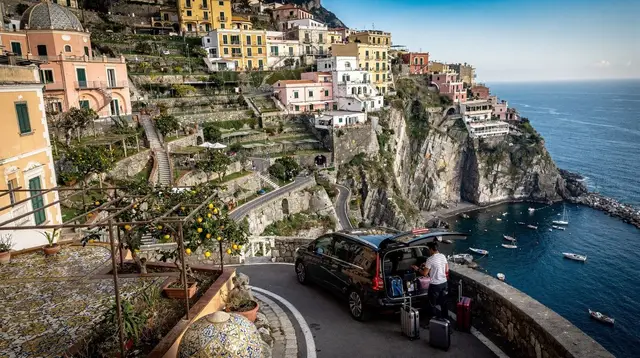
Photos of the Amalfi Coast almost always include the same shot: a car or scooter rounding a cliffside bend with the sea somewhere below. Those images suggest a scenic drive built for pleasure. The reality on the ground is different. The SS163, the single road that connects Amalfi, Positano, Ravello, and the rest of the coastal villages, is a narrow regional road, not a highway. For most of its roughly 50-kilometer length it carries one lane of traffic in each direction, hugs a cliff face, and bends sharply and repeatedly. Two tour buses meeting on a curve sometimes cannot pass without one of them reversing. This page exists to correct the postcard version before it costs you a rental deposit or an afternoon stuck in a queue of cars outside Praiano.
None of this means the SS163 is impassable or that visiting by car is impossible. It means the road should be evaluated for what it is: a working coastal artery for around a dozen villages, a network of SITA buses, delivery trucks, scooters, and pedestrians, not a route designed for unhurried sightseeing at the wheel. Understanding that distinction changes how most travelers plan their trip.
What actually makes the SS163 difficult
A few concrete features explain why the SS163 has a reputation among both first-time visitors and locals.
- Width. Much of the road allows barely enough space for two mid-size vehicles to pass safely. Buses and larger vans frequently cannot pass each other, which is why bus drivers who know the road well use a system of horn signals at blind curves.
- Bends. The road follows the contour of the cliff, which means near-constant hairpin turns rather than long straight stretches. There is no cruising speed to settle into.
- One-way alternation. At several of the tightest pinch points, traffic is regulated to alternate direction in high season, sometimes with a traffic light, sometimes with a person directing flow by hand. This adds waiting time that is impossible to predict from a map.
- ZTL zones. Amalfi, Positano, and Ravello each enforce a zona a traffico limitato (ZTL), a restricted-traffic zone that bans non-resident and non-permitted vehicles, typically monitored by camera. Driving into one without authorization risks a fine mailed to your rental company weeks later. These zones are active mainly in high season but are worth checking before entering any village center.
- Parking. Free roadside parking is scarce to nonexistent in the villages that matter most to visitors. Paid lots exist at the edges of Amalfi, Positano, and Ravello, and they fill up on summer days well before midday.
None of these factors is exotic on its own. Together, on a road with no shoulder and a cliff on one side, they add up to a drive that requires sustained attention rather than a relaxed cruise.
Driving on the right does not offset the difficulty
Italy drives on the right, which is the same convention used across most of continental Europe and will feel familiar to many visitors. It is worth stating plainly: this familiarity does not make the SS163 easier. The challenge here has nothing to do with which side of the road traffic keeps to and everything to do with the road’s width, its blind curves, the buses sharing it, and the volume of traffic squeezed onto a single route with no real alternative. A driver who is entirely comfortable with right-hand traffic elsewhere can still find the SS163 demanding on a first attempt, particularly in July or August.
Why most visitors skip the rental car altogether
Given these constraints, the majority of people visiting the Amalfi Coast do not drive themselves along it. Three alternatives cover almost all of the coast’s transport needs:
- The SITA bus network, which runs the length of the SS163 and connects every village from Sorrento to Salerno, driven by professionals who know the road’s blind spots and passing points. See the SITA bus guide for routes and tickets.
- Seasonal ferries, which link the coastal villages, Capri, Naples, and Sorrento by sea and bypass the road entirely in season. Coverage drops sharply outside the Easter-to-October window, so check the ferry guide before assuming a boat will be running.
- A private driver, who absorbs the burden of navigating the ZTLs, the passing maneuvers, and the parking search on your behalf. The private driver guide covers when this option makes sense compared to public transport.
None of the coastal villages themselves, including Amalfi, Positano, and Ravello, has a train station. The nearest stations are in Salerno or Sorrento, which is one reason the bus and boat networks carry so much of the coast’s visitor traffic rather than rail. If you are arriving from Naples, the practicalities of that first leg are covered separately in the Naples airport to Amalfi Coast guide.
If you would rather not drive at all but still want to see the coast without piecing together bus timetables, a shared or private touring option covers the same route with someone else handling the road. a shared driving tour along the coast follows the SS163’s key viewpoints without you needing to find parking at each stop, and a private tour of the coast works well for groups or travelers with limited walking ability who still want to stop at Positano, Amalfi, and Ravello in one day.
When people do choose to drive
Some travelers still have good reasons to rent a car: multi-generational families with heavy luggage, trips that combine the coast with inland Campania, or itineraries built around early-morning or late-evening drives when traffic thins out. If that describes your plan, a few practical points reduce the risk:
- Book accommodation with private parking confirmed in writing, since street parking cannot be relied on.
- Avoid entering village centers directly; use the paid lots at the edges and walk in, which also sidesteps most ZTL exposure.
- Time coast-road driving for early morning or after dinner in July and August, when midday and late-afternoon traffic is at its worst.
- Check each village’s current ZTL hours and boundaries before driving in, since these can change seasonally and are not always obvious from the road itself.
Comparing a rental car against the bus and boat network in more detail is covered in the rental car itinerary and the public transport itinerary, which lay out day-by-day logistics for each approach.
Choosing the right vehicle if you do rent
Vehicle size matters more on the SS163 than on almost any other road most travelers will drive in Europe. A compact car has an easier time on the tightest bends and in the narrow lanes of village approach roads than a full-size sedan or an SUV, and it is also easier to fit into the compact paid parking lots at the edges of Amalfi, Positano, and Ravello, where spaces are frequently sized for smaller European cars rather than larger rental-fleet vehicles. Automatic transmissions are available but less common in the local rental fleet than manuals, so confirm the transmission type when booking rather than assuming.
Scooters and small motorbikes are a common local alternative to a car, since their narrower profile makes passing easier on tight bends and parking simpler in village centers. They are not, however, an easier introduction to the SS163 for a first-time visitor: the same blind curves, bus traffic, and cliffside drops apply, with less protection than a car provides. Riders without prior experience on similarly narrow, hilly roads are usually better served by a guided option such as a Vespa tour with an experienced local rider than by renting a scooter solo for their first pass along the coast.
Whatever the vehicle, insurance worth checking twice before signing: confirm what damage the rental company’s basic coverage excludes, since narrow passing maneuvers on the SS163 are exactly the situation in which mirror clips and minor scrapes happen most often. Photographing the vehicle at pickup, from all sides, is a small step that avoids disputes over pre-existing damage later.
Where the SS163 fits into a wider Campania trip
The SS163 is only one piece of how visitors move around this part of southern Italy, and it is worth seeing it in that context rather than in isolation. Travelers based in Sorrento or elsewhere on the Sorrentine Peninsula can reach Capri entirely by sea, bypassing the coast road altogether; the Sorrento to Capri ferry guide covers that crossing. Day trips inland to Pompeii or to Naples typically run on the Circumvesuviana train rather than the SS163 at all, since the coast road does not connect directly to those sites; see the Circumvesuviana guide for how that line fits together with a coast-based stay.
This matters for planning because a rental car booked specifically to handle the SS163 often sits unused, and paid, for the days built around Capri or Pompeii, where a car adds cost without adding convenience. Travelers weighing whether a car earns its cost across a full itinerary, rather than just for the coast road itself, may find it useful to work through the Amalfi Coast without a car guide before booking anything.
Traffic patterns worth planning around
| Period | Typical traffic on the SS163 | What it means for drivers |
|---|---|---|
| July–August | Heaviest of the year; midday and late-afternoon congestion near Positano and Amalfi | Expect long queues at ZTL and one-way alternation points; parking lots fill early |
| Shoulder season (May–June, September) | Moderate, with weekend spikes near Praiano and Conca dei Marini | Weekday mornings are the calmest window |
| Winter (November–March) | Lightest overall | Fewer cars, but sharp bends and changeable, sometimes wet, weather remain |
The table above is a general pattern, not a guarantee: local events, roadworks, or a single stalled vehicle on a blind curve can create a backup at any time of year. For a broader sense of how conditions shift month to month, see the guide on Amalfi Coast weather by month and the page on visiting in August specifically, when road and village crowding peak together.
A road that rewards respect, not confidence
The clearest way to frame the SS163 is this: it is not dangerous when treated with the caution a narrow cliffside road with heavy mixed traffic deserves, and it is genuinely risky when treated as a leisurely scenic drive. The same bends that produce spectacular photographs also demand a driver’s full attention, in every season, not just in the crowded summer months. A quieter November afternoon still has hairpin turns and a cliff edge; it simply has fewer cars sharing them with you.
If the appeal of the coast road is the experience of moving along it rather than the mechanics of driving it yourself, a guided option removes the burden of navigation entirely. A private tour from Naples along the coast handles the SS163’s traffic and parking on your behalf, and travelers who want a closer, open-air feel for the road without renting a car can consider a guided Vespa tour with a road captain, which pairs an experienced local rider with the route’s tightest sections.
Whichever way you experience it, the SS163 is best planned around, not through. Building your itinerary with the bus, the ferry, or a driver as the default, and a rental car only as a deliberate exception, matches how most of the coast’s own residents get around, and it avoids treating a working, narrow, heavily used road as something it was never designed to be.
Frequently confused points about driving the Amalfi Coast
Do I need a car to visit the Amalfi Coast?
No. Most visitors reach and move along the coast by SITA bus, seasonal ferry, or private driver, precisely because the SS163 is narrow and parking is scarce. A car is optional, not a requirement.
What is a ZTL and where does it apply on the Amalfi Coast?
A ZTL (zona a traffico limitato) is a restricted-traffic zone that bans non-resident and non-permitted vehicles, usually enforced by camera. Amalfi, Positano, and Ravello all operate ZTL zones in their historic centers, especially in high season.
Is the SS163 a highway?
No. It is a regional coastal road (strada statale), not a motorway. It has one lane in each direction for most of its length, with frequent hairpin bends and cliffside drops.
When is traffic worst on the SS163?
July and August bring the heaviest traffic of the year, with midday and late-afternoon congestion around Positano and Amalfi. Weekends in shoulder season can also back up near Praiano and Conca dei Marini.
Is it safe to drive the SS163 in winter?
Winter traffic is lighter, but the road itself does not become easier: the bends, narrow shoulders, and changeable weather remain, and rain or fog can make visibility difficult on cliffside sections.
Where can I park on the Amalfi Coast?
Parking is limited and almost always paid, concentrated in a handful of lots at the entrance to each village. Free roadside parking is rare, especially in Amalfi, Positano, and Ravello in high season.
Which side of the road do you drive on in Italy?
Italy drives on the right, the same as most of continental Europe. This does not offset the difficulty of the SS163 itself, which comes from its width, bends, and traffic density rather than which side traffic keeps to.
Is renting a car worth it just to drive the SS163 for the views?
Treating the SS163 as a scenic drive for its own sake means committing to slow traffic, tight passing maneuvers, and paid parking at every stop, so most travelers get the same views more comfortably from a SITA bus window or a boat.
Transport & Transfers on GetYourGuide
Verified deep-linked GetYourGuide tours. Book through these links and we earn a small commission at no cost to you.
GetYourGuide does not provide a product photo for this activity — the image shows the meeting point, photographed by us.