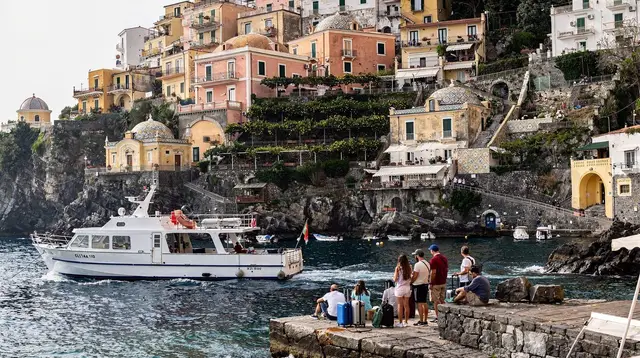
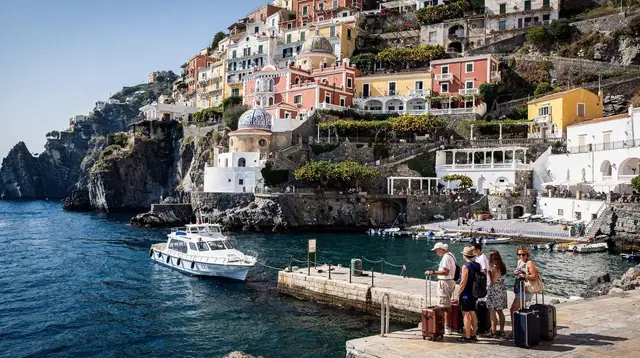
Ferries Between Sorrento, the Amalfi Coast and Capri: What They Actually Cover
Can you rely on ferries to get around Sorrento, the Amalfi Coast and Capri all year?
No. Ferries between Sorrento, Positano, Amalfi and Capri run frequently from Easter through late October but are drastically reduced, and often suspended entirely, from November to March. Even in high season, rough sea conditions can cancel individual crossings with little warning, so a ferry should never be treated as a guaranteed year-round service.
A Network That Exists, But Not All Year
Ferries are one of the most useful ways to move between Sorrento, Positano, Amalfi and Capri, and for a lot of travelers they are more pleasant than the road. But the honest starting point is that this is a seasonal network, not a permanent public transport line. From Easter through the end of October, hydrofoils and ferries link the main coastal towns and the island several times a day. Outside that window, the schedule thins out dramatically, and on many routes it disappears altogether. Treating the ferry as something you can always count on, the way you might a train or a scheduled flight, is the single most common planning mistake for this stretch of coast.
This guide focuses specifically on what the ferry network between Sorrento, the Amalfi Coast towns and Capri actually does and does not guarantee, so you can decide whether to plan around it, build in a backup, or choose a different way to get around entirely.
Why the Ferry Is Often Better Than the SS163
The SS163 is the single road that threads the entire Amalfi Coast together, and it was never built for the volume of traffic it now carries. It is narrow, cut into a cliff face, full of blind curves, and subject to ZTL (limited traffic zone) restrictions in Amalfi, Positano and Ravello during the busiest months. In July and August in particular, a drive that should take forty minutes can stretch well past two hours once you add queueing traffic, tour coaches, and one-lane sections where cars must take turns.
Against that backdrop, a ferry that skips the road entirely and drops you close to the town center is often the more relaxed choice, especially for trips between towns that both sit on the water, such as Sorrento to Positano or Amalfi to Capri. It is also why most visitors who do not have a rental car lean on a mix of SITA buses and ferries rather than driving themselves; see our broader guide to visiting the Amalfi Coast without a car for how the pieces fit together.
That said, “often better” is not “always available,” which is the point the rest of this page keeps coming back to.
What Routes the Ferry Network Actually Covers
Scheduled ferry and hydrofoil services along this stretch of coast generally connect a limited set of larger landings rather than every village. In a typical high-season week, you can expect direct or near-direct connections along these lines:
| Route | Typical frequency in high season | Typical frequency in winter |
|---|---|---|
| Sorrento – Positano | Multiple daily departures | Little to none |
| Sorrento – Amalfi | Multiple daily departures | Little to none |
| Sorrento – Capri | Frequent, among the busiest routes | Reduced, some links may continue |
| Positano – Capri | Several daily departures | Suspended on most operators |
| Amalfi – Capri | Several daily departures | Suspended on most operators |
| Naples – Capri | Frequent, year-round backbone route | Reduced but more likely to continue |
| Salerno – Amalfi / Positano | Regular daily departures | Sharply reduced |
Two things stand out from that table. First, smaller villages such as Praiano, Minori, Maiori, Cetara or Atrani are not consistently part of fixed ferry timetables; travelers based there usually rely on the SITA bus for onward connections rather than a boat stop at their own dock. Second, the Naples–Capri link tends to be the most resilient route on the whole network, because it serves Capri as a year-round destination rather than as one stop on a seasonal coastal circuit.
Capri Has More Than One Way In
It’s worth being precise about this, because it changes how you should plan a Capri day trip. Capri is not served by a single ferry line from one town. It is reachable by ferry or aliscafo (hydrofoil) from at least three separate gateways: Naples, Sorrento, and the Amalfi Coast towns themselves. That makes Capri a hub with multiple points of entry rather than a place tied to one specific departure port.
In practice, this means that if the direct Amalfi–Capri or Positano–Capri boat isn’t running on a given day, you are not necessarily out of options. Routing through Sorrento, or even through Naples, can still get you to the island, sometimes with better frequency, since Sorrento and Naples both function as larger, more consistently served embarkation points. For a closer look at the most common leg of that journey, see our dedicated guide to the Sorrento–Capri ferry.
Once on Capri, transport switches to land: a funicular carries passengers from Marina Grande up to Capri town, while Anacapri is reached separately by bus or by the Monte Solaro chairlift. None of that onward network changes the fact that getting to the island in the first place still depends entirely on a boat.
High Season vs Winter: A Service That Effectively Disappears
The line between “frequent” and “almost nonexistent” on this network falls around the edges of the high season, which on the Amalfi Coast runs roughly from Easter to the end of October. Inside that window, hydrofoils and ferries between Sorrento, the Amalfi towns and Capri run often enough that many visitors can build a day around hopping between two or three stops by boat.
Step outside that window and the picture changes fast. Heading into winter on the Amalfi Coast, most seasonal operators wind down their coastal routes entirely, and a number of businesses connected to the ferry piers close for the season alongside them. The routes most likely to survive into the colder months are the larger, more weather-tolerant links such as Naples–Capri; village-to-village hops like Positano–Amalfi or Amalfi–Capri are the first to be cut. Our related piece on why Amalfi Coast ferries stop in winter goes into the operational reasons behind this, from smaller passenger volumes to the increased frequency of rough seas.
The practical consequence is timing-dependent: a trip planned for May or August can lean on ferries with real confidence, while a trip in October sits in a shoulder period where services are already thinning, and anything from November onward should be planned as if ferries may not be an option at all.
Sea Conditions Can Cancel a Crossing Any Time of Year
Even inside high season, a published summer timetable is not a promise. Ferries and hydrofoils on this coast are small, fast vessels, and they are genuinely sensitive to wind and swell. A stretch of rough weather in July can suspend crossings for a few hours or a full day, the same way it can in December, just less often. This is not a technicality to skim past: travelers who plan a same-day return, or who need to be back for a flight, take on real risk if the return leg is their only route off an island or out of a village with no road access.
The clearest illustration of this dependency on the whole coast is the Blue Grotto on Capri, whose entry is decided by tide and sea state on the day, sometimes closing with no advance warning even in peak season. Ferry crossings follow the same logic on a larger scale: conditions, not the calendar, decide whether a boat sails.
The practical takeaway is to build slack into any itinerary that depends on a ferry, particularly for a Capri day trip, and to have a fallback in mind, whether that is a later sailing, a different departure port, or accepting that the day’s plan may need to change.
Ferry vs Bus vs Car: Choosing How to Get Around
For most journeys along this coast, the real choice is between three options, and each behaves differently by season and by traffic conditions.
| Option | Strongest in | Weakest in |
|---|---|---|
| Ferry | High season, coast-to-coast or to Capri, avoiding SS163 traffic | Winter, rough seas, smaller villages without a dock stop |
| SITA bus | Year-round, reaches every village on the SS163 | Heavy summer congestion, standing room only at peak times |
| Rental car | Off-season flexibility, reaching inland stops | ZTL restrictions, parking, SS163 congestion in July–August |
None of the three is a universal answer. A traveler splitting time between Sorrento, Positano and Capri in June will likely lean heavily on ferries. The same traveler visiting in December will plan almost entirely around the SITA bus network, since most boat options will simply not be running. Anyone weighing whether to rent a car at all should read our fuller breakdown of what driving the SS163 actually involves before committing to that option for a whole trip.
Booking a Boat Trip Instead of a Scheduled Ferry
It’s worth separating two different things that both involve a boat on this coast: a scheduled ferry, which is point-to-point transport with a timetable, and a private or small-group boat tour, which is built around sightseeing, swimming stops, and a route chosen for scenery rather than for the shortest crossing.
If your goal is simply to get from Sorrento to Positano, a scheduled ferry is usually the cheaper and more direct choice. But if you want to see Capri’s coastline from the water, stop for a swim near the Faraglioni, or cruise past Positano and Amalfi without needing to plan a return connection yourself, a private cruise covers that ground in a single booked trip. An option worth considering along this coast is the Amalfi Coast and Capri private cruise, which combines several of these stops into one day on the water.
Travelers based in Sorrento who want the Amalfi Coast and Capri without juggling separate ferry tickets can also look at the Capri and Amalfi Coast boat tour departing from Sorrento, which handles the routing as part of the booking. For those arriving via Naples rather than Sorrento, a similar option exists in the private boat tour to Capri and the Amalfi Coast from Naples, useful for cruise passengers or travelers based in the city who want to see both in one outing rather than arranging separate ferries.
None of these tours replace scheduled public ferries for simple town-to-town transport, but they solve a different problem: seeing the coastline itself, on a day when conditions allow, without needing to plan each connection independently.
Planning Around a Service That Isn’t Guaranteed
A few practical habits make ferry dependency easier to manage, whatever time of year you’re traveling:
- Treat any ferry connection to or from Capri as the leg most likely to need a backup, since it is the one journey on this coast with no road alternative at all.
- If your trip falls in the shoulder months of April or late October, check actual current schedules rather than assuming a “high season” timetable is already in force or still running.
- For a trip built primarily around public transport, read our guide to getting around the Amalfi Coast by public transport alongside this page, since ferries are only one part of that picture.
- Keep a buffer day, or at least a buffer of several hours, around any ferry-dependent leg during a multi-stop itinerary, rather than scheduling a flight or onward train for the same afternoon.
None of this means ferries should be avoided. In the right season, and with a realistic sense of their limits, they are one of the most enjoyable ways to experience this coastline, and often the most sensible alternative to fighting the SS163 in a rental car. The mistake is assuming the schedule you see in July still applies in December, or that a calm morning guarantees a calm afternoon crossing.
Ferries Between Sorrento, Amalfi and Capri: Common Questions
Do ferries run between Sorrento, the Amalfi Coast and Capri in winter?
Rarely. Most seasonal ferry and hydrofoil routes linking Sorrento, Positano, Amalfi and Capri stop operating between November and March. A handful of larger, weather-tolerant vessels may keep limited winter links, but nothing close to the high-season timetable, and services can be pulled at short notice.
Is Capri only reachable from Sorrento and the Amalfi Coast?
No. Capri is also served directly by ferries and faster hydrofoils (aliscafi) from Naples, which is often the busiest and most frequent gateway to the island, especially outside the summer months when coastal village routes are thinnest.
Is the ferry better than driving the SS163 in summer?
For most travelers, yes. In July and August the SS163 coastal road is heavily congested, narrow, and subject to ZTL traffic restrictions in Amalfi, Positano and Ravello, so a ferry along the coast is often faster and far less stressful than a car.
Can rough seas cancel a ferry even in high season?
Yes. Sea state, not the calendar, has the final word. Wind and swell can suspend hydrofoil and ferry crossings for a few hours or a full day at any point in the season, including the peak summer months.
Should I book a scheduled ferry or a private boat tour?
Scheduled ferries are point-to-point transport between towns, while a private or shared boat tour is built around sightseeing, swimming stops and flexible timing along the coast or around Capri. Travelers who mainly want transportation use scheduled ferries; those who want the coastline as the experience itself tend to book a cruise or boat tour.
Do ferries stop at every Amalfi Coast village?
No. Scheduled routes typically call at a handful of larger landings such as Sorrento, Positano, Amalfi and Salerno, plus Capri. Smaller villages like Praiano, Minori or Cetara are not always on fixed public ferry timetables and are more often reached by SITA bus or by chartered boat.
What is the alternative if a ferry is cancelled?
The SITA bus network along the SS163 and, for Sorrento-area connections, the Circumvesuviana train are the usual fallbacks. Neither replaces a Capri crossing, since the island itself is only reachable by boat.
Ferry Transfers on the Amalfi Coast on GetYourGuide
Verified deep-linked GetYourGuide tours. Book through these links and we earn a small commission at no cost to you.
GetYourGuide does not provide a product photo for this activity — the image shows the meeting point, photographed by us.