The Amalfi Coast in Winter: What Actually Stays Open
Is the Amalfi Coast open in winter?
Yes, but the rhythm changes sharply. Many shops, restaurants, and beach lidos close between November and March, and ferry links between the coast, Capri, Sorrento, and Naples become sparse or suspended entirely. Buses on the SS163 and the Circumvesuviana train to Sorrento keep running year-round, so the coast stays reachable, just on a reduced schedule.
A different coast from November to March
Ask what the Amalfi Coast looks like in January and the honest answer is: much quieter, much slower, and noticeably more closed than the version of it sold in summer brochures. From November through March, the coast does not shut down, but it does contract. Many restaurants, shops, and the paid beach lidos that line Positano’s shoreline pull down their shutters for the season. Ferry lines that run every half hour in August can vanish for weeks at a time. If you want a full read on what changes month by month, see our Amalfi Coast weather by month guide, which lays out temperatures and rainfall alongside these seasonal closures.
None of this means the coast is inaccessible. It means the trip runs on a different set of tools: the SITA bus network, the Circumvesuviana train into Sorrento, and, for the first time all year, a car on the SS163 without the summer gridlock.
What actually closes, and what doesn’t
The clearest way to plan a winter trip here is to separate what genuinely shuts down from what merely slows down.
| Category | Winter reality |
|---|---|
| Beach lidos (Positano, Amalfi, Minori) | Mostly closed; a few may open weekends in shoulder months |
| Ferries (coast–Capri–Sorrento–Naples) | Sharply reduced or suspended for stretches |
| SITA buses | Reduced timetable, but running daily |
| Circumvesuviana train (Naples–Sorrento) | Runs year-round, unchanged frequency |
| SS163 driving conditions | Lighter traffic, no summer ZTL pressure, but weather-dependent |
| Restaurants in Amalfi, Positano, Ravello | Roughly half close for the season, more in smaller villages |
| Villa Rufolo and Villa Cimbrone (Ravello) | Generally open, reduced garden events |
| Ravello concert season | Paused; resumes with the warmer months |
This table is a general pattern, not a guarantee for any specific week: individual businesses set their own winter closing dates, and they shift from year to year depending on demand and weather.
Ferries: the piece that quietly disappears
The single biggest change to how people move around this coast in winter is the ferry network. In high season, boats link Amalfi, Positano, Capri, Sorrento, and Naples on frequent, near-turnkey schedules. That entire system depends on demand and weather that simply are not there from November to March. Some operators suspend service outright; others run a thin schedule that can still be cancelled on short notice for sea conditions.
The practical rule: never build a winter Amalfi Coast trip around a ferry connecting on a specific date. If a boat happens to be running when you need it, treat that as a bonus, not a plan. For a full picture of why this happens and what usually survives, read why Amalfi Coast ferries stop in winter and our ferry guide covering the coast, Sorrento, and Capri, which both spell out the seasonal pattern in more depth.
This also reshapes day trips. A winter visit to Capri is not impossible, but it depends entirely on which crossings happen to be operating that week from Naples or Sorrento rather than the coast itself, so check current sailings close to your dates rather than assuming last summer’s timetable still applies.
The SITA bus: still the backbone
While ferries fade, the SITA bus keeps the coast connected. Buses running the SS163 between Salerno, Amalfi, Positano, and Sorrento operate year-round, including in winter, on a reduced but genuinely reliable timetable. This is the one mode of transport visitors can plan around with real confidence between November and March. Our SITA bus guide covers routes, tickets, and stop patterns, and remains accurate for winter travel with a longer wait between departures than you’d see in July.
For Sorrento specifically, the Circumvesuviana train from Naples runs its normal year-round schedule, passing through Pompeii and Herculaneum on the way. It does not reach any Amalfi Coast village directly, since none of them have a rail line, but it remains the steadiest link into the region regardless of season. See our Circumvesuviana guide for the full route.
Anyone building a trip without a rental car should read Amalfi Coast without a car before finalizing dates, since winter’s reduced ferry options make the bus and train even more central to the plan than they are in summer.
Driving the SS163 when it’s actually driveable
Summer visitors are told, correctly, to avoid renting a car on this coast: the SS163 is narrow, cliffside, and subject to a ZTL and alternating one-way traffic regulation in Amalfi, Positano, and Ravello during peak months. Winter removes most of that pressure. Traffic is far lighter, the ZTL restrictions common in high season are not in force, and parking, while never abundant, is easier to find.
That does not make the road itself easier. The SS163 stays narrow and cliff-hugging whatever the season, and winter brings its own hazard: changeable weather. Rain reduces visibility on hairpin turns, and wind or sudden downpours can make a coastal drive genuinely uncomfortable for anyone unused to the road. Anyone considering a winter self-drive should read the full breakdown in driving the SS163 before deciding, and should not assume a quiet road is automatically a fast or easy one.
If you’d rather not deal with either the bus timetable or the driving, a private driver remains available in winter and can be a reasonable middle ground. You can look at options through this private tour of the Amalfi Coast, which runs with a driver-guide rather than public transport or a self-drive rental.
What stays open: Amalfi, Positano, Ravello
The three best-known names on this coast, Amalfi, Positano, and Ravello, all remain inhabited, reachable, and at least partially open through the winter. None of them shut down. What changes is depth of offer.
Amalfi keeps its cathedral, its historic paper-making tradition, and a meaningful share of its restaurants open, since it functions as a year-round town rather than a purely seasonal resort. See our Amalfi walking guide and the Amalfi Cathedral guide for what remains worth seeing off-season.
Positano loses the most visible layer of its summer identity: the paid lidos on Spiaggia Grande and Fornillo close, along with a large share of its restaurants and boutiques. The town itself, its stairs, viewpoints, and a smaller set of open businesses, is still there and considerably less crowded. Our Positano beaches guide explains what the shoreline looks like in and out of season.
Ravello, perched at roughly 350 meters with no beach of its own, is arguably the steadiest winter destination of the three: Villa Cimbrone and Villa Rufolo generally stay open, and the town’s elevation and orientation make it a pleasant winter walk regardless of sea conditions below. What does pause is the Ravello concert season, which resumes with the warmer months rather than running year-round. See Villa Rufolo, Villa Cimbrone, and the Ravello concert season guide for specifics.
The smaller villages: quieter still
Beyond the three best-known names, the coast’s smaller villages settle into an even quieter winter routine. Praiano, wedged between Positano and Amalfi, keeps a genuine year-round population and a handful of restaurants open, without ever having built the dense seasonal infrastructure that Positano shuts down each winter, so there is proportionally less to close in the first place. Minori and Maiori, the flattest stretch of coastline here with the region’s longest sandy beach, lose their summer beach-bar scene entirely, but their promenades stay walkable and several bakeries and trattorias keep serving locals through the off-season.
Further east, Vietri sul Mare, Cetara, and Atrani run on much the same rhythm they always have: Vietri’s ceramics workshops don’t depend on tourist season the way a beach lido does, and Cetara’s anchovy fishing continues regardless of the month. None of these villages offer a nightlife scene or a full restaurant lineup in January, but none of them close either, and visitors who prefer real streets over seasonal storefronts often find the smaller villages more rewarding in winter than in August.
What to pack for a winter visit
Winter here is coastal Mediterranean, not alpine, but the combination of sea wind, rain, and stone stairs everywhere makes the packing list different from a summer trip. Waterproof, comfortable footwear matters more than it does in July, since wet marble steps and cobbled lanes in Positano or Ravello get genuinely slippery, and a proper layer against wind is worth more than a heavy coat given how mild a sunny January afternoon can still feel at sea level. Our Amalfi Coast packing list covers this in more detail and applies directly to the winter months, not just the high-season crowd. Travelers who like the idea of thinner crowds but want a bit more open around them than deep winter offers should also look at the Amalfi Coast in October, a shoulder-season alternative where ferries and lidos are still partly running.
Day trips that don’t depend on the ferry
Since winter strips out most boat-based options, the day trips that still work well are the ones reachable by road or rail: Pompeii and Herculaneum, reached via the Circumvesuviana through Sorrento, and Naples itself, the region’s year-round gateway city. A guided option covering both the coast and Pompeii in a single day is available through this Pompeii and Amalfi Coast day trip, which runs by road rather than ferry and is less exposed to winter cancellations.
Paestum and Salerno also stay reachable year-round by train and road, making them a sound winter add-on for travelers who don’t want their itinerary hostage to sea conditions. If you’re weighing whether a winter trip should stretch to include them, our Amalfi Coast and Paestum extension itinerary lays out a road- and rail-based version of that route.
A realistic winter day on the coast
For travelers who still want a guided overview of the coast itself rather than piecing together bus stops, a scheduled coach tour is one of the few winter options that runs on a fixed schedule rather than depending on sea conditions. This Amalfi Coast bus tour covers the main towns by road, sidestepping the ferry question entirely. Travelers who prefer a smaller, more flexible group can look at this Amalfi Coast sightseeing tour instead, which covers similar ground with a different format.
Planning around what winter actually offers
The honest framing for a winter Amalfi Coast trip is this: expect a quieter, cheaper, more workable version of the coast for driving and walking, and a noticeably thinner version of it for dining, beach access, and boat travel. If your priority is avoiding crowds and traffic, winter delivers well beyond what’s realistic in July or August; our avoiding crowds guide covers the same trade-off from the opposite direction. If your priority is beach clubs, sunset cruises, or hopping to Capri on a whim, this is the wrong season, and best time to visit is a better starting point than this page.
For a full off-season itinerary built around the transport realities described here, rather than a summer schedule applied to winter dates, see our Amalfi Coast off-season itinerary.
Amalfi Coast in winter: frequently asked questions
Do ferries run on the Amalfi Coast in winter?
Rarely, and never on a schedule you should count on. Most seasonal ferry operators linking Amalfi, Positano, Capri, Sorrento, and Naples suspend service for large stretches of November through March. A handful of routes may run on demand or on a skeleton timetable, but nothing is guaranteed months, or even weeks, ahead.
Is it worth visiting the Amalfi Coast in winter?
It suits travelers who want quiet streets, lower prices, and easier driving on the SS163 rather than a full menu of open restaurants, boat trips, and lidos. If a specific beach club, ferry crossing, or seasonal restaurant is the point of the trip, winter is the wrong season.
Can you drive the SS163 in winter?
Yes, and traffic is far lighter than in summer since the ZTL restrictions and alternating one-way regulation used in high season are not in force. The trade-off is changeable weather: rain, wind, and reduced visibility on a narrow cliffside road are real hazards that summer drivers rarely face.
Is Positano open in winter?
Positano stays inhabited and reachable year-round, but its rhythm slows considerably. Many restaurants, shops, and the paid lidos on Spiaggia Grande and Fornillo close for the season, and the town’s usual crowds thin out to a fraction of the Easter-to-October flow.
How do you get around the Amalfi Coast in winter without a car?
SITA buses remain the backbone of coastal transport in winter, connecting Amalfi, Positano, Ravello, Praiano, and the smaller villages along the SS163 on a reduced but still functioning timetable. Sorrento stays linked to Naples year-round by the Circumvesuviana train, which does not touch the coast itself but reaches Pompeii and Herculaneum along the way.
Does Ravello stay open in winter?
Ravello remains accessible year-round by SITA bus or car, and its main sights, Villa Cimbrone and Villa Rufolo, generally stay open, but Ravello’s concert season and much of its restaurant and hotel capacity operate on a reduced winter footing.
Is Capri open in winter?
Capri stays inhabited year-round, but winter sailings from Naples, Sorrento, and the Amalfi Coast are far less frequent than in season, and some routes pause for stretches at a time. Anyone planning a winter day trip to Capri should treat the crossing as uncertain rather than routine.
Popular Amalfi Coast Tours on GetYourGuide
Verified deep-linked GetYourGuide tours. Book through these links and we earn a small commission at no cost to you.
GetYourGuide does not provide a product photo for this activity — the image shows the meeting point, photographed by us.
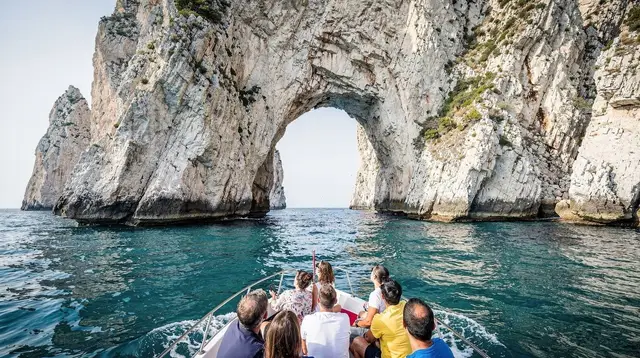
Capri by Yacht from Marina di Stabia Mochi Craft 33 8 Person Maximum

Private Cruise from Naples to Capri and Amalfi Coast - yacht 50'