Three villages, one quieter side of the coast
Most first-time visitors to the Amalfi Coast build their entire trip around Positano and Amalfi, and treat everything between them as scenery to glimpse from a bus window. That is a mistake. Praiano, Conca dei Marini and Scala sit on the exact same stretch of the SS163 and are served by the same SITA buses as their famous neighbors — none of the three has a train station, just like the rest of the Amalfi Coast itself — but they trade a fraction of the postcard fame for lower prices, thinner crowds and a more residential, lived-in atmosphere. If you have already seen Positano’s Spiaggia Grande in a brochure, this trio is where you go to feel like the coast still belongs to the people who live there.
This page groups the three together because they share the same practical profile: no train access, direct SITA bus connections along the SS163, and a slower pace than the marquee towns. But each has its own distinct reason to stop.
Praiano: sunsets and a village between two icons
Praiano sits almost exactly halfway between Positano and Amalfi, strung along a ridge above two small marinas, Marina di Praia and Cala della Gavitella. That midpoint position is its main practical advantage: staying here puts both famous towns within a short SITA bus ride, while hotel and restaurant prices stay noticeably lower than in either.
Praiano’s other claim is its light. The village faces west and slightly south, which gives it some of the best unobstructed sunset views on the entire coast, without the crowds that gather on Positano’s beach terraces for the same show. Locals and regular visitors gather on the church terrace by San Gennaro or on restaurant terraces cut into the cliff to watch the sun drop behind the headland toward Capri.
The village is also one of the access points for the Path of the Gods hike, which passes through the upper hamlets before descending toward Nocelle and Positano — worth knowing if you are planning the Amalfi Coast hiking itinerary and want a starting point away from the Positano trailhead crowds.
For a look at how Praiano compares directly with its famous neighbor, see Praiano vs Positano.
Conca dei Marini: the Emerald Grotto and a fjord next door
Conca dei Marini is smaller and quieter than Praiano, built around a natural harbor once used by Amalfi’s medieval maritime republic for shipbuilding. Today its best-known feature is the Grotta dello Smeraldo, the Emerald Grotto — a sea cave where light entering underwater gives the interior an intense green glow, reached by a short elevator or stairway from the SS163 followed by a rowboat ride inside the cave. It is a smaller, calmer alternative to Capri’s Blue Grotto, without the tide-dependent access restrictions that can shut the Capri cave without notice. Full practical details are in the Emerald Grotto guide.
Conca dei Marini also sits closest to the Fiordo di Furore, the narrow, fjord-like inlet squeezed between sheer cliffs just west of the village. It is worth being precise about what the Fiordo di Furore actually is: it is not a village or a town in its own right, but a dramatic photo stop on the SS163, where a footbridge crosses the gorge above a tiny beach and a cluster of houses wedged into the rock. Most visitors stop here for ten to twenty minutes on the way between Conca dei Marini and Praiano rather than staying overnight. See the Fiordo di Furore guide for the best viewpoints and how to reach the beach below.
Conca dei Marini’s own beach, at the harbor, is small and mostly used by locals and residents of the village’s few hotels, which makes it a useful stop if you want swimming without the crowds of Positano’s Spiaggia Grande.
Scala: the oldest village on the coast
Scala is the outlier of the three because it sits inland and uphill, perched on the mountainside opposite Ravello rather than directly on the coastal cliffs. It holds a specific distinction: historians consider Scala the oldest settlement on the Amalfi Coast, predating even Amalfi itself as a population center in the early medieval period, when the surrounding hills offered safer ground than the exposed shoreline.
Scala’s Duomo, dedicated to San Lorenzo, retains a Romanesque crypt and fragments that reflect this older history, in contrast to the more elaborately decorated cathedrals in Amalfi and Ravello. The village is also the starting or ending point for one of the coast’s more rewarding short hikes: a marked path connects Scala directly to Ravello, climbing and descending through terraced hillsides and hamlets in under an hour, well documented in the Ravello walking tour guide.
Because Scala sits above the coastal road rather than on it, it sees a fraction of the day-trip traffic that passes through Ravello, even though the views across the Dragone valley toward the sea are comparable. It rewards travelers willing to add one uphill leg to an otherwise flat itinerary.
Beaches and swimming in Praiano and Conca dei Marini
Swimming here looks different from the wide sandy stretch of Positano’s Spiaggia Grande. Praiano’s two access points, Marina di Praia and Cala della Gavitella, are small coves reached by steep stairways cut into the cliff rather than a promenade — Marina di Praia keeps a handful of fishing boats and a couple of restaurants at sea level, while Cala della Gavitella is a quieter pebble cove below a longer staircase, popular with locals in the early morning before day-trippers arrive. Neither charges the crowded-beach-club prices you find on Positano’s main beach, and neither gets anywhere near as full even in August.
Conca dei Marini’s harbor beach is smaller still, tucked beneath the village and mostly used by residents and guests of its few hotels. It is not a destination beach the way Positano’s or Minori’s are, but it is a genuine, uncrowded place to swim if you are staying nearby and want the sea without a bus ride. Divers and snorkelers sometimes use Conca dei Marini’s harbor as a calmer entry point than the more exposed coves further along the coast, since the water inside is sheltered from the swell that can make the open cliffs choppy.
Where to stay: Praiano and Conca dei Marini as a base
Because Praiano sits roughly at the midpoint of the SS163, it works well as a base for travelers who want to split time between Positano and Amalfi without paying Positano’s room rates. Most hotels here are built into the cliff facing west, which means sea-view rooms often come with the same sunset the village is known for, at a noticeably lower price point than an equivalent view in Positano. Conca dei Marini has fewer accommodation options overall, which keeps it quieter still, but also means booking ahead matters more, especially outside the shoulder-season months when the coast’s already-limited room supply gets stretched thin. For a broader comparison of where to base a trip across the whole coast, see the where to stay guide.
Scala, being inland and away from the coastal road, has the least tourist infrastructure of the three and is rarely used as an overnight base — most visitors see it as a half-day stop connected to a stay in Ravello or elsewhere on the coast, rather than a destination for accommodation in its own right.
Eating in Praiano and Conca dei Marini
Restaurant terraces in Praiano make the most of the same west-facing position that defines the village’s sunsets: a meal timed for early evening on a cliffside terrace here delivers the same view that draws crowds to Positano’s beachfront restaurants, often at a fraction of the price and without needing a reservation weeks in advance. Seafood dominates the menus in both Praiano and Conca dei Marini, drawing on the same waters as Cetara’s anchovy fishing fleet further down the coast, and lemon-based dishes and limoncello appear on nearly every menu, echoing the lemon groves that cover much of this stretch of hillside, similar to those documented in the Sorrento lemon groves guide.
Why choose this trio over the marquee towns
None of this means Praiano, Conca dei Marini and Scala are a lesser substitute for Positano, Amalfi or Ravello. They offer access to the same cliffs, the same sea, and many of the same views, with meaningfully less pressure on the SS163, on parking, and on restaurant tables — particularly outside the July-August peak, when the coast’s single road becomes genuinely congested and ZTL restrictions tighten in the busier towns.
| Village | Known for | On the coastal road? | Train access |
|---|---|---|---|
| Praiano | Sunsets, midpoint location | Yes (SS163) | None; nearest station Amalfi/Sorrento area buses |
| Conca dei Marini | Emerald Grotto, near Fiordo di Furore | Yes (SS163) | None |
| Scala | Oldest village, Ravello hike | No, inland/uphill from Ravello | None |
A realistic day using this trio as a base might combine a morning at the Emerald Grotto, a midday bus ride to Amalfi for lunch and the cathedral, and an evening back in Praiano for sunset — all without needing a rental car, and all cheaper than staying in Positano itself. For multi-day planning that incorporates these villages alongside the bigger names, see the Amalfi Coast in 5 days itinerary.
Getting around without a car
All three villages are reachable by SITA bus along the SS163, the same route connecting Positano, Amalfi and Ravello’s turnoff at Atrani. There is no train station anywhere on this stretch of coast; the nearest stations are in Salerno or Sorrento, as detailed in the Amalfi Coast without a car guide. In season, ferries also call at Praiano’s small marina and elsewhere along the coast, connecting toward Amalfi, Positano and Capri, though these services thin out considerably or stop altogether in winter and should never be counted on as a year-round option — see the ferries guide for seasonal schedules.
Driving the SS163 yourself is possible but demands caution: the road is narrow, winding, and subject to ZTL restrictions and one-way alternation in the busiest towns during peak season. Most visitors, including those based in Praiano or Conca dei Marini, find the SITA bus a less stressful way to reach Amalfi or the Sorrentine Peninsula. Details are in the driving the SS163 guide and the SITA bus guide.
Seeing the coast from the water
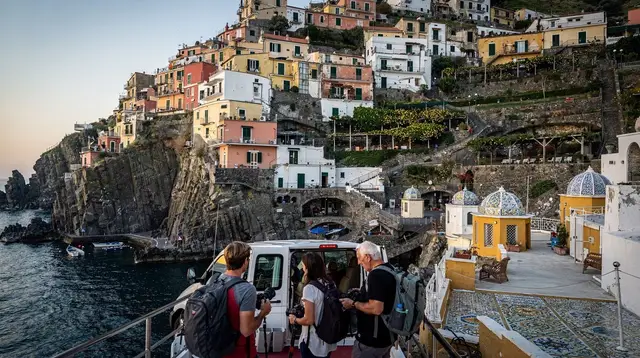
Because none of these villages has its own tourist harbor comparable to Amalfi’s or Positano’s, a boat tour is often the easiest way to see this stretch of coastline, including the Fiordo di Furore and the cliffs around Conca dei Marini, from the best angle. An Amalfi Coast boat tour departing from Praiano covers this exact section of coast, passing the Emerald Grotto’s cliff face and the fjord entrance from the water. Travelers wanting to cover more ground can join a full boat tour along the Amalfi Coast that extends toward Positano and Amalfi in a single outing.
For a special-occasion option, an exclusive yacht cruise combining the Amalfi Coast and Capri passes this same coastline before crossing to the island, useful for travelers basing themselves in Praiano who also want to see Capri without switching hotels. After a day on the water, a sea-view lunch or dinner in Praiano is a fitting way to close the day in the village itself rather than in a busier neighboring town.
Praiano, Conca dei Marini and Scala: frequently asked questions
Is Praiano cheaper than Positano?
Yes. Hotels, restaurants and beach access in Praiano are generally noticeably cheaper than in Positano, while still offering direct SITA bus access to Positano in about 10-15 minutes.
Does Praiano have a train station?
No. Like the rest of the Amalfi Coast, Praiano has no train station. The nearest rail connections are in Salerno or Sorrento, reached from Praiano by SITA bus.
What is the Fiordo di Furore, and is it a town?
The Fiordo di Furore is a narrow, fjord-like inlet on the SS163 near Conca dei Marini, not a village in its own right. It is a photo stop with a footbridge, a small beach, and a cluster of houses built into the cliff, usually visited briefly on the way between other villages.
Can you visit the Emerald Grotto and the Fiordo di Furore in the same day?
Yes. Conca dei Marini, home to the Emerald Grotto, is only a few minutes by SITA bus or car from the Fiordo di Furore, making them an easy pair to combine in a single half-day.
Why is Scala considered the oldest village on the Amalfi Coast?
Historians point to Scala’s inland, elevated position as evidence it was settled before Amalfi itself, since the surrounding hills offered safer refuge than the exposed shoreline during the early medieval period.
How do you get from Scala to Ravello?
A marked hiking path connects Scala directly to Ravello, crossing terraced hillsides and small hamlets in under an hour. Scala can also be reached by local bus from the Ravello area.
Is it worth staying in Praiano or Conca dei Marini instead of Positano or Amalfi?
For travelers prioritizing lower costs and fewer crowds over being in the most famous town, yes. Both villages sit on the same SS163 and SITA bus line as Positano and Amalfi, keeping those towns within easy reach.
When is the best time to visit this part of the coast?
May, June, September and October offer the best balance: the SS163 is less congested than in July-August, ferry services are usually still running, and accommodation prices are lower than at the summer peak.