Fiordo di Furore: Is It Really a Fjord?
Is the Fiordo di Furore an actual fjord?
No. It is a narrow, fjord-shaped rock cleft carved into the cliffs between Amalfi and Positano, with a small pebble beach at the bottom. It is not a glacially formed fjord in the Scandinavian sense, and reaching the water requires descending a steep staircase from the coast road.
A Fjord in Name Only
Every photo of the Fiordo di Furore looks the same: a slim gash of blue water squeezed between two towering rock walls, spanned by a single high bridge, with a scatter of pastel houses clinging to the cliff above. The name does a lot of marketing work, and it is worth being precise about what it actually describes before you plan a stop. A true fjord, in the geological sense used in Norway, Chile, or New Zealand, is a long, deep valley carved by a glacier and later flooded by rising seas after the ice retreated — often stretching for many kilometers inland, with depths measured in hundreds of meters.
The Fiordo di Furore has none of that history. It is a short, narrow inlet cut into limestone by a seasonal mountain torrent, the same kind of process that has carved dozens of ravines and gorges along this stretch of the Amalfi Coast. Locals adopted the word “fiordo” because the shape, seen from above, genuinely resembles a miniature fjord: steep parallel walls, a slender channel of water, a sense of scale compressed into a tiny footprint.
That distinction matters for expectations, not just semantics. Visitors arriving with images of Norwegian fjords in mind — vast, silent, requiring a boat cruise of hours — sometimes struggle to reconcile that picture with what is, in reality, a compact inlet you can walk down to, look at, and swim in within twenty or thirty minutes total. The Fiordo di Furore rewards a different kind of attention: it is a striking, photogenic detail on a coastline built from cliffs and terraces, not a vast natural feature to be explored at length. Treat it as a focused stop on a longer day along the SS163 coast road, not a half-day destination in its own right.
Where It Actually Sits: Furore, Not a Town of Its Own
The fjord takes its name from the comune of Furore, a municipality whose population is spread across a dozen small hamlets scattered up and down the cliffside rather than concentrated in one center. This is an important correction for anyone expecting a village square, a row of shops, or a cluster of restaurants clustered around the fjord itself. Furore is often described, half-jokingly, as “the village that doesn’t exist,” precisely because it lacks the single compact nucleus that towns like Amalfi or Positano have. What you find near the fjord is a small number of buildings directly above the inlet, a handful of murals painted on walls along the road (part of an open-air art project), and very limited commercial infrastructure — a couple of small businesses, not a developed tourist strip.
Geographically, Furore sits on the SS163 between Praiano and Conca dei Marini, roughly in the stretch of coast where the road climbs and dips most dramatically. If you are coming from Amalfi, the fjord appears before you reach Praiano; coming from Positano, it appears after Praiano, shortly before Conca dei Marini and its own well-known site, the Emerald Grotto. Because Furore itself has so little visible town center, many travelers pass through without realizing they have entered a distinct municipality at all — the fjord is usually the only stop that registers.
Getting Down: A Real Descent, Not a Roadside Glance
The single most common misunderstanding about the Fiordo di Furore is treating it as a scenic overlook you can appreciate from a car window or a brief roadside pause. It is not. The inlet lies well below the level of the SS163, and reaching the water means descending a steep, uneven staircase of roughly sixty to seventy steps cut into the rock, with no elevator, no escalator, and no gentle ramp alternative. The climb back up is the same staircase in reverse, and after a day of walking elsewhere on the coast, or in the heat of a July afternoon, that ascent is where most visitors feel the effort most acutely.
This has practical consequences worth planning around:
- Footwear matters. The steps are uneven stone, sometimes damp near the waterline, and flip-flops or sandals with no grip make both the descent and the ascent noticeably harder.
- It is not stroller- or wheelchair-accessible. There is no accessible route to the beach level; anyone with mobility constraints should plan to view the fjord from the bridge or roadside vantage points instead.
- Budget real time, not a five-minute detour. Between finding somewhere to stop, walking to the staircase, descending, spending time at the water, and climbing back, thirty to forty-five minutes is a realistic minimum, more if the stairs are busy.
- There is no shade for most of the descent. In summer, the stone steps absorb heat, and carrying water is a sensible precaution.
None of this makes the fjord not worth visiting — for most travelers who come prepared for a genuine set of stairs rather than a photo pull-off, it remains one of the most memorable short stops on the coast. It simply is not the passive glance-and-go stop that some itineraries imply.
A Small Beach With Real Capacity Limits
At the bottom of the staircase, the fjord opens onto a narrow pebble beach, hemmed in on both sides by sheer rock walls and overshadowed by the tall stone bridge that carries the SS163 traffic overhead. This beach is genuinely small. There is no wide stretch of sand, no long promenade, and no significant flat terrace for large numbers of sunbathers. In practical terms, this means the site has a low natural capacity: on a busy August afternoon, the available space at water level can feel crowded within minutes of a tour bus or a few cars unloading nearby, and there is little room to spread out or wait comfortably for space to open up.
Understanding this scarcity helps set realistic expectations for timing a visit. Early morning and late afternoon tend to be calmer than the midday hours when day-trippers moving along the coast road are most likely to stop. The water itself is often calm and strikingly clear, sheltered as it is by the surrounding cliffs, and it is a genuinely appealing place to swim for anyone who manages a spot on the pebbles — but arriving with the expectation of a spacious beach day, complete with loungers and wide berth from other visitors, will likely disappoint. This is a stop built around a striking, contained scene, not around comfortable, extended lounging.
Walking the Fjord vs. Canyoning: Two Different Activities
Because the word “fjord” and the dramatic cliff walls suggest adventure sports, it is worth being clear about a distinction that trips up some visitors: walking down to see and swim at the Fiordo di Furore is not the same activity as canyoning or rock climbing in the area, even though both can technically happen in the same general stretch of coastline.
The pedestrian visit — descending the public staircase, reaching the beach, swimming if conditions allow, and returning the same way — requires no special equipment, no booking, and no guide. It is accessible to anyone reasonably fit and appropriately shod, following an established public route.
Canyoning, by contrast, involves technical descent of narrow watercourses and rock faces using ropes, harnesses, wetsuits, and helmets, under the direction of a qualified guide — this is a specialized, equipment-heavy activity found in various ravines around the Amalfi Coast and the wider Lattari Mountains, and it is not something available to casual visitors showing up at the fjord without a prior booking and proper gear. The dramatic verticality of the Fiordo di Furore’s walls can suggest that climbing or canyoning infrastructure is simply available on site; in practice, the public staircase and small beach represent a walking-and-viewing experience, while any rope-based descent of the surrounding cliffs is a separate, professionally guided undertaking that needs to be arranged independently and is not part of a standard visit to the inlet.
Reaching the Fiordo di Furore Without a Car
Given how limited roadside parking is near the fjord, and how narrow and congested the SS163 becomes through this stretch in high season, many visitors choose not to drive at all. SITA buses running between Amalfi and Positano pass along this section of road; getting off near the fjord still involves a short walk along the shoulder of the SS163 to reach the staircase, so care around traffic is warranted, particularly with children.
For travelers already exploring the coast by boat, several excursions pass along the base of the cliffs beneath Furore, offering a view of the inlet’s dramatic rock walls from the water even without stopping to descend the stairs. A boat tour tracing the cliffs between Amalfi and Positano typically passes this stretch of coastline, giving a very different, seaward perspective on the same fjord that most visitors only see from above. Travelers based in Praiano specifically can also consider a private cruise departing from Praiano with drinks included, which often threads past this same coastline at a relaxed pace.
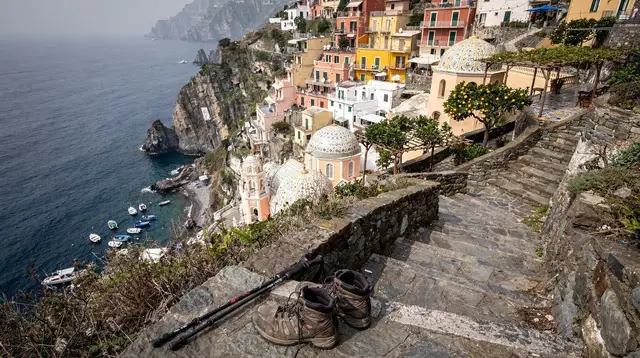
For those who prefer to combine the fjord with a longer, structured walking day rather than a quick stair descent, it sits reasonably close to the lower trailheads associated with the Path of the Gods hike, and a guided trek along the Path of the Gods can be paired with a fjord stop on the drive or bus ride back down to the coast road, for travelers who want both a serious hike and this shorter, dramatic detour in the same trip.
Fitting the Fjord Into a Coastal Day
Because a visit itself takes under an hour for most people, the Fiordo di Furore works best folded into a longer day along the coast rather than treated as a solo destination requiring its own dedicated outing. Travelers driving themselves — despite the challenges of the SS163 — often combine it with a stop in Praiano, a visit to the Emerald Grotto in Conca dei Marini a few minutes further along, and a fuller stop in Amalfi itself. Those relying on buses and boats generally weave the fjord into an itinerary that also includes Positano and Amalfi town, using the fjord as a brief, memorable pause between the two.
Anyone planning several days along this coast without a rental car may find it useful to review a broader guide to getting around the Amalfi Coast without a car, since the same SITA bus network that serves the fjord also connects the larger towns most visitors use as a base. And for travelers weighing whether a hidden inlet like this is worth prioritizing at all amid a shortlist of better-known sights, it helps to see it in context alongside the coast’s other natural landmarks, from the Valle delle Ferriere hike above Amalfi to the sea caves near Capri.
Practical Summary
| Detail | What to expect |
|---|---|
| Type of site | Narrow rock cleft resembling a fjord shape, not a glacial fjord |
| Location | Municipality of Furore, between Praiano and Conca dei Marini |
| Access | Steep staircase (roughly 60-70 steps) down from the SS163 |
| Accessibility | Not suitable for strollers or wheelchairs |
| Beach size | Small pebble beach, limited capacity in high season |
| Typical visit length | 30-45 minutes including the descent and climb |
| Parking | Very limited roadside parking; buses recommended in summer |
| Best viewed from | The bridge above, the beach below, or passing boats |
Frequently Asked Questions About the Fiordo di Furore
Is the Fiordo di Furore a real fjord like in Norway?
No. Scandinavian fjords are long glacial valleys carved by ice sheets and flooded by the sea. The Fiordo di Furore is a short, steep-sided rock cleft shaped like a miniature fjord, formed by a seasonal torrent cutting into the limestone cliffs, not by glaciation.
How do you get down to the Fiordo di Furore?
From the SS163 coast road, a steep staircase of roughly 60 to 70 steps descends to the small beach and the arched bridge above the inlet. There is no elevator, escalator, or gentle path; the descent and the climb back up both take real effort.
Is Furore a town you can visit with shops and restaurants?
Furore is a small comune (municipality) scattered across several hamlets on the cliffside between Praiano and Conca dei Marini, not a single compact village with a developed commercial center. Visitors mostly pass through for the fjord itself and a handful of scattered viewpoints, not for a town square lined with shops.
Can you swim at the Fiordo di Furore?
Yes, when conditions allow, but the pebble beach is very small and space at water level is limited, especially in July and August. There are no large sunbathing terraces, and access can be restricted or feel crowded within minutes of arrival at peak times.
Is visiting the Fiordo di Furore a canyoning activity?
Not by default. Walking down to view and swim at the fjord is a pedestrian visit using the public staircase, while canyoning or climbing the cliff faces around Furore is a separate, equipment-heavy activity that requires a qualified guide, ropes, and harnesses not available to casual visitors on site.
Where does the Fiordo di Furore fit between Amalfi and Positano?
It sits roughly midway along the SS163, within the municipality of Furore, between the villages of Praiano and Conca dei Marini. SITA buses running the Amalfi-Positano route pass close to the site, though the nearest formal bus stop still leaves a short road walk to the staircase.
Is there parking at the Fiordo di Furore?
Roadside parking near the fjord is extremely limited and largely informal, filling up quickly in high season. Many visitors reach the site by SITA bus rather than by rental car, given how narrow and congested the SS163 becomes around the inlet in summer.
Canyoning & Climbing on the Amalfi Coast on GetYourGuide
Verified deep-linked GetYourGuide tours. Book through these links and we earn a small commission at no cost to you.
GetYourGuide does not provide a product photo for this activity — the image shows the meeting point, photographed by us.