Praiano: The Amalfi Coast's Quieter Village Between Positano and Amalfi
Is Praiano a quieter alternative to Positano?
Praiano is smaller and has fewer shops and crowds than Positano or Amalfi, but it shares the same narrow SS163 road, the same high-season traffic restrictions, and the same lack of a train station. It is a calmer base, not a different coast.
A Village on the Same Road, at a Different Volume
Ask anyone who has driven the SS163 in August whether Praiano is a “quieter Positano,” and the comparison sounds tidy. It is also only half true. Praiano is genuinely calmer than Positano or Amalfi: fewer boutiques, fewer tour groups moving through its lanes, fewer restaurants requiring a reservation weeks in advance. But it is not a different coast, and it is not exempt from the coast’s basic realities. Praiano depends on the same narrow, cliffside SS163 for every arrival and departure, it has no railway of its own, and its high-season traffic slows to the same crawl that affects Positano and Amalfi. Understanding Praiano means holding both facts at once: it is quieter, and it is still fully part of the same logistics as everywhere else on this stretch of coast.
That combination is exactly why Praiano works well as a base for travelers who want proximity to the coast’s two most photographed towns without absorbing all of their crowds. It sits on the Amalfi Coast between Positano and Amalfi, close enough to reach either in twenty to forty minutes by bus when traffic cooperates, and close to the Fiordo di Furore as well.
Where Praiano Sits: Between Positano and Amalfi
Praiano occupies a stretch of coastline east of Positano and west of Amalfi, past Vettica Maggiore, and just before the road curves down toward the fjord at Furore. This position is Praiano’s single biggest practical advantage. A traveler based here can reach the Path of the Gods trailhead area without a long transfer, look across the water toward the Positano skyline from a quieter vantage point, and still be within a short SITA bus ride of Amalfi’s cathedral square.
This middle position also means Praiano absorbs some through-traffic rather than generating it. Buses running the full Sorrento–Amalfi–Salerno line pass through Praiano regularly, and the village functions as a stop along that route rather than an endpoint most visitors specifically target. That is part of why it stays quieter: fewer people are traveling to Praiano as a single-destination trip, and more people are passing through it on their way to Amalfi or back toward Positano.
The Same Road, the Same Constraints
It is tempting to imagine that a smaller, less famous village escapes the SS163’s problems. It does not. Every vehicle reaching Praiano, whether a rental car, a SITA bus, or a private driver, travels the same single carriageway that squeezes through Positano and Amalfi. For a full explanation of why this road behaves the way it does, see our guide on driving the SS163, but the short version matters here: it is a two-lane cliffside road with blind curves, seasonal one-way alternation in the busiest towns, and no realistic alternative route.
Praiano itself does not run the same kind of ZTL (limited traffic zone) restrictions that shut private cars out of central Positano or Amalfi in peak season, but that does not insulate it from delays. A traffic jam in Positano during July ripples backward along the SS163 and can add thirty minutes or more to a bus ride that starts or ends in Praiano. Anyone comparing Praiano favorably to Positano because “there’s less traffic” is only partly right: there is less traffic generated by Praiano, not less traffic experienced by Praiano.
The absence of a railway is another shared trait, not a Praiano-specific gap. No village on the Amalfi Coast proper (as opposed to Sorrento, which connects to Naples via the Circumvesuviana) has a train station. Reaching Praiano means arriving by SITA bus, by seasonal ferry, or by private driver, exactly the same options available to someone headed for Amalfi or Ravello.
| Getting to Praiano | Typical journey | Notes |
|---|---|---|
| SITA bus from Amalfi | ~20-30 min | Frequent in season, subject to SS163 delays |
| SITA bus from Positano | ~15-25 min | Same route, same traffic exposure |
| Ferry (seasonal) | ~15-20 min from either | Suspended or reduced outside roughly April-October |
| Private driver from Naples Airport | ~1.5-2 hours | See our Naples airport transfer guide |
| Train | Not available | No station on the Amalfi Coast itself; nearest is Salerno or Sorrento |
Built on the Slope, Not Along a Shoreline
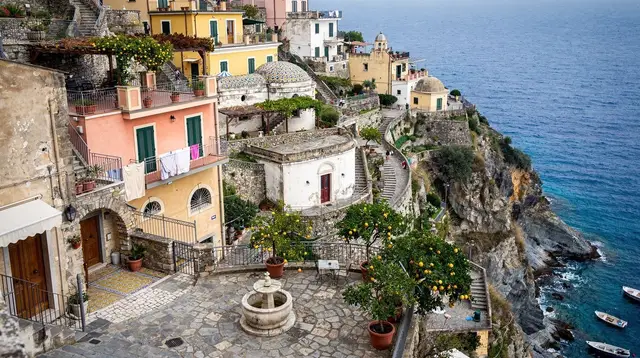
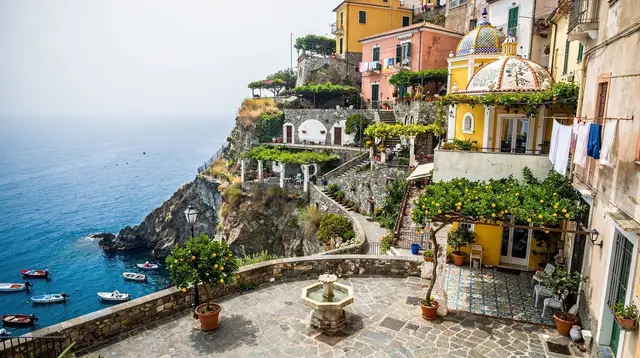
Praiano’s second defining feature is its shape. Like most of the coast, the village is not laid out along a flat seafront but stacked up a steep hillside, with houses, churches, and terraces climbing from the water toward the SS163 and beyond. This is not an exception to how the Amalfi Coast works; it is the pattern. Amalfi, Positano, and Ravello are all built on slopes for the same reason: a coastline of near-vertical limestone cliffs left almost no flat ground to build on.
What this means practically for Praiano is that reaching the water involves stairs, not a stroll. The village’s two access points to the sea, Marina di Praia (a narrow inlet with a small pebble beach, several restaurants, and a diving center) and a smaller landing near the church of San Gennaro, are both reached by stepped paths that descend from the main road level. There is no promenade to walk along at sea level connecting one part of the village to another; movement in Praiano happens on a vertical axis as much as a horizontal one.
This staircase-based geography is worth planning around, particularly for travelers with mobility limitations or heavy luggage. It is also, more positively, part of what gives Marina di Praia its appeal: the descent filters out casual foot traffic, and the small cove at the bottom feels more contained and less crowded than the open beach areas of Positano.
What Praiano Is Not
Praiano is not a village without tourism, and it is worth being direct about that, because the “quiet alternative” framing sometimes tips into inaccuracy. Praiano’s restaurants fill up on summer evenings, its two marinas see steady boat traffic between May and September, and its handful of hotels and guesthouses run close to capacity in July and August. The difference from Positano is one of scale and density, not of kind. Praiano follows the same seasonal curve as the rest of the coast, just with fewer total visitors spread across a smaller footprint of shops and lodging.
It is also not a village built primarily around one visible product the way Vietri sul Mare is known for ceramics or Amalfi for handmade paper. Praiano’s identity is more tied to the sea itself: fishing, diving, and boating out of Marina di Praia, along with a reputation among some travelers as one of the better points on the coast to watch the sunset, since it faces west across the water toward Positano and Capri in the distance.
A Practical Base for Exploring Both Directions
The clearest argument for staying in Praiano rather than Positano or Amalfi is logistical rather than aesthetic. Accommodation prices in Praiano typically run lower than in either of its more famous neighbors, particularly in shoulder season, while travel time to both remains short enough for day trips. A traveler based in Praiano can spend a morning in Amalfi visiting the cathedral, an afternoon in Positano for photos and a beach club, and return to a quieter village in the evening, all without the premium pricing that comes with sleeping inside either town’s center.
This also makes Praiano a sensible stop for anyone building a coastal itinerary around hiking. The Path of the Gods trail runs along the ridge above the coast between Bomerano/Agerola and Nocelle, and Praiano’s position makes the Nocelle end of that trail, which descends into Positano, more convenient to reach than it would be from towns further east. Combined with the short hop to the Fiordo di Furore, Praiano works well as a base for an active few days that mixes hiking, swimming, and short bus trips rather than one built entirely around a single town.
Food and Local Life
Praiano’s dining scene leans toward seafood pulled straight from the water below Marina di Praia, along with the same lemon-driven flavors found across the coast. A hands-on way to get past the restaurant menu is a cooking class: several are run from terraces overlooking the sea, where you can learn to make pasta and traditional Amalfi Coast dishes from a home cook in Praiano, or, for a version built around the view itself, join a cooking class on a terrace overlooking the water.
For travelers who want to experience the coast from the water rather than the road, Praiano’s marinas are a genuinely practical departure point, often less congested than the boat traffic around Positano’s main beach. It is possible to take a boat tour along the coast departing directly from Praiano, which sidesteps the parking and crowd pressure of launching from a bigger town. Those wanting something more private can book a private guided cruise from Praiano that includes drinks on board, a good option for couples or small groups who want the scenery without a shared boat.
Praiano vs. Positano vs. Amalfi: A Direct Comparison
| Praiano | Positano | Amalfi | |
|---|---|---|---|
| Crowd level in August | Moderate | Very high | High |
| Shops and boutiques | Limited | Extensive | Extensive |
| Sea access | Staircases to two small marinas | Steps to Spiaggia Grande and Fornillo | Small town beach and marina |
| Train station | None | None | None |
| Typical accommodation cost | Lower | Highest on the coast | High |
| Known for | Fishing, diving, sunsets | Beach clubs, photography, nightlife | Cathedral, paper-making history |
Read more on how the two better-known towns compare directly in Positano vs. Amalfi, and on how Praiano itself stacks up against its more famous neighbor in Praiano vs. Positano.
Planning Your Time in Praiano
Most visitors treat Praiano as either a short stop between Positano and Amalfi or a multi-night base for a calmer stay. Either approach works, but it helps to plan around the coast’s seasonal rhythm: buses and ferries run frequently from around Easter through October, then thin out sharply in winter, when some restaurants and boat operators close entirely. For a broader sense of how to structure days across the coast, our guides on how many days you need on the Amalfi Coast and getting around without a car cover the logistics that apply just as much to Praiano as to its neighbors.
If your visit includes a wedding, anniversary, or another occasion worth marking on the water, it is also possible to combine a Praiano departure with a themed outing further along the coast, such as a private tour by vintage Fiat 500 to Praiano and Atrani, which pairs Praiano’s calmer streets with the small, historic village of Atrani nearby.
Frequently Asked Questions About Praiano
Is Praiano quieter than Positano?
Yes, noticeably. Praiano has far fewer shops, hotels, and day-trip crowds than Positano, and its two small marinas rarely feel overwhelmed even in August. It still gets busy in summer, just at a smaller scale.
Does Praiano have a train station?
No. Like every other village on the Amalfi Coast itself, Praiano has no railway. The nearest stations are in Salerno or Sorrento, and you reach Praiano from either by SITA bus, ferry in season, or private transfer.
How do you get from Praiano to the beach?
Praiano is built on the slope above the sea, so both of its access points, Marina di Praia and the smaller landing near the church of San Gennaro, are reached by stepped paths and staircases rather than a flat seafront promenade.
Is Praiano a good base for visiting Positano and Amalfi?
Yes. Praiano sits roughly midway on the SS163 between Positano and Amalfi, close to the Fiordo di Furore, which makes it a practical anchor point for day trips to both towns without paying the peak accommodation prices found in either.
Is there anything to do in Praiano itself?
Praiano follows the coast’s seasonal rhythm on a smaller scale: swimming and boat trips from Marina di Praia in summer, quiet walking in the church squares, and access to hiking routes like the Path of the Gods, which starts nearby.
Is Praiano affected by the same traffic problems as Positano?
Yes. Praiano depends on the same single-lane SS163 coastal road, which means it experiences the same high-season congestion, ZTL restrictions in neighboring towns, and slow travel times by car or bus.
What is Praiano known for?
Praiano is known as a low-key fishing and diving village with two small marinas, sunset views toward Positano, and its proximity to both the Fiordo di Furore and the trailhead area for the Path of the Gods hike.
Village Tours on the Amalfi Coast on GetYourGuide
Verified deep-linked GetYourGuide tours. Book through these links and we earn a small commission at no cost to you.
GetYourGuide does not provide a product photo for this activity — the image shows the meeting point, photographed by us.