Amalfi Town Walking Tour: A Complete Self-Guided Route
How long does it take to walk around Amalfi town?
The historic center can be covered in 2 to 3 hours at a relaxed pace, including the Duomo and a stop at the Museo della Carta. Add another hour or two if you climb further into the stepped lanes above the piazza, since much of the route is uphill on stairs rather than flat waterfront walking.
What a walk through Amalfi actually involves
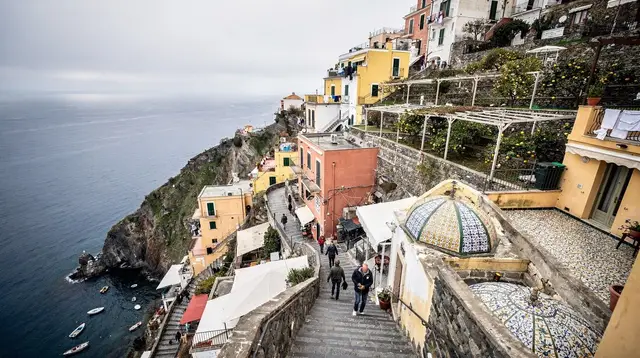
Amalfi looks small on a map, and in area it is: the historic center can be crossed end to end in about fifteen minutes if you don’t stop. But “small” is not the same as “flat” or “quick to see properly.” Amalfi is built into a cleft in the cliffs of the Amalfi Coast, and its layout reflects that geography directly. The seafront and the main square sit at sea level, but almost everything else — the residential lanes, the covered stairways, the paper museum, and the path toward the inland valley — climbs. A walking tour of Amalfi is, structurally, a walking tour of stairs.
That distinction matters because Amalfi is often described in travel content as a pleasant seafront stroll, and that description undersells what the town is. The real walking route mixes a short flat stretch along the harbor with a much longer stepped ascent through the old town. Comfortable shoes are not optional here; sandals and stairs in Amalfi’s midday heat are a common regret reported by visitors who treated it as a beach-town saunter.
This guide lays out a realistic route, timing, and the practical arrival details — because unlike Positano or Sorrento, Amalfi has some specific quirks around transport and parking that shape how a walking visit should be planned.
Getting to Amalfi before you even start walking
Amalfi has no railway station of any kind. This surprises visitors who assume every town on the coast connects by train the way Sorrento does via the Circumvesuviana. In reality, the entire stretch of coastline that includes Amalfi, Positano, and Ravello is served only by the SS163 coastal road, SITA buses, and seasonal ferries — never by rail. The nearest stations are in Salerno and Sorrento, and from either one the final leg to Amalfi is by bus or boat.
For a walking-tour day, this changes the arrival logic:
- By SITA bus: the most common approach, running along the SS163 from Sorrento or Salerno. Buses stop directly on Amalfi’s seafront, right at the start of the walking route described below. See the SITA bus guide for schedules and ticketing.
- By ferry: fast and scenic in season, but ferries between Amalfi, Positano, Capri, and Naples run on a reduced or suspended schedule outside roughly Easter to October. Don’t plan a winter day trip around a boat that may not be running — check the ferry guide before relying on one.
- By car: possible but constrained. The SS163 is a narrow corniche road, and Amalfi’s town center is governed by a ZTL (zona a traffico limitato) in high season, meaning unauthorized vehicles are restricted from the core streets. Parking directly in the center is scarce and expensive during summer; most drivers use paid lots at the edge of town and walk in. Full detail is in the driving the SS163 guide and the Amalfi Coast without a car guide.
If you’re building a longer trip and deciding how to structure your days on the coast, the Amalfi Coast in 3 days itinerary shows where a half-day in Amalfi fits alongside neighboring towns.
The route: from the seafront to Piazza del Duomo
Most walking routes through Amalfi begin at the same point: the seafront promenade where the SITA bus stops and the ferry dock sits, a short walk from each other. From there, the town’s single unmistakable landmark pulls you inward.
Piazza del Duomo is Amalfi’s civic and visual center, reached by a wide flight of stone steps rising from the square in front of it. The Cathedral of Sant’Andrea, with its striped stone facade and adjoining Cloister of Paradise, dominates the space. This is the busiest single point in town, especially midmorning in high season, and it’s worth timing your visit for earlier or later in the day if crowds bother you. A full breakdown of the cathedral, its bronze doors, and the crypt below is in the Amalfi Cathedral guide.
From the piazza, the walking route has two natural directions:
- Toward the harbor and Marina Grande, a level stretch good for the views back at the cliffside town and a look at the boats — useful if you’re also considering a boat tour from Amalfi later in the day.
- Inland and uphill, following Via Genova and the narrow lanes that climb behind the Duomo. This is where the walk stops being flat.
Climbing into the old town: Via Genova and the Museo della Carta
This inland stretch is the part of an Amalfi walking tour that a simple “seafront stroll” description leaves out entirely. Via Genova narrows quickly into a covered lane lined with shops selling ceramics, limoncello, and local food products, then continues climbing past small piazzas and residential stairways that most day-trippers never see.
About ten to fifteen minutes up this route sits the Museo della Carta, Amalfi’s paper museum, housed in a working medieval mill. This stop deserves to be built into the route rather than treated as optional: Amalfi has a documented paper-making tradition going back centuries, producing a distinctive handmade cotton-rag paper known as carta bambagina. This is specifically an Amalfi tradition — not something shared with Positano, Ravello, or the other coastal villages, each of which has its own separate craft (Vietri sul Mare is the ceramics town, for instance, not Amalfi). The museum shows the original hydraulic hammers and mill machinery still in place, and short demonstrations of hand papermaking run through the day. Details on hours and what to expect are in the Museo della Carta guide.
Past the museum, the lane continues toward the Valle delle Ferriere, a shaded gorge trail that keeps climbing well beyond what a short town walk covers — that’s a separate, longer hike rather than part of a basic Amalfi walking tour, but it’s worth knowing the same lane connects to it if you have an extra hour. See the Valle delle Ferriere hike guide if you want to extend the day that way.
Realistic timing for the walk
| Segment | Approximate time | Terrain |
|---|---|---|
| Seafront to Piazza del Duomo | 10–15 minutes | Flat, then stairs into the piazza |
| Piazza del Duomo and cathedral visit | 30–45 minutes | Stairs, level piazza |
| Via Genova to Museo della Carta | 15–20 minutes | Uphill, narrow lanes |
| Museo della Carta visit | 30–45 minutes | Indoor, mostly level |
| Return to seafront | 15 minutes | Downhill |
| Core loop total | 2–2.5 hours | Mixed, majority stairs/incline |
Add 45 minutes to an hour if you also walk out toward Marina Grande or continue partway up toward Valle delle Ferriere. None of this is strenuous by hiking standards, but it is not the flat promenade walk that “Amalfi town” sometimes implies — pace yourself, especially in July and August heat, and carry water.
What Amalfi’s walk is not
It’s worth being direct about a couple of common misconceptions. Amalfi is not a beach-resort town where the main activity is a level seafront promenade — the walkable core is largely vertical, and a visit that only follows the harbor misses the cathedral steps and the paper-mill lane that actually define the town’s character. It is also not connected by rail to the rest of the region: unlike Sorrento’s link to Naples via the Circumvesuviana, Amalfi (like Positano and Ravello) is reachable only by road or sea, a detail that changes how you should plan your arrival time and your backup options if a ferry is cancelled.
Extending the day beyond Amalfi’s center
Because Amalfi has no train line, most extensions from here are either by SITA bus along the coast or by boat. A few natural pairings:
- Atrani, the tiny village immediately next to Amalfi, reachable on foot in about ten minutes along the coastal path — often skipped by day-trippers who don’t realize it’s this close. See the Atrani village guide.
- Minori and Maiori, a short bus ride east, known for their beaches rather than a stepped historic core — see the Minori and Maiori beaches guide.
- Ravello, reachable by bus from Amalfi’s seafront in about 25 minutes, offering hilltop gardens rather than a paper-mill lane — compare the two towns in the Ravello vs Positano guide or read the dedicated Ravello walking tour guide.
- A limoncello tasting, since Amalfi sits in the heart of the Sfusato Amalfitano lemon-growing area — see the limoncello tasting in Amalfi guide.
If you’d rather not navigate the lanes and timing yourself, a guided option covers the same ground with local commentary on the cathedral, the cloister, and the town’s paper-making history: the Amalfi guided private walking tour follows essentially this same route with a local guide filling in the history at each stop.
For those who want to pair Amalfi with its closest neighbor in one outing, the private walking tour combining Amalfi and Atrani covers both towns in a single two-hour session, useful if your time on the coast is limited to a single afternoon.
Travelers interested in a broader thematic angle can also look at the private walking tour focused on Amalfi’s LGBTQ history and the cathedral cloister, which spends more time on the Cloister of Paradise and its history than a standard route.
For an evening version of the same streets, once the day-trip crowds have thinned, the Amalfi Dolce Vita tour walks the same core lanes with a focus on local food and atmosphere rather than monuments.
Practical notes before you go
- Footwear: flat, closed shoes with grip. The stairs near the Duomo and on Via Genova are worn smooth in places.
- Timing: arrive before 10:00 or after 16:00 to avoid the densest crowds around the cathedral steps, especially June through August.
- ZTL and parking: if driving, don’t expect to park inside the historic center in high season; use the paid lots at the edge of town and walk in, or take the SITA bus instead.
- Ferry dependency: if your plan includes leaving Amalfi by boat, keep the SITA bus as a backup — ferry schedules shrink sharply outside the Easter-to-October window and can be affected by rough seas even in season.
- Combine, don’t rush: because Amalfi’s core is compact, it’s easy to treat it as a one-hour photo stop. Building in the Museo della Carta and a short stretch toward Atrani gives a more complete picture of the town for only a modest extra time cost.
Frequently asked questions about walking Amalfi town
How long do you need to walk around Amalfi?
Plan on 2 to 3 hours for the compact core around Piazza del Duomo and the seafront, and closer to half a day if you also climb into the upper lanes toward Valle delle Ferriere or linger at the Museo della Carta.
Is Amalfi town walkable, or do you need a car?
Amalfi’s center is entirely walkable and largely pedestrian, but getting there is best done without a car: there is no train station, parking is scarce and ZTL-restricted in high season, and most visitors arrive by SITA bus or seasonal ferry.
Is the walk in Amalfi flat or uphill?
It is not flat. The seafront and main piazza sit at sea level, but the historic lanes climb quickly on stone stairs toward the hillside, and reaching the Museo della Carta or the upper valley involves a genuine, if short, uphill effort.
What is the Museo della Carta and is it worth visiting?
It is Amalfi’s paper museum, set in a working medieval paper mill that explains carta bambagina, the handmade cotton-rag paper unique to Amalfi’s tradition. It is worth the stop for anyone walking the town, since it ties directly to Amalfi’s history in a way the piazza alone does not.
Where does the Amalfi walking route start?
Most self-guided routes start at the bus stop or ferry dock on the seafront, move to Piazza del Duomo and the cathedral steps, then continue up Via Genova toward the Museo della Carta and the stepped lanes beyond.
Can you park in Amalfi town center?
Parking directly in the historic center is limited and subject to ZTL (limited traffic zone) rules, especially from Easter through October. Most visitors park outside the center or skip driving altogether in favor of the SITA bus or a seasonal ferry.
Does Amalfi have a train station?
No. Amalfi has no railway station at all. The nearest stations are in Salerno and Sorrento, and the town is reached by SITA bus along the SS163, by seasonal ferry, or by car.
Town Walking Tours on the Amalfi Coast on GetYourGuide
Verified deep-linked GetYourGuide tours. Book through these links and we earn a small commission at no cost to you.
GetYourGuide does not provide a product photo for this activity — the image shows the meeting point, photographed by us.