Atrani: The Amalfi Coast Village That Isn't Amalfi
Is Atrani part of Amalfi, or a separate village?
Atrani is a fully separate comune from Amalfi, with its own town hall, parish, and history. The two are divided by a small promontory and connected by a pedestrian tunnel and a short flight of stairs, a walk of only a few minutes, which is why day-trippers often confuse the two.
Two towns, one headland
Most visitors who walk from Amalfi toward Atrani assume they are still in Amalfi. The confusion is understandable: the two towns sit close enough that a short pedestrian tunnel through a rocky promontory, or a brief flight of stairs over it, is all that separates them. But Atrani is not a neighborhood, a suburb, or an overflow district of Amalfi. It is its own comune, with its own town hall, its own parish, and a history that runs parallel to, but distinct from, its more famous neighbor. If you check Amalfi off your list without crossing into Atrani, you have not actually seen the full picture of this part of the coast — you have seen half of it and assumed the rest looked the same.
This matters for more than local pride. Amalfi’s center is built around tourist flow: a cathedral piazza, shopfronts selling ceramics and limoncello, restaurant terraces angled toward the view. Atrani’s center is built around nothing of the sort. Its square, Piazza Umberto I, wraps around a small cove and functions the way a village square is supposed to function — as a place where residents actually gather, not a set piece for photographs. The contrast is the entire reason to make the crossing.
Where Atrani actually sits
Atrani belongs to the same stretch of coastline as Vietri sul Mare, Cetara, and Atrani, the eastern end of the Amalfi Coast closer to Salerno than to Positano. Like every settlement on this coast, it has no railway station of its own. The entire Costiera Amalfitana, from Positano to Vietri, is served exclusively by the SS163 coastal road, SITA buses, and seasonal ferries — a fact that trips up visitors who assume a coastline this famous must have a train line running along it. It does not. The nearest stations are inland, at Salerno or across the peninsula at Sorrento, and Atrani is no exception to that rule.
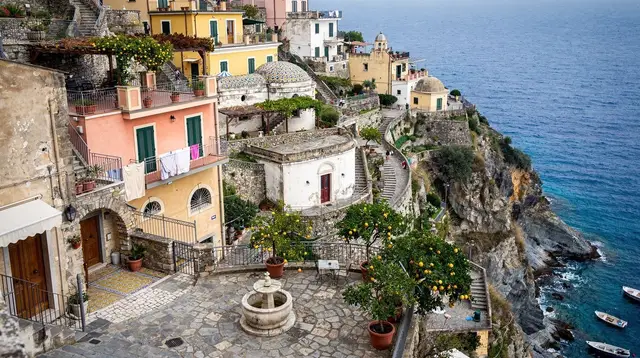
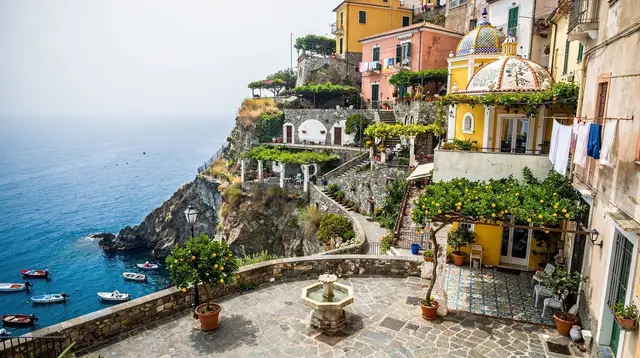
The village itself is compact almost to the point of disorientation for first-time visitors. There is no sprawling seafront promenade, no long stretch of shops. Instead there is a tight cluster of stepped lanes, tunnels, and archways climbing back from a small central square and an equally small cove beach. Cars cannot really penetrate the core; most of what defines Atrani is only reachable on foot, which is part of why it retains a texture that busier villages have smoothed over.
Most visitors reach Atrani indirectly, by first reaching Amalfi or the wider coast. Travelers flying in generally start with the connection covered in getting from Naples airport to the Amalfi Coast, then work their way along the SS163 by bus, private driver, or ferry until they land in Amalfi and make the short crossing on foot. There is no separate arrival route built specifically for Atrani, and there doesn’t need to be one — the village is close enough to Amalfi’s harbor and bus stop that it functions as an easy add-on to any itinerary that already includes Amalfi, rather than a destination requiring its own transport plan.
The walk that takes minutes, not effort
The single fact worth repeating to anyone tempted to skip Atrani: the walk from Amalfi takes a few minutes. It is not a hike, it does not require special shoes, and it does not eat into a day’s itinerary in any meaningful way. A short pedestrian tunnel cuts directly through the promontory dividing the two towns, and an alternative route over a modest staircase gets you there just as quickly if you’d rather stay above ground. Compare that to the effort of, say, the Path of the Gods hike, which genuinely does take hours, and it becomes clear that “I didn’t have time for Atrani” rarely holds up. The excuse to skip it is almost always really about not knowing it’s there.
Visitors moving along the coast by SITA bus will pass directly by Atrani’s edge between Amalfi and Ravello or points east, which makes a stop even easier to fold into a existing plan. Those arriving by ferry usually land in Amalfi’s harbor, again just a few minutes’ walk from Atrani’s own small waterfront.
A village that is actually lived in
The clearest way to describe the difference between Amalfi and Atrani is population density measured against tourist density. Amalfi’s historic center, while genuinely charming, is largely organized around receiving visitors: hotels, restaurants with multilingual menus, ceramic and limoncello shops lining the main corridor toward the Duomo. Atrani, by contrast, is one of the most densely inhabited small towns on this stretch of coast relative to its footprint — a place where the buildings stacked into the hillside are still mostly homes, not guesthouses, and where the square fills with residents running errands or sitting at the same handful of cafés rather than with tour groups moving in a single direction.
This is not a claim that Atrani has no visitors at all, or that it is some undiscovered secret — it appears in every serious guide to the coast. The claim is narrower and more useful: unlike villages whose daily rhythm has been substantially reorganized around tourism, Atrani’s rhythm is still substantially its own. Laundry hangs across the alleys. Fishermen still keep boats pulled up on the small beach. Church bells mark the day for residents, not for a schedule of guided tours. If you want a sense of what ordinary Amalfitan life looks like away from a postcard version of the coast, Atrani is where you find it, not Amalfi’s cathedral square.
The square and the cove
Piazza Umberto I is the heart of Atrani, and it is worth sitting in for its own sake rather than treating it as a five-minute photo stop. It opens directly onto the small cove beach — pebbles and coarse sand rather than fine sand, in keeping with nearly every beach on this coast — which is a genuine local swimming spot in summer rather than a curated lido strip. There is nothing here on the scale of Positano’s Spiaggia Grande or Amalfi’s town beach; that is precisely the point. It is smaller, plainer, and used by people who live a short walk up the hill rather than by visitors who arrived by ferry for the afternoon.
The Collegiata di Santa Maria Maddalena, Atrani’s main church, sits just off the square and is worth a brief visit, though it draws none of the queues that gather outside Amalfi’s Duomo. Narrow lanes climb from the piazza in several directions, threading under archways and past building facades that lean into each other overhead — a layout shaped by centuries of building on a tight, cliff-bound footprint rather than by any modern planning.
What Atrani is not
Atrani is not a beach destination in the way Minori or Maiori can be; anyone hoping for a long stretch of sand should look toward Minori and Maiori’s beaches instead. It is not a hub for nightlife the way parts of Positano are — there is no real bar scene here, and evenings are quiet. It has no ceramics tradition to rival Vietri sul Mare, no paper-making history like Amalfi’s own, and no anchovy-curing trade like Cetara a little further along the coast. Atrani’s value is not a specific craft or product; it is the town itself, kept largely intact and lived-in, at a moment when many of its neighbors have leaned hard into their tourist-facing identity.
It is also not reachable by car in any practical sense at its core. The SS163 skirts the town, but the historic center is a warren of steps and pedestrian passages, and drivers should not expect to park near the square in high season, if at all.
The best time to see Atrani at its quietest
Atrani never draws the volume of visitors that fills Amalfi’s cathedral piazza or Positano’s Spiaggia Grande, but its square still has a livelier and quieter rhythm depending on the season and the hour. Mid-morning and mid-afternoon in peak summer bring a trickle of day-trippers crossing over from Amalfi, though nothing like a crowd; early morning and evening, the square belongs almost entirely to residents. Visitors following the coast’s general advice on how to avoid the crowds will find Atrani one of the easiest wins on that list — a five-minute walk delivers a noticeably calmer scene than the town it sits beside.
Shoulder-season months, covered in more detail in the guide to the best time to visit the Amalfi Coast, suit Atrani especially well. With fewer ferries running and Amalfi itself thinner on visitors, the contrast between the two towns narrows, but Atrani’s square remains genuinely lived-in year-round in a way Amalfi’s tourist-facing center is not. There is no real “off day” for visiting Atrani the way there might be for a beach town waiting out winter closures — the village functions on its own schedule regardless of season, since its daily life was never built around visitor traffic in the first place.
Fitting Atrani into a coastal day
The easiest way to include Atrani costs nothing extra in planning: treat an Amalfi visit as a two-town visit by default. Walk the tunnel or the stairs, spend thirty to forty-five minutes in the square and along the lanes, and continue on to wherever the rest of your day was already headed, whether that’s east toward Cetara and Vietri sul Mare or back through Amalfi toward Ravello and Positano.
Visitors who prefer a guided introduction to Amalfi itself before crossing over often pair the two towns with a structured Amalfi walking tour, using the guided portion to cover the cathedral and main corridor, then finishing on their own in Atrani’s quieter lanes where a guide’s script would add little. The pairing works because the two towns are different enough that neither visit feels redundant, and close enough that neither requires a separate outing.
For visitors who want a more structured way to explore this eastern end of the coast, guided options based in nearby Vietri sul Mare cover the walking history of the area with local guides, or get you onto the water for a different vantage point on the villages stacked along the cliffs. A guided walk through Vietri sul Mare’s old town with a local guide is a useful way to understand the wider area’s layered history before or after your own stroll through Atrani.
For a view of this coastline from the water, a kayak trip from Vietri toward Cetara shows how tightly these villages cling to the cliffs, a perspective that’s hard to get on foot. And travelers curious about the region’s craft traditions, distinct from Atrani’s own quiet character, can try a hands-on majolica decoration workshop in Vietri sul Mare to see how the coast’s best-known ceramics are actually made.
The bigger pattern
Atrani is a small case of a larger truth about this coast, laid out plainly on the site’s own explainer that the Amalfi Coast is not one town: what looks from a distance like a single scenic strip is in fact a chain of separate communities, each with its own governance, history, and character, artificially blurred together by how quickly a car or bus can move between them. The same logic explains why there’s no train on the Amalfi Coast at all — the terrain simply does not allow it, which is exactly why Atrani, like every other village here, depends on the SS163, SITA buses, and ferries rather than rail.
Skipping Atrani because “it’s basically Amalfi” repeats a version of the same mistake visitors make when they lump Positano, Ravello, and Amalfi together as interchangeable stops on one itinerary. Each has its own layout, its own reason for existing, and its own relationship to the sea. Atrani’s reason is the plainest of all: it is what an Amalfi Coast village looks like when it hasn’t been rebuilt primarily for visitors. For things to do in Amalfi or across the coast’s traditional villages, Atrani belongs on the list not as an afterthought but as the corrective to what the busier stops don’t show you.
Frequently asked questions about visiting Atrani
Is Atrani a neighborhood of Amalfi?
No. Atrani is a distinct Italian comune with its own municipal administration, separate from Amalfi. They sit next to each other, split by a rocky headland, but they have always been governed and identified as two different towns.
How do you get from Amalfi to Atrani?
On foot, through a short pedestrian tunnel cut through the promontory, or up and over a brief staircase route. Either way takes only a few minutes and requires no special effort, no car, and no bus ticket.
Does Atrani have a train station?
No village on this stretch of coast has a train station. Atrani, like Amalfi, Positano, and Ravello, is reached by the SS163 coastal road, SITA buses, or seasonal ferries. The nearest railway stations are in Salerno or Sorrento.
Is Atrani worth visiting if you’ve already seen Amalfi?
Yes, precisely because it looks nothing like Amalfi once you’re standing in its square. Amalfi has a cathedral piazza built for visitor flow; Atrani has a small, lived-in square wrapped around a modest cove, with daily life happening around you rather than a tourist circuit.
Does Atrani have a beach?
Atrani has a small pebble-and-coarse-sand cove directly below its square, considerably smaller and quieter than the beaches at Amalfi or Minori. It is a local swimming spot rather than a destination beach with rows of lidos.
Can you drive to Atrani?
You can reach the edge of Atrani by the SS163, but the village core is pedestrian, with narrow stepped lanes unsuited to cars. Parking is limited and most visitors arrive on foot from Amalfi or by SITA bus.
Why is Atrani less crowded than Amalfi?
Atrani has no large piazza built around a cathedral, no cruise-excursion pull, and comparatively little tourist infrastructure. It remains a residential town where people live year-round, which keeps its rhythms closer to ordinary Amalfitan life than to a coastal showcase.
Village Tours on the Amalfi Coast on GetYourGuide
Verified deep-linked GetYourGuide tours. Book through these links and we earn a small commission at no cost to you.
GetYourGuide does not provide a product photo for this activity — the image shows the meeting point, photographed by us.