Naples Airport to the Amalfi Coast: Every Realistic Way to Get There
How do you get from Naples Airport to the Amalfi Coast?
There is no direct train to the Amalfi Coast. Most travelers take a taxi or shuttle from the airport to Naples Centrale or Sorrento, then continue by Circumvesuviana train, SITA bus, seasonal ferry, or a private transfer. A direct road transfer via the SS163 is also possible but takes longer in July and August traffic.
Naples Is the Gateway, Not the Destination
If you are flying into Naples Airport (officially Aeroporto di Napoli Capodichino) on your way to Amalfi, Positano, or Ravello, the first thing to understand is that Naples is not part of the Amalfi Coast. It is the region’s main air and rail gateway, sitting on the Bay of Naples, more than an hour’s drive from the coastal villages themselves. There is no direct train from Naples Airport to any Amalfi Coast town, because the Amalfi Coast has no railway at all. Every itinerary from the airport involves at least one change of transport, and often two or three.
This matters for planning because a lot of loose travel advice talks about “the transfer from Naples to Amalfi” as if it were a single hop. In practice you are choosing between two realistic multi-leg routes, or a private road transfer, and the right choice depends heavily on your season, your luggage, and exactly which village you are staying in. This guide breaks down the two standard routes, plus the direct road option, without pretending any of them has a fixed travel time in minutes.
Why There Is No Simple Answer on Travel Time
Before comparing routes, it helps to understand why nobody can honestly promise “it takes 90 minutes.” Travel time from Naples Airport to the Amalfi Coast depends on:
- Season: In July and August, the SS163 coastal road is at its most congested, with ZTL (limited traffic zone) restrictions active in Amalfi, Positano, and Ravello. Off-season, the same road can be driven far more freely.
- Ferry availability: Seasonal boats connecting Naples, Sorrento, and the coast run frequently from spring to October and are reduced or suspended in winter, so a route built around a ferry crossing simply does not exist for part of the year.
- Your final destination: Positano, Amalfi, Minori, and Ravello are spread across roughly 50 km of cliffside coastline. “The Amalfi Coast” is not one point on a map, and travel time to Positano can differ substantially from travel time to Minori, even from the same airport gate.
- Airport transfer congestion: Naples Airport’s own access roads and Naples Centrale station can add unpredictable delays before you have even left the city.
Because of this, the sections below describe routes and their logic, not minute counts.
Route 1: Via Sorrento (Circumvesuviana, Then Bus or Ferry)
This is the standard route for anyone staying in Sorrento itself, or in western Amalfi Coast towns like Positano or Praiano.
Step 1 — Airport to Naples Centrale. From Naples Airport, take a taxi, an airport shuttle bus, or a private transfer to Naples Centrale station. There is no train station at the airport itself.
Step 2 — Naples Centrale to Sorrento by Circumvesuviana. The Circumvesuviana train runs from Naples to Sorrento, stopping at Pompei and Herculaneum stations along the way, which is useful if you plan a day trip to Pompeii and Herculaneum before continuing to the coast. It is worth remembering that this line only reaches Sorrento — it does not serve any village on the Amalfi Coast itself.
Step 3 — Sorrento to the coast. From Sorrento, you continue either by SITA bus along the SS163, or, in season, by ferry to Positano, Amalfi, or other coastal stops. The ferry option is generally more comfortable with luggage but is not available in winter, when SITA buses become the only public option.
This route suits travelers whose base is Sorrento, Positano, or Praiano, and who don’t mind an extra change of transport. It also naturally sets up a side trip to Capri via the Sorrento-to-Capri ferry, since Sorrento is the main jumping-off point for the island.
Route 2: Via Salerno (Regional Station, Then Bus or Ferry East)
For travelers heading to Amalfi, Minori, Maiori, or Vietri sul Mare — the eastern half of the coast — the Salerno route is often more logical than looping through Sorrento.
Step 1 — Airport to Salerno. From Naples Airport, you can take a taxi or private transfer directly to Salerno, or travel via Naples Centrale and connect onward by regional train. Salerno has a proper regional railway station, unlike anywhere on the Amalfi Coast proper.
Step 2 — Salerno to the coast. From Salerno, SITA buses run west along the coast toward Vietri sul Mare, Cetara, and Atrani, then on to Amalfi and Minori and Maiori. In season, ferries also connect Salerno to Amalfi and other coastal towns, often faster and more scenic than the bus, though again not guaranteed to run outside spring through October.
This route tends to work better for Amalfi, Ravello (reached via Amalfi, since Ravello has no beach or coastal access of its own and sits about 350 m above the shore), Minori, and Maiori, because it avoids the longer westward detour through Sorrento.
Route 3: A Direct Transfer via the SS163
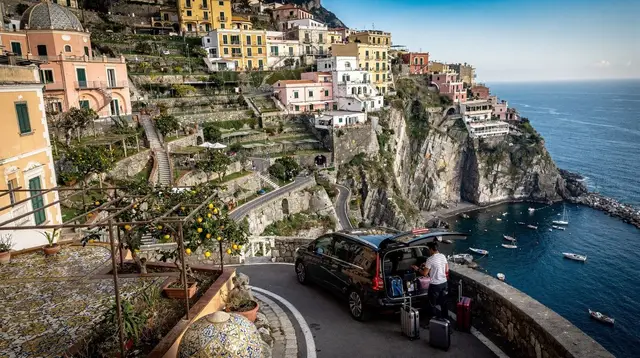
The third option skips public transport changes entirely: a taxi, private car, or shuttle drives you directly from Naples Airport to your accommodation on the coast via the SS163 coastal road.
This is the most comfortable option if you are traveling with a lot of luggage, arriving late at night, or traveling in a group, since it removes the need to manage train platforms and ferry timetables. It is also the option most exposed to the realities of the road itself: the SS163 is narrow, cliffside, and prone to slow single-file traffic in peak summer, and ZTL restrictions in Amalfi, Positano, and Ravello can affect where a vehicle is allowed to drop you. A private driver familiar with these restrictions is generally more reliable than a standard rental car, which is one reason so few visitors choose to self-drive for this leg.
a private transfer straight from the airport to Sorrento removes the Circumvesuviana leg entirely if your base is Sorrento or the western coast, while a transfer from the airport to the Naples port is useful if your onward plan is a ferry rather than a road or rail connection.
Comparing the Three Routes
| Route | Best for | Main transport | Weather/season risk |
|---|---|---|---|
| Via Sorrento | Sorrento, Positano, Praiano | Circumvesuviana + SITA bus or ferry | Ferry leg reduced or suspended in winter |
| Via Salerno | Amalfi, Minori, Maiori, Vietri | Train/taxi + SITA bus or ferry | Ferry leg reduced or suspended in winter |
| Direct SS163 transfer | Any coastal village, heavy luggage | Private car, taxi, or shuttle | Heavy traffic and ZTL in July–August |
Combining the Transfer With a Day of Sightseeing
Because Naples, Pompeii, Herculaneum, and Vesuvius all sit between the airport and the coast, some travelers use the transfer day itself as a first sightseeing stop rather than a pure travel day. A guided option such as a guided route from Naples through Pompeii and on to the Amalfi Coast can turn what would otherwise be a logistics-only day into a first look at Pompeii’s ruins before you even check into your hotel. Travelers with two days to spare sometimes prefer a two-day itinerary linking Sorrento, the Amalfi Coast, and Pompeii, which spreads the transfer and the sightseeing across two more relaxed days instead of one long one.
If your priority is reaching the coast itself with a guided stop along the way rather than a full day of ruins, a day tour from Naples to the Amalfi Coast is built around exactly that combination, typically pairing transport with a stop in one or two coastal towns.
None of these guided options replace the basic logistics above — you will still be moving from Naples toward Sorrento or Salerno either by road or rail — but they can make the transfer day productive rather than purely functional.
Which Route Should You Actually Choose?
- Staying in Positano, Praiano, or Sorrento itself: the Sorrento route (Circumvesuviana, then SITA bus or seasonal ferry) is usually the most logical, since it lands you closest to the western coast.
- Staying in Amalfi, Minori, Maiori, or Vietri sul Mare: the Salerno route generally involves less backtracking, since Salerno sits directly east of these villages.
- Staying in Ravello: either route works as a first leg, since you will reach Ravello via Amalfi or via a direct road connection regardless — Ravello has no coastal access of its own and sits well above the shoreline.
- Traveling with heavy luggage, young children, or arriving late at night: the direct SS163 transfer avoids train platforms and ferry piers entirely, at the cost of exposure to summer road traffic.
- Traveling in July or August: expect the SS163 to be the slowest link in any of these routes, public transport or private car alike, due to traffic volume and active ZTL zones in the main villages.
For most first-time visitors, reading a broader planning guide such as how many days to spend on the Amalfi Coast or getting around without a car alongside this page helps place the airport transfer in the context of the whole trip, rather than treating it as an isolated logistics problem.
Practical Notes for the Journey
- Naples Airport has no train station on-site; every rail connection starts with a taxi, bus, or shuttle to Naples Centrale.
- The Circumvesuviana line connects Naples to Sorrento via Pompei and Herculaneum, but it does not reach any Amalfi Coast village directly.
- Salerno has a proper regional station and is often the more direct option for the eastern coast, unlike Sorrento, which only reaches the western side.
- Seasonal ferries linking Naples, Sorrento, Salerno, and the coast are a comfortable option from spring through October, but should never be assumed to run in winter.
- The SS163 is a narrow, winding cliffside road with ZTL restrictions in Amalfi, Positano, and Ravello — expect delays in July and August regardless of which route you choose.
- If your trip includes a stop in Naples itself, note that Naples is not part of the Amalfi Coast but is worth treating as its own destination rather than a rushed transit point.
Frequently Asked Questions About the Naples Airport Transfer
Is there a direct train from Naples Airport to Amalfi or Positano?
No. Naples Airport has no train station, and Amalfi, Positano, and Ravello have no railway line at all. Every route involves at least one train, bus, or boat change, usually through Sorrento or Salerno.
Which is faster: the Sorrento route or the Salerno route?
Neither is reliably faster, since both depend on traffic, ferry schedules, and your final destination on the coast. Salerno tends to suit Amalfi, Minori, and the eastern villages better, while Sorrento suits Positano and the western coast.
Can I take a taxi directly from Naples Airport to Positano or Amalfi?
Yes, a private taxi or transfer can drive the SS163 directly, but this road is narrow, winding, and heavily congested in July and August, with ZTL traffic restrictions in Amalfi, Positano, and Ravello.
Does the ferry run all year from Naples or Sorrento to the Amalfi Coast?
No. Ferry services between Naples, Sorrento, Capri, and the Amalfi Coast towns are dense from spring through October but greatly reduced or suspended in winter, so they should never be treated as a guaranteed year-round option.
Is Naples Airport actually on the Amalfi Coast?
No. Naples is the main air and rail gateway to the region, but it sits on the Bay of Naples, more than an hour’s drive from the Amalfi Coast itself.
Should I rent a car at Naples Airport to reach the Amalfi Coast?
Most visitors avoid it. The SS163 coastal road is difficult to drive and park on, and most travelers rely on trains, SITA buses, ferries, or a private driver instead of a rental car.
How do I reach Amalfi or Minori specifically from the airport?
The Salerno route is usually more direct for the eastern villages: airport to Salerno by taxi, shuttle, or train via Naples Centrale, then a SITA bus or seasonal ferry onward to Vietri sul Mare, Amalfi, or Minori.
Transport & Transfers on GetYourGuide
Verified deep-linked GetYourGuide tours. Book through these links and we earn a small commission at no cost to you.
GetYourGuide does not provide a product photo for this activity — the image shows the meeting point, photographed by us.