Three Villages, Three Identities
Most itineraries for the Amalfi Coast fixate on Positano’s cliffside photographs and Ravello’s clifftop gardens, and in doing so they skip past three towns that sit at the coast’s eastern edge, closest to Salerno. Vietri sul Mare, Cetara and Atrani are easy to lump together as “the villages before Amalfi” or dismiss as a blur seen from a bus window. That is a mistake. Each one carries a distinct identity, a distinct craft or dish, and a reason to stop that has nothing to do with the postcard views a few kilometers west.
This page treats them as three separate places rather than one generic stretch of road, because that is what they are. Vietri sul Mare is a ceramics town. Cetara is a fishing port with a single, famous product. Atrani is a residential village so compact it barely registers on a map, yet it has its own church, its own beach and its own identity distinct from neighboring Amalfi.
Vietri sul Mare: The Real Home of Amalfi Coast Ceramics
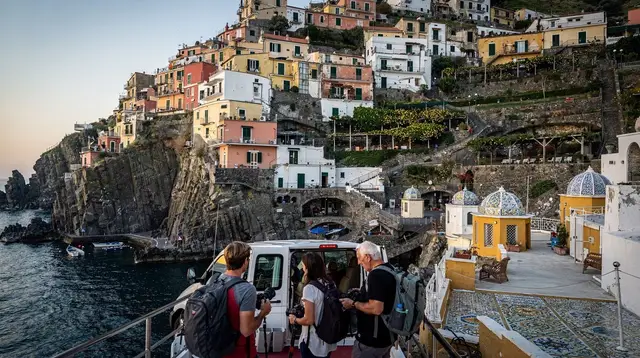
If you have seen the blue-and-yellow majolica tiles, bowls or lemon-patterned plates sold across the region, they trace back to Vietri sul Mare, not to Amalfi or Positano. Vietri is the historic center of ceramics production on this coast, a tradition that goes back centuries and that still supports dozens of working studios along the town’s main street and around Piazza Matteotti. The dome of the Chiesa di San Giovanni Battista, tiled in colorful majolica, is the clearest visual proof of the craft’s local weight.
This distinction matters because visitors often assume ceramics are a generic “Amalfi Coast souvenir” available everywhere in equal quality. They are not. Vietri workshops produce the originals; shops elsewhere on the coast largely resell them, sometimes alongside imported imitations. Buying directly in Vietri means seeing the kilns, meeting the potters, and paying prices that have not been marked up for a village that draws day-trip crowds from Positano.
A walking tour through Vietri’s historic core is the easiest way to understand the layout: the ceramics district clusters near the church and along Corso Umberto I, while the town’s small harbor and beach sit a short walk downhill.
a guided walk through Vietri’s ceramics quarter with a local host covers both the historic workshops and the town’s layout in a couple of hours, useful context before deciding which studio to visit for a hands-on session.
For travelers who want to do more than watch, several studios run short workshops. a majolica decoration workshop where you paint your own piece is a common format: an artisan sets up brushes, glazes and a blank tile or bowl, and the finished piece is fired and shipped or collected later. A separate option, a pottery workshop that includes time at the wheel, goes a step further by letting visitors shape clay rather than only decorate a pre-made surface.
Vietri also functions as a practical gateway. It sits at the eastern end of the Amalfi Coast proper, closest of the three villages on this page to Salerno and its regional train station — a detail covered in more depth below.
Cetara: A Working Fishing Port, Not a Resort Town
Nine kilometers west of Vietri, Cetara looks and functions differently from almost anywhere else on this stretch of coast. It has no grand villas, no clifftop gardens, and comparatively few hotels. What it has is a working fishing fleet, a small crescent of beach flanked by a defensive tower, and a single culinary tradition that has made the town’s name known well beyond Campania: colatura di alici.
Colatura is a clear, intensely savory anchovy sauce, made by pressing salted anchovies for months in wooden barrels and collecting the liquid that drains off. It is a direct descendant of garum, the fermented fish sauce used across the ancient Roman world, and Cetara is the place in Italy most closely associated with keeping that tradition alive today. Locally it appears most often tossed through spaghetti on Christmas Eve, though restaurants in Cetara serve versions of the dish year-round.
It is easy to confuse colatura with ordinary anchovy paste or with the salted anchovies sold across Mediterranean Italy. It is neither. The production method — slow pressure-fermentation in chestnut barrels — and the resulting sauce’s clarity and concentration are specific to this coastal fishing tradition, and specific in practice to a handful of small producers based in Cetara.
Beyond the sauce itself, Cetara rewards a slow walk along its harbor, where fishing boats still unload the daily catch, and a stop at one of the small trattorias serving tuna, anchovies and colatura-based pasta. There is little in the way of formal sightseeing here — no museum, no cathedral to tour — which is precisely what makes it a useful counterweight to busier stops. If a full day dedicated to ceramics and cooking traditions appeals, pairing Vietri and Cetara with a home-hosted meal in Vietri sul Mare turns the day into a food-focused itinerary rather than a photo-driven one.
Atrani: One of Italy’s Smallest Villages, Right Next to Amalfi
Atrani sits so close to Amalfi — separated by a short headland and, in places, by only a few hundred meters of coastal path — that many visitors do not realize they have entered a separate municipality. But Atrani is its own town, with its own mayor, its own church, and by most measures one of the smallest land areas of any comune in Italy. Its historic core is a tangle of covered passageways, external staircases and a small central piazza, Piazza Umberto I, that opens directly onto a compact beach.
The village’s church, Collegiata di Santa Maria Maddalena, with its own majolica-tiled dome, gives Atrani a visual echo of Vietri, though the two towns are unrelated in that respect — Atrani’s dome is a shared regional architectural style, not evidence of its own ceramics industry (that industry, again, belongs to Vietri). Atrani’s other notable structure is the Church of San Salvatore de Birecto, historically linked to the doges of the medieval Maritime Republic of Amalfi, when Atrani served as a ceremonial site for ducal investitures.
Because Atrani has almost no dedicated parking and only a small beach, it works best as a walking extension of a visit to Amalfi rather than as a separate destination requiring its own transport plan. Many visitors reach it on foot along the coastal path from Amalfi in under fifteen minutes, then continue toward Ravello or back to the SS163 bus stops.
Getting There: No Train, One Road, One Bus Line
None of these three villages has a railway station, a fact true of the entire Amalfi Coast proper. The nearest stations are in Salerno to the east and Sorrento to the west, both reached by different transport modes and neither directly by rail from the coast itself.
Vietri sul Mare is the exception worth flagging clearly: it lies close enough to Salerno’s regional train station that many visitors treat it as a short taxi or local bus ride from the rail network, making it the most transport-convenient of the three villages, not the least. Cetara and Atrani, by contrast, depend entirely on the SITA bus line running the SS163 coastal road, or on seasonal ferries, exactly like Amalfi, Positano and the rest of the coast.
| Village | Distance from Salerno | Distance from Amalfi | Train access |
|---|---|---|---|
| Vietri sul Mare | ~5 km | ~20 km | None; closest to Salerno station |
| Cetara | ~15 km | ~10 km | None |
| Atrani | ~24 km | ~1 km | None |
The SS163 through this stretch carries the same constraints as the rest of the coast: it is a narrow corniche road, not a highway, and it can back up in midsummer even outside the more famous bottlenecks near Positano. Travelers relying on public transport should check current SITA timetables before planning a day that strings together all three villages, since departure frequency drops sharply outside the April-to-October season. For a full breakdown of how the bus network operates, see the dedicated guide to SITA buses on the Amalfi Coast.
Ferries connect some of these towns seasonally as well, but service is inconsistent in shoulder season and largely suspended in winter — never treat a ferry connection between Vietri, Cetara or Atrani and other coastal towns as guaranteed outside summer months. For the wider ferry network, see the guide on ferries between the Amalfi Coast, Sorrento and Capri.
Where These Villages Fit in a Longer Trip
Vietri, Cetara and Atrani work best as a half-day or full-day add-on rather than a base for a multi-night stay, since accommodation options are far more limited than in Amalfi, Positano or Sorrento. A practical sequence for travelers arriving from or departing toward Salerno is to stop in Vietri first, continue to Cetara for lunch, and finish in Atrani before entering Amalfi itself — effectively using the SS163 as a single connective thread rather than three separate excursions.
Travelers planning a broader route should look at the 3-day Amalfi Coast itinerary or the public-transport itinerary, both of which can absorb a stop in one or more of these villages without requiring an extra overnight. Those coming from Naples or combining the coast with archaeological sites will often pass near Vietri and Cetara anyway; see the Pompeii and Herculaneum day trip for how that logistics chain typically runs, or consider a direct bus connection between Pompeii and the coast that passes through this eastern stretch.
For travelers focused on ceramics shopping specifically, Vietri deserves more time than a passing stop — a dedicated half-day lets you compare several workshops rather than buying from the first shop encountered near the bus stop. For those prioritizing food, Cetara’s colatura is worth seeking out even for visitors who normally skip fish-based condiments; it is used sparingly and does not taste overtly “fishy” in a finished dish. For those short on time, Atrani can be folded into an Amalfi visit at no extra transport cost, simply by walking the coastal path between the two.
Vietri, Cetara and Atrani: Frequently Asked Questions
Is Vietri sul Mare part of the Amalfi Coast?
Yes. Vietri sul Mare sits at the eastern end of the officially recognized Amalfi Coast, closest to Salerno, and is included in the UNESCO World Heritage designation covering the coastline.
What is Vietri sul Mare famous for?
Vietri sul Mare is the historic center of Amalfi Coast ceramics production, known for majolica pottery in characteristic blue, yellow and green glazes. Its main church has a dome tiled in the same style, visible from much of the town.
What is colatura di alici and where does it come from?
Colatura di alici is a clear anchovy sauce made in Cetara by pressing salted anchovies in wooden barrels over several months. It descends from the ancient Roman fish sauce garum and is a specialty specific to Cetara rather than the wider coast.
Is Atrani the same town as Amalfi?
No. Atrani is immediately adjacent to Amalfi, in places only a few hundred meters away, but it is a separate, independently governed comune with its own church, piazza and small beach.
How do I get to Vietri, Cetara and Atrani without a car?
All three are served by SITA buses running the SS163 coastal road. Vietri is also reachable by short taxi or local transfer from Salerno’s train station, making it the most train-adjacent of the three villages.
Do Vietri, Cetara and Atrani have train stations?
No village on the Amalfi Coast itself has a train station, including these three. The nearest stations are in Salerno, close to Vietri, and in Sorrento, on the opposite side of the peninsula.
Can I visit all three villages in one day?
Yes, since they sit within roughly 25 kilometers of each other along the same road. A full day allows time in each; a half-day usually only covers two of the three comfortably, particularly if a ceramics workshop is included.
Is Vietri sul Mare worth visiting if I’ve already seen Amalfi and Positano?
Yes, for a different reason: Vietri’s appeal is craft and shopping rather than scenery. Travelers interested in buying authentic ceramics directly from producers, rather than resellers, get the most value from a dedicated stop here.