Vietri sul Mare: The Real Home of Amalfi Coast Ceramics
Is the ceramic sold in Positano and Amalfi actually made there?
No. The colorful majolica pottery associated with the Amalfi Coast is a historic craft of Vietri sul Mare, at the eastern edge of the coast near Salerno. Positano and Amalfi are sales points, not production centers, and some pieces sold there are imported from elsewhere with no link to the local tradition.
The Ceramic You Bought in Positano Probably Wasn’t Made There
Almost every visitor to the Amalfi Coast walks past shop windows stacked with colorful plates, lemon-patterned tiles, and hand-painted bowls in Positano and Amalfi. It’s easy to assume this pottery is a local craft of those two towns, produced somewhere just behind the shopfront. It isn’t. The tradition behind this style of ceramic, known as majolica, belongs historically to one town: Vietri sul Mare, at the eastern end of the coast, closer to Salerno than to Positano or Amalfi.
This isn’t a minor technicality. Positano and Amalfi are commercial outlets for ceramics, not production centers. The workshops, kilns, and generations of painters who developed the distinctive cobalt-blue-and-lemon-yellow style you see everywhere on the coast are concentrated in and around Vietri. Some of what’s sold along the coast does come from these Vietri workshops, transported west along the SS163 for sale in higher-traffic tourist towns. But not all of it. A portion of the pottery on Amalfi Coast shelves is imported from elsewhere in Italy or abroad, produced to resemble the local style without any connection to the actual craft tradition or the artisans who built it.
If you want to understand where this ceramic really comes from, or you want to buy a piece with a real story behind it, the answer is to go to Vietri sul Mare itself.
Where Vietri sul Mare Actually Sits
Vietri sul Mare is often overlooked because of where it sits on the map. It marks the eastern gateway to the Amalfi Coast, right at the point where the coastal road meets Salerno. Most visitors heading toward Amalfi, Positano, or Ravello pass through or past Vietri without stopping, focused on reaching the more famous villages further west.
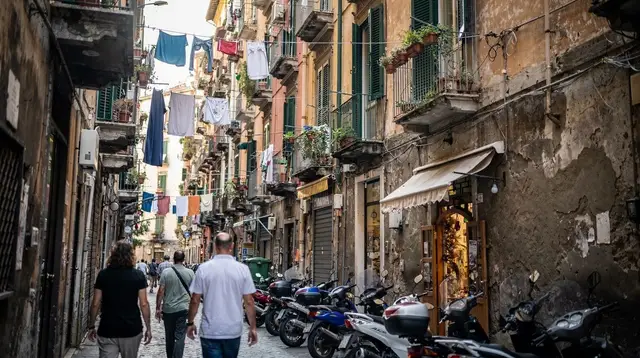
That position, at the edge rather than the center of the coast, is precisely why Vietri has kept a different rhythm. It doesn’t see the same concentration of day-trippers that overwhelms Positano’s beaches or Amalfi’s cathedral steps in July and August. It functions as a real working town, with ceramic ateliers, family businesses, and a strip of coastline that feels considerably calmer than what you’ll find at the western end of the SS163.
Getting there is also more straightforward than reaching most of the coast. Vietri is one of the very few places on this stretch of coastline connected to Salerno’s train station, since the rest of the villages further along the coast have no railway service at all. From Salerno, a SITA bus or a short drive along the SS163 gets you into Vietri in about 10 to 15 minutes. If you’re arriving from the west, the same SITA line connects Vietri to Cetara, Amalfi, and beyond, though the bus can run slowly during peak season traffic.
A Craft Tradition Centuries in the Making
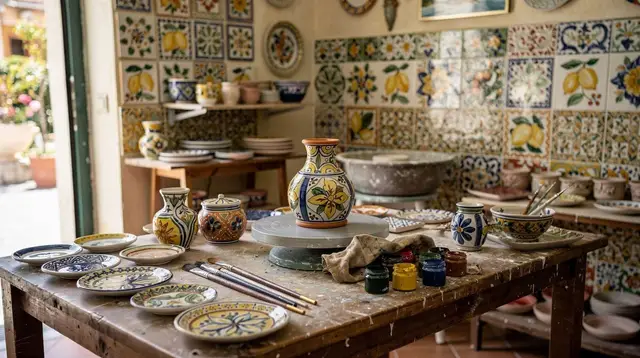
Ceramic production in Vietri sul Mare goes back centuries, shaped by the clay deposits and maritime trade routes of the Gulf of Salerno. What developed here wasn’t a single decorative motif but an entire visual language: thick, hand-applied glazes in saturated cobalt blue, ochre yellow, and green, often built around lemons, fish, sailing boats, and scenes of Mediterranean daily life. The style is immediately recognizable once you’ve seen it up close, distinct from generic tourist pottery in the weight of the glaze and the texture of hand-painted brushstrokes rather than printed patterns.
This tradition has been passed down through family-run workshops, some operating for multiple generations. Walking through Vietri’s streets, you’ll notice ceramic work isn’t confined to shop displays. It’s built into the town itself: street signs, house numbers, fountains, and benches are often decorated with local majolica tile work, a visible sign that this craft is part of daily life here rather than a product manufactured purely for visitors.
The Church Dome That Announces Vietri’s Identity
The clearest single symbol of this tradition is the Church of San Giovanni Battista, whose dome is covered in colorful ceramic tiles that catch the light from a distance as you approach the town along the coastal road. This tiled dome functions almost as a landmark and a statement at once: it tells you, before you’ve even parked the car or stepped off the bus, that you’ve arrived somewhere where ceramic isn’t decoration bought elsewhere and applied here, but a material woven into the architecture of the town itself.
Standing beneath that dome and then walking the surrounding streets, where balconies, planters, and shopfronts continue the same visual language, gives a much clearer sense of where this craft actually originates than glancing at a shop shelf in Positano ever could.
What You Can Actually Do in Vietri
Visiting Vietri sul Mare for its ceramics doesn’t have to mean just browsing shops, though there are plenty of those too, run by the same families who operate the workshops behind them. Several ateliers welcome visitors to see the painting and firing process directly, and some structure this into a proper visit rather than a passive shop browse.
A guided walking tour with ceramics tastings is one of the more direct ways to see multiple workshops in a single visit while getting context on the town’s history from a local guide, rather than piecing it together from shop signage. The Vietri sul Mare ceramics walking tour with limoncello tasting combines stops at working ateliers with a taste of the region’s other well-known product, limoncello made from Sfusato Amalfitano lemons, giving a broader sense of the town’s craft economy beyond pottery alone.
For a more hands-on experience, the majolica decoration workshop in Vietri sul Mare lets you sit down with an artisan and paint your own piece using the traditional glazes and motifs, a much more concrete way to understand the technique than watching from behind a counter. A similar option, the Amalfi Coast pottery workshop in Vietri sul Mare, covers the same ground with a slightly different format, useful if the majolica workshop’s schedule doesn’t line up with your visit.
If you’d rather explore the town on foot with a local perspective on its history and craft heritage without a hands-on painting component, the guided walking tour of Vietri sul Mare with Enzo covers the town’s streets, its ceramic-tiled landmarks, and its position at the edge of the Amalfi Coast, including context on why it developed so differently from Positano or Amalfi despite sitting on the same coastline.
Verifying What You’re Actually Buying
Given how much ceramic sold along the Amalfi Coast has no connection to Vietri’s actual workshops, a little scrutiny goes a long way if authenticity matters to you. A few practical habits help:
| What to check | Why it matters |
|---|---|
| A signature or stamp on the base of the piece | Established Vietri workshops typically mark their pieces; unmarked pottery is harder to trace |
| Where the shop says the piece was made | A shop willing to name the specific workshop is more likely to be selling genuine local pottery |
| The price relative to hand-painted work elsewhere | Very low prices in high-traffic tourist streets often indicate mass-produced or imported pieces |
| The texture and weight of the glaze | Genuine hand-applied majolica glaze tends to be thicker and slightly uneven compared to printed or machine-glazed pottery |
| Buying directly in Vietri rather than Positano or Amalfi | Removes the layer of resale markup and the risk of imported substitutes entirely |
None of this means every piece sold in Positano or Amalfi is fake or imported. Many shops there do stock genuine Vietri ceramics, sometimes from workshops with decades of history. But the only way to buy with certainty, and often at a better price, is to go directly to the source.
Combining a Vietri Visit With the Rest of the Coast
Because Vietri sits right at the Salerno end of the coast, it fits naturally into a day that also includes Cetara, known for its anchovy colatura tradition, and Atrani, one of the smallest and least-visited villages on the entire coast. All three sit within a short SITA bus ride of each other, making it possible to see a very different side of the Amalfi Coast than the postcard views of Positano, without the same density of crowds.
If you’re arriving from Naples or staying closer to Sorrento, Vietri also works well as a stop on the way in or out via Salerno, since it’s one of the only points on the coast reachable directly from Salerno’s train station. Travelers following the SS163 by car from Salerno toward Amalfi will pass directly through Vietri in the first few minutes of the drive, making a brief stop easy to fit in even without dedicating a full day to it.
For a broader sense of how a stop in Vietri fits into a longer coastal trip, see guides on how many days you need on the Amalfi Coast and getting around without a car, both of which touch on how the eastern end of the coast, where Vietri sits, differs from the busier central villages.
For travelers who want to combine a workshop visit with time on the water, the private kayak tour along the Amalfi Coast from Vietri sul Mare departs from the town itself, offering a view of the coastline from the sea before or after exploring the ceramic workshops on land.
Vietri Sul Mare Ceramics: Frequently Confused Points
The confusion between Vietri and the more famous villages further west isn’t limited to where the ceramics are made. A few related points are worth clarifying directly, since they tend to get flattened together in casual descriptions of the coast.
Vietri sul Mare vs. Positano and Amalfi as Craft Centers
Positano is known for its beaches, cliffside architecture, and boutique shopping. Amalfi is known for its cathedral, its former maritime republic history, and its own craft tradition in handmade paper, documented at the Amalfi Paper Museum. Neither town has a historic ceramic production tradition of its own. Ceramic sold there is either transported in from Vietri or imported from further afield. Vietri, by contrast, is the town where the craft actually developed and where the workshops remain active today.
The Church Dome Is a Landmark, Not a Museum Exhibit
Unlike a museum display, the ceramic-tiled dome of the Church of San Giovanni Battista is a functioning part of an active church, visible from the coastal road and from many points in the town. It’s worth seeing as part of a walk through Vietri rather than treating it as a single photo stop, since the same tile work continues through the streets around it.
Not Every Ceramic Purchase Needs to Be a Workshop Visit
You don’t need to book a workshop session to buy genuine Vietri ceramics. Many of the town’s shops sell directly from the workshops behind them, and simply asking where a piece was made, combined with checking for a maker’s mark, is often enough to buy with confidence, even on a brief stop.
Frequently Asked Questions About Vietri Sul Mare Ceramics
Is the ceramic sold in Positano and Amalfi actually made there?
No. The colorful majolica pottery associated with the Amalfi Coast is a historic craft of Vietri sul Mare, at the eastern edge of the coast near Salerno. Positano and Amalfi are sales points, not production centers, and some pieces sold there are imported from elsewhere with no link to the local tradition.
Where exactly is Vietri sul Mare?
Vietri sul Mare sits at the eastern end of the Amalfi Coast, right where the SS163 road meets Salerno. It is often described as the gateway to the coast rather than one of its central villages.
How do I get to Vietri sul Mare?
The easiest approach is by SITA bus or car along the SS163 from Salerno, a ride of about 10 to 15 minutes. Salerno’s train station also makes Vietri reachable without a car, unlike most of the coast further west.
What makes Vietri sul Mare ceramics different from other Italian pottery?
Vietri majolica is known for its thick, hand-painted glazes in cobalt blue, ochre yellow, and green, often featuring lemons, fish, and Mediterranean scenes. The style developed over centuries of local workshop production rather than being a generic decorative pattern.
Can I watch ceramics being made in Vietri sul Mare?
Yes. Several family-run workshops in the village welcome visitors to see painting and firing in progress, and some offer short hands-on decoration sessions or guided walking tours that stop at multiple ateliers.
How can I tell if a ceramic piece is genuinely from Vietri?
Look for a workshop signature or stamp on the base, ask directly where a piece was made, and be cautious of very low prices in high-traffic tourist areas, since imported look-alike pottery is common in Positano and Amalfi shops.
Is Vietri sul Mare worth visiting if I’m not buying ceramics?
Yes. The village itself, its ceramic-tiled church dome, and its quieter pace compared to Positano or Amalfi make it a worthwhile stop for understanding the coast’s craft history, even without making a purchase.
Is Vietri sul Mare crowded like Positano or Amalfi?
No. Most day-trip crowds concentrate on Positano, Amalfi, and Ravello further west, leaving Vietri comparatively calm even in high season, though summer weekends still bring more visitors than winter.
Vietri Ceramics & Craft Tours on GetYourGuide
Verified deep-linked GetYourGuide tours. Book through these links and we earn a small commission at no cost to you.
GetYourGuide does not provide a product photo for this activity — the image shows the meeting point, photographed by us.