Vietri, Not Positano, Is the Ceramics Town
I bought my first piece of Amalfi Coast ceramics in Positano. A small hand-painted dish, lemons on a blue background, from a shop just off the steps leading down to the water. The woman who sold it to me called it “our pottery” — meaning Positano’s — and I didn’t think twice about it. It was only months later, reading up on where these things actually come from, that I realized she’d been selling me something made somewhere else entirely.
That somewhere is Vietri sul Mare, a town most visitors barely register because it isn’t one of the postcard names. It sits at the eastern end of the coast, right where the coastal road meets Salerno, and it’s easy to drive through without stopping. But if you want to know where the majolica ceramic tradition actually belongs, Vietri is the answer. Not Positano. Not Amalfi. Vietri.
Why the confusion happens in the first place
Walk through Positano, Amalfi, or Ravello and you’ll see ceramics everywhere — shop windows full of hand-painted plates, tiles, vases, the whole colorful catalog. It’s a completely reasonable assumption that whichever town you’re standing in made what you’re looking at. I made that assumption myself.
But selling something and making something are different acts, and the coast’s shops don’t advertise the distinction. Ceramics travel well. They’re light enough to ship, durable enough to display, and visually distinctive enough to work as a souvenir from anywhere on the coast. So shops in Positano stock ceramics because tourists want to buy ceramics in Positano, not because Positano has a ceramic workshop tradition of its own.
I don’t think this is dishonest, exactly. It’s more that nobody corrects you. The dish gets wrapped in newspaper, you pay, you leave happy, and the actual provenance never comes up unless you ask directly — and I didn’t ask directly until it was too late to un-buy the assumption.
What belongs to Vietri, and only to Vietri
The attribution I want to be precise about is this: the ceramic (majolica) tradition of this stretch of coast is a Vietri sul Mare tradition. That’s where it comes from. I’m not going to tell you when it started, how many workshops currently operate there, or describe a signature decorative style in detail, because I don’t have those facts in front of me and I’d rather leave a gap than fill it with something that sounds authoritative and isn’t. What I can say plainly is the attribution itself: Vietri sul Mare, not the coast in general, not Positano, not Amalfi.
That distinction matters more than it might seem. If every village “has” ceramics equally, then the craft stops meaning anything specific — it becomes generic coastal decor rather than the identity of one particular place. Vietri’s ceramic tradition is worth naming correctly precisely because it’s Vietri’s, not because it’s diffuse coastal color that happens to be sold everywhere.
What Positano and Amalfi actually have instead
Here’s the part that I think gets lost when ceramics get credited to the wrong towns: it erases what those other towns are actually known for.
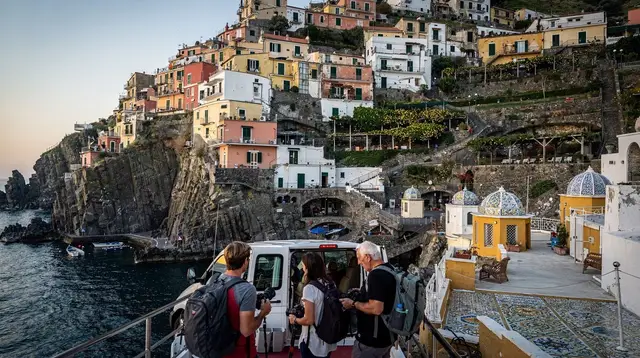
Positano isn’t a ceramics town, but it has its own identity — the cliffside houses stacked above the water, Spiaggia Grande, and a longstanding tradition around resortwear and handmade sandals. That’s Positano’s own thing, and lumping ceramics into “the Positano look” quietly displaces it.
Amalfi, meanwhile, has a genuinely distinct craft tradition of its own: handmade paper, known locally as carta bambagina, with its own dedicated museum, the Amalfi Paper Museum. Paper, not pottery. Amalfi’s identity is tied to that papermaking history, and it deserves to be known for it rather than folded into a generic “coastal ceramics” story that isn’t accurate to the town.
Ravello has its villas and gardens, including Villa Rufolo and the gardens at Villa Cimbrone. Cetara has its anchovy colatura. Minori has its pasta-making tradition. Every one of these towns has something specific, and treating ceramics as shared coastal wallpaper flattens all of that specificity into one indistinct souvenir shelf.
Getting to Vietri sul Mare, if you actually want to go
Because Vietri sits right at the eastern edge of the coast where the SS163 coastal road meets Salerno, it’s easier to reach than the towns further west — you don’t need to fight the same amount of cliffside traffic to get there. The SITA bus network that connects the coast’s towns runs through this stretch too, so it’s a realistic add-on even if you’re getting around without a car for the rest of the trip. It’s also a natural stop on the way in or out via Salerno, which functions as the coast’s rail and bus gateway from that direction.
A quick way to keep it straight
| Town | Craft tradition |
|---|---|
| Vietri sul Mare | Ceramics (majolica) |
| Amalfi | Handmade paper (carta bambagina) |
| Positano | Resortwear, sandal-making |
| Cetara | Anchovy colatura |
| Minori | Pasta-making |
None of these overlap by default. If a shop in Positano is selling ceramics, it’s selling Vietri’s craft, not its own — worth knowing whether you’re buying a souvenir or just trying to understand the place you’re standing in.
Why I think this is worth correcting
I’m not bringing this up to scold anyone for buying a dish in Positano and assuming it was local. I did the same thing. But travel writing has a habit of smoothing over these distinctions because “the Amalfi Coast is famous for colorful ceramics” is an easier sentence to write than “Vietri sul Mare, one town on the Amalfi Coast, is famous for colorful ceramics, and the other towns have their own separate traditions.” The easier sentence isn’t wrong exactly, but it’s imprecise in a way that erases Vietri’s specific claim to the craft and blurs what makes the other villages distinct.
If you’re planning a visit and ceramics are part of what draws you here, it’s worth routing some actual time toward Vietri sul Mare itself rather than assuming any shop on the coast will give you the same thing. And if you’re comparing where to base yourself, it’s a small but real data point in the broader Positano vs. Amalfi question — two towns with their own identities, neither of which is the ceramics town.
Most people visiting from Naples come through on a broader day trip that covers a scenic run down to Positano from Naples, or a version that also swings through Positano and the wider Amalfi Coast in one day. Others extend it into a longer loop covering Positano, Sorrento, and Pompeii, or a route from Salerno that also takes in Pompeii, Sorrento, and Positano. None of those itineraries are wrong for skipping Vietri — it’s genuinely off the main tourist track — but if ceramics are the reason you’re interested in this coast, it’s worth knowing which town actually earned that reputation before you spend your euros somewhere else convinced you’re buying local.
If you’re deciding where to spend your limited time and want to understand what each base town is actually known for, our Positano vs. Amalfi comparison and the Vietri sul Mare ceramics guide go further into what’s genuinely distinct about each place, ceramics included.
Frequently confused about Vietri and its ceramics
Is ceramic pottery an Amalfi Coast tradition, or specific to one town?
It’s specific to one town. The majolica ceramic tradition belongs to Vietri sul Mare, at the eastern end of the coast near Salerno. Positano and Amalfi have their own separate traditions and are not ceramic-producing towns in the same sense.
Why do so many shops in Positano and Amalfi sell ceramics if it isn’t their tradition?
Ceramics travel well as souvenirs and sell reliably to visitors, so shops across the coast stock pieces made in or associated with Vietri sul Mare. Selling the pottery is not the same as being the town where it’s made.
What is Positano actually known for, if not ceramics?
Positano is best known for its cliffside architecture, beaches like Spiaggia Grande, and its own tradition of resortwear and sandal-making, distinct from Vietri’s ceramic craft.
What is Amalfi actually known for, if not ceramics?
Amalfi’s defining craft tradition is handmade paper, carta bambagina, documented at the Museo della Carta. That is Amalfi’s own attribution, separate from Vietri’s ceramics.
Where exactly is Vietri sul Mare located?
Vietri sul Mare sits at the eastern edge of the Amalfi Coast, right where the coastal road meets Salerno. It’s often treated as a gateway town rather than a headline destination, which may be part of why its ceramic tradition gets misattributed.
Can I visit ceramic workshops in Vietri sul Mare itself?
Yes, Vietri sul Mare has ceramic shops and studios in town where pieces are sold and made, though this article does not list specific workshop names, styles, or an official count.
Does every village on the Amalfi Coast share the ceramic tradition equally?
No. This is the core misconception. Ceramics are a Vietri sul Mare tradition specifically, not a coast-wide craft shared evenly by Positano, Amalfi, Ravello, or the other villages.
tours.Culture
Verified deep-linked GetYourGuide tours. Book through these links and we earn a small commission at no cost to you.
GetYourGuide does not provide a product photo for this activity — the image shows the meeting point, photographed by us.