Emerald Grotto in Conca dei Marini: Is It the Same as the Blue Grotto?
Is the Emerald Grotto the same as the Blue Grotto?
No. The Emerald Grotto (Grotta dello Smeraldo) is in Conca dei Marini on the Amalfi Coast, while the Blue Grotto (Grotta Azzurra) is on the island of Capri. They are two separate sea caves in two different places, each with its own light and color effect, and visiting one has nothing to do with reaching the other.
Two Grottoes, Two Places: Clearing Up the Confusion
If you’ve been researching sea caves on your Amalfi Coast trip, you’ve probably run into two names that sound almost interchangeable: the Emerald Grotto and the Blue Grotto. They are not the same cave, not in the same place, and not reached the same way. The Emerald Grotto (Grotta dello Smeraldo) sits directly on the Amalfi Coast, in the small village of Conca dei Marini, between Amalfi and Positano. The Blue Grotto (Grotta Azzurra) sits on the island of Capri, across the water in the Gulf of Naples, and is a completely different excursion with a different logistics chain.
Confusing the two matters because they don’t substitute for one another. If you book a boat trip expecting to see the Blue Grotto’s famous electric-blue glow and end up at the Emerald Grotto instead, you’ll see a different cave, a different color effect, and you’ll have missed the island crossing that the Capri cave requires. The reverse is also true: travelers planning a quick coastal stop sometimes assume they need to organize a whole island day, when the Emerald Grotto near Conca dei Marini is a five-minute detour off the coastal road.
This guide treats the two as what they are: separate sights, in separate territories, with separate mechanisms behind their color. If you want the full picture on Capri’s cave, see our dedicated Blue Grotto guide; this page focuses entirely on the Emerald Grotto in Conca dei Marini.
Where the Emerald Grotto Actually Is
Conca dei Marini is one of the smaller villages on the Amalfi Coast proper, tucked along the SS163 between Amalfi and Praiano, a few kilometers before Positano heading west. It’s a quiet fishing village best known outside Italy for two things: this sea cave, and a claim to being the birthplace of sfogliatella pastry.
The Emerald Grotto is a natural sea cave carved into the limestone cliff at the base of the village, at sea level, directly accessible from the coast road. Unlike the Blue Grotto, there is no island to reach and no ferry crossing required. You can drive or bus along the SS163, stop at Conca dei Marini, and be inside the cave within minutes. That single fact is the most practical difference between the two grottoes: one is a coastal roadside stop, the other is an island excursion.
How Access Works: Road or Boat, Never a Ferry to an Island
There are two ways to reach the cave, and neither of them involves a boat trip to another landmass.
By road. From the SS163, an elevator (and a staircase alternative) descends from road level down to the cave entrance at the waterline. This is the fastest option if you’re already driving or riding the SITA bus along the coast, since driving the SS163 or catching a SITA bus already brings you past Conca dei Marini.
By boat. Many boat tours that run along the coast between Amalfi, Positano, and Praiano include a stop at the Emerald Grotto as part of a longer route, approaching it from the sea rather than from the road above. This is a common inclusion on general Amalfi Coast boat tours, since the cave sits directly on the water and requires only a short detour from a coastal cruise route.
Once inside, whether you arrived by elevator or by boat, a small rowboat typically takes visitors from the entrance into the cave itself for a short circuit, usually 15 to 30 minutes depending on how many people are waiting.
Compare that to the Blue Grotto on Capri, which requires a ferry or hydrofoil from Naples, Sorrento, or the Amalfi Coast to reach the island first, then a transfer to a small rowboat that lies flat to pass under the cave’s low entrance. The Emerald Grotto skips that entire island-crossing step.
Why the Water Looks Emerald, Not Blue
Both grottoes owe their color to sunlight entering the cave and scattering underwater, but the mechanisms and resulting hues are not identical, and neither is guaranteed.
At the Emerald Grotto, light filters in primarily from underwater openings and refracts through the water, producing the green tones that give the cave its name. At the Blue Grotto, an underwater cavity lets sunlight in from below the surface, scattering blue wavelengths and giving the water its intense blue glow. Different entry points, different light paths, different colors — another reason the two caves are not interchangeable experiences.
What both caves share is unpredictability. The strength of the color effect depends on the sun’s angle, cloud cover, and sea conditions on the day of your visit. Late morning to early afternoon tends to produce the clearest results at the Emerald Grotto, but no tour operator, driver, or website can promise a specific shade of green on a specific day. If color intensity is the main reason you’re visiting, build in flexibility rather than fixing your only free morning around it.
A Short Stop, Not a Full-Day Excursion
One of the most common planning mistakes is treating the Emerald Grotto like it needs its own dedicated day, the way a Capri excursion often does. It doesn’t. The cave visit itself typically takes well under an hour, elevator or boat ride included, which makes it a natural add-on rather than a standalone plan.
The most practical way to fit it in is as a stop along a drive or bus ride between Amalfi and Positano, or as one leg of a longer coastal boat tour that also passes Praiano and the Fiordo di Furore. Trying to build an entire day around Conca dei Marini alone will likely leave you with unused time; pairing it with a nearby village or a boat itinerary makes better use of the stop.
For a boat-based visit that folds the Emerald Grotto into a wider Amalfi Coast route from Positano, an option like Positano’s private boat tour to the Amalfi Coast and Emerald Grotto covers the cave alongside coastal views without requiring a separate car or bus leg. Travelers based in Naples who want the cave combined with Positano and Ravello in one outing can look at the day tour from Naples covering Positano, the Emerald Grotto, Amalfi, and Ravello, which handles transport logistics in one booking.
Emerald Grotto vs. Blue Grotto at a Glance
| Emerald Grotto (Grotta dello Smeraldo) | Blue Grotto (Grotta Azzurra) | |
|---|---|---|
| Location | Conca dei Marini, Amalfi Coast | Island of Capri |
| How to reach it | SS163 coast road (elevator/stairs) or boat | Ferry/hydrofoil to Capri, then rowboat |
| Color mechanism | Underwater openings refract green light | Underwater cavity scatters blue light |
| Typical visit length | 15–30 minutes | 15–30 minutes once inside, plus island transfer |
| Guarantee of color | Not guaranteed, varies with light/sea | Not guaranteed, varies with tide and sea |
| Fits into | A stop on the coast road or a boat tour | A dedicated island day trip |
Pairing the Visit with the Rest of the Coast
Because Conca dei Marini sits between Amalfi and Positano, the Emerald Grotto naturally fits into itineraries that already move along that stretch. A boat tour departing from Praiano or Positano that swings past Conca dei Marini, the Fiordo di Furore, and on toward Amalfi covers a lot of coastline without backtracking. The coastal boat tour departing from Praiano is one way to combine the grotto with views of the fjord and nearby cliffs in a single outing.
Group cruises that start in Positano and work along the coast, such as the group cruise from Positano along the Amalfi Coast and Emerald Grotto, are a lower-cost alternative to a private boat if you don’t mind sharing the vessel with other travelers. For a broader coastal cruise that isn’t grotto-specific but still passes the area, the general boat tour along the Amalfi Coast is worth comparing against the grotto-focused options above.
If you’re staying in Amalfi itself, the village is an easy addition to a day that also includes Atrani or a walk through Amalfi’s historic center. If you’re based in Positano, it sits on the road toward Praiano and makes sense paired with a stop at Praiano’s traditional village core or the viewpoint over the Fiordo di Furore.
Reaching Conca dei Marini from Farther Afield
Most visitors don’t start their day in Conca dei Marini itself — they arrive from a base elsewhere on the coast, from Sorrento, or straight off a flight. If you’re landing at Naples and heading to the coast for the first time, the drive or transfer described in our Naples airport to Amalfi Coast guide will typically pass near Conca dei Marini on the way to Amalfi or Positano, which makes a first-day stop at the grotto an easy add-on rather than a special trip. Travelers coming from Sorrento or Capri instead of Naples usually connect via ferry, and our guide to ferries linking the Amalfi Coast, Sorrento, and Capri covers those routes, though the Emerald Grotto itself is reached by road or a short coastal boat hop rather than by any of those longer ferry lines.
Fitting the Grotto Into a Multi-Day Itinerary
Because the visit itself is short, it slots naturally into a longer stay rather than anchoring one. Travelers building a 3-day Amalfi Coast itinerary can fold the grotto into a day that already covers Amalfi and Positano, since Conca dei Marini sits directly between them on the SS163. On a 5-day itinerary with more time to spread stops across the coast, it works equally well as a mid-morning detour before or after a longer stop in one of the bigger towns, without needing its own dedicated block of time.
Where to Stay If You Want It Close By
Conca dei Marini itself has limited lodging compared to Amalfi or Positano, so most travelers base themselves in one of the larger neighboring towns and treat the grotto as a day-stop rather than an overnight destination. Our broader where to stay on the Amalfi Coast guide compares the main bases along this stretch of coast; either Amalfi or Positano puts Conca dei Marini and its cave within a short drive, bus ride, or boat hop, which keeps the grotto visit flexible around whatever else is on the day’s plan.
What Not to Expect
Set expectations before you go, since the cave’s small scale and short visit time can surprise first-timers. There is no swimming inside the grotto itself on most standard visits — access is managed through the rowboat circuit, and rules around swimming can vary by season and operator, so check on-site rather than assuming. There is no large dock or extensive facilities at the entrance; it’s a modest roadside stop, not a resort complex. And there is no substitute here for the Capri experience: travelers hoping to tick off the Blue Grotto should plan a separate trip to Capri, covered in our Blue Grotto guide, rather than assuming this stop covers it.
Practical Notes Before You Go
- Timing: aim for late morning to early afternoon for the best chance at strong color, though results vary by day.
- Access point: look for the elevator/staircase sign on the SS163 in Conca dei Marini if arriving by road.
- Combine it: pair the stop with a drive or bus ride between Amalfi and Positano, or a boat tour that already includes it.
- Manage expectations on color: it is not guaranteed to look the same on every visit, and no operator can promise a specific shade in advance.
- Don’t confuse it with Capri: if the Blue Grotto is what you’re after, that requires a separate island crossing covered in our Blue Grotto guide.
For travelers who want the cave folded into a broader coastal cruise from Amalfi with food and drink included, the private boat tour from Amalfi with snacks and drinks is worth comparing for a more relaxed pace along the same stretch of coastline.
Frequently Confused Points About the Emerald Grotto
Is the Emerald Grotto the same as the Blue Grotto in Capri?
No. They are two distinct sea caves in two different places — one on the Amalfi Coast in Conca dei Marini, one on the island of Capri — with different access routes and different light mechanisms behind their color.
How do you get to the Emerald Grotto?
Via the SS163 coastal road using an elevator or staircase down to sea level, or by boat as part of a coastal cruise from Amalfi, Positano, or Praiano. No ferry to an island is involved.
Is the water always green inside the Emerald Grotto?
No. The color depends on sunlight, time of day, and sea conditions during your specific visit, and cannot be guaranteed in advance for any date or time.
How long does a visit to the Emerald Grotto take?
Typically 15 to 30 minutes for the cave visit itself, which is why it works as a short stop rather than a full day trip.
Can you swim in the Emerald Grotto?
Swimming is generally not part of a standard visit, since access runs through short rowboat trips; check current on-site rules, as they can change with the season.
Is the Emerald Grotto worth visiting if you’ve already seen the Blue Grotto?
Yes — they are unrelated sights in different locations. Seeing one doesn’t cover the other, and each fits a different kind of day on the coast.
What is the best time of day to visit the Emerald Grotto?
Late morning to early afternoon generally offers the clearest light, though conditions can vary from day to day regardless of the time you choose.
Blue Grotto Tours in Capri on GetYourGuide
Verified deep-linked GetYourGuide tours. Book through these links and we earn a small commission at no cost to you.
GetYourGuide does not provide a product photo for this activity — the image shows the meeting point, photographed by us.
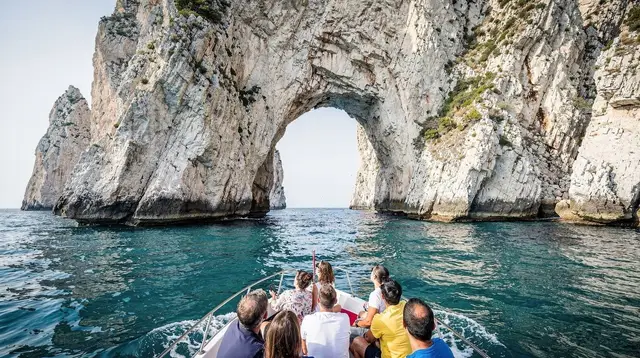
Capri by Yacht from Marina di Stabia Mochi Craft 33 8 Person Maximum

Private Cruise from Naples to Capri and Amalfi Coast - yacht 50'