Where to Stay on the Amalfi Coast: Coast, Sorrento, Capri, or Salerno
Where should you stay on the Amalfi Coast?
Stay directly on the coast (Amalfi, Positano, Ravello, Praiano) for immersion if you accept slow SS163 travel between villages. Choose Sorrento for a practical base with train access to Naples, Capri for an island stay reached by ferry, or Salerno for a cheaper, train-connected option a bus ride from the coast.
Why this decision matters more here than elsewhere
Pick the wrong base on the Amalfi Coast and you will not just have a longer commute — you will lose entire mornings. No village along the coast has a railway station, the single road connecting them is narrow and slow, and the ferry network that fills the gap runs on a seasonal schedule that all but disappears in winter. Before comparing hotels, most travelers need to compare geography first. This guide walks through the four bases that actually make sense — Amalfi, Positano, Ravello and Praiano on the coast itself; Sorrento on the neighboring Sorrentine Peninsula; Capri as an island stay; and Salerno as the budget, train-connected option — and explains what each trade-off actually costs you in time.
If you’re still deciding how many days you need before worrying about where to sleep, start with how many days on the Amalfi Coast and come back here.
The four bases, at a glance
| Base | On the coast? | Train access | Best for | Main trade-off |
|---|---|---|---|---|
| Amalfi / Positano / Ravello / Praiano | Yes | None | Immersion, walkability, views | Slow, costly transfers to everything else |
| Sorrento | No (Sorrentine Peninsula) | Yes, to Naples | Logistics, day trips, families | 45–75 minutes from the coast itself |
| Capri | No (island) | No | A dedicated island stay | Ferry-dependent, weather can cancel crossings |
| Salerno | No (gateway city) | Yes, regional hub | Budget, transport flexibility | Furthest from the coast’s scenic core |
Staying directly on the coast: Amalfi, Positano, Ravello, Praiano
Staying in one of the coastal villages themselves is the choice most people picture when they imagine this trip: waking up to the view, walking to dinner, stepping onto a boat from town. It’s also the choice that pays the biggest transport tax in July and August, when the SS163 slows to a crawl and SITA buses run standing-room only.
Amalfi functions as the coast’s practical hub — the Duomo, the closest thing to a transport interchange (buses and ferries converge here), and a walkable old town. It’s a strong base if you want one central-feeling point without paying Positano’s premium.
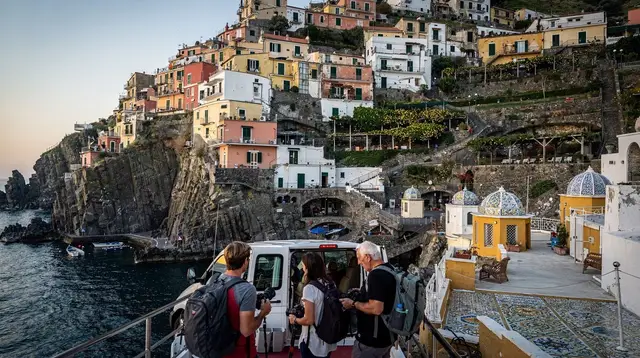
Positano is the postcard image, with beaches and photo spots that justify the price, but it’s also the most expensive and most crowded village, built on a near-vertical hillside where “walking to your hotel” can mean climbing hundreds of steps with luggage.
Ravello deserves a specific warning: it sits roughly 350 meters above sea level on a ridge, and it has no beach of its own. Getting to the water means descending by road or by a steep staircase to Amalfi or Minori — a real consideration if swimming or beach time is a daily priority rather than an occasional outing. Ravello rewards travelers who want quiet, views, gardens like Villa Cimbrone and Villa Rufolo, and don’t mind a deliberate trip down to the coast for the sea.
Praiano, between Positano and Amalfi, is the quieter, more residential alternative — often cited as a value pick precisely because it sits on the same road without Positano’s markup. See Praiano vs Positano for the direct comparison.
Whichever coastal village you choose, understand what you’re committing to: any trip beyond your home base — to a neighboring village, a museum, a boat tour — runs through the same single road or the same limited ferry timetable everyone else is using. A short-looking distance on the map does not translate into a short travel time in August.
Sorrento: the logistics base that isn’t on the coast
Sorrento is not part of the Amalfi Coast — it sits on the Sorrentine Peninsula, a separate geography — but it’s the most commonly recommended base for travelers who want efficiency over immersion, and for one specific reason: it’s the only town in the whole area connected to Naples by train, the Circumvesuviana. That line also stops at Pompeii and Herculaneum, making Sorrento a strong base for combining Amalfi Coast time with day trips to Pompeii or Naples.
The trade-off: Sorrento is not the Amalfi Coast, and reaching Amalfi, Positano or Ravello from here means 45 to 75 minutes by bus or ferry, depending on season and traffic. For families who value a stable base over daily village-hopping, or for anyone flying into Naples without a car, Sorrento’s practicality often outweighs not sleeping “on” the coast. Compare it directly against a coastal stay in Sorrento vs Amalfi Coast: where to stay.
Sorrento is also the easiest jumping-off point for Capri: the Sorrento–Capri ferry is short and frequent in season, making a two-day Capri and Sorrento combination straightforward.
Capri: a separate island stay, not a coastal base
Capri deserves its own category because it isn’t reachable by road from the mainland at all — only by ferry or hydrofoil from Naples, Sorrento, or seasonally from the coast itself. Treating Capri as a base for exploring Amalfi, Positano or Ravello doesn’t work logistically: you’d be adding a boat crossing, weather dependency, and a funicular or bus ride to Anacapri on top of every coastal excursion.
Capri makes sense as its own dedicated stop — a night or two focused on Capri’s highlights, the tide-dependent Blue Grotto, and Anacapri via the Monte Solaro chairlift — rather than a home base for the rest of the trip. Ferry schedules thin out considerably outside the Easter-to-October season, so an off-season Capri stay needs a flexible itinerary.
Salerno: the budget, train-connected alternative
Salerno rarely appears on shortlists, but it solves the problem this whole guide is built around: it has a real regional train station, connecting to Naples, Rome and the rest of Campania, plus bus and ferry links toward Amalfi. Prices tend to run noticeably lower than anywhere directly on the coast, and Salerno also sits closer to Paestum and its Greek temples than any coastal village does.
The cost of that value is distance from the coast’s scenic core — expect 40 minutes to well over an hour by bus or ferry to reach Amalfi, more to reach Positano or Ravello. Salerno suits travelers prioritizing budget and transport flexibility over waking up inside the postcard view, and pairs naturally with a Paestum extension.
How the high season changes this decision
From Easter through October, and sharply from June through August, two things happen at once: hotel prices along the coast rise, and the SS163 becomes genuinely congested, with ZTL traffic restrictions active in Amalfi, Positano and Ravello. A base that looks “20 minutes away” on a map can mean an hour or more in a bus queue in mid-August. If you’re traveling in peak season, weigh a coastal stay’s convenience against its price premium and traffic exposure — see avoiding crowds and best time to visit for the seasonal detail. Outside that window, from November through March, ferries and some bus lines reduce service or stop entirely, which can rule out Capri or village-hopping plans built around boats — see Amalfi Coast in winter.
There is no single “central” village
It’s tempting to look for the one town that’s “central” to the whole region, the way a traveler might pick a hotel near a city’s train station. The Amalfi Coast doesn’t work that way. It’s a roughly 50-kilometer linear strip clinging to a cliff, served by one road and a patchwork of buses and ferries — there is no midpoint that puts you equally close to everything, because everything is arranged in a line, not a cluster. Amalfi is the closest thing to a transport hub, but even from there, Positano is a real bus ride away and Ravello requires climbing uphill. Choosing a base here means choosing what you’re closest to, not choosing a center.
Matching a base to your trip style
- First-time visitors wanting the classic experience: a coastal base — Amalfi or Positano — accepting slower transfers as the cost of immersion. See the first-time visitor guide.
- Travelers without a rental car, flying via Naples: Sorrento, for the direct Circumvesuviana link and easier onward connections. Pair with getting around without a car.
- Couples wanting quiet and views over beach time: Ravello, understanding the walk or drive down to the water.
- Budget-conscious travelers or those extending to Paestum: Salerno, using its train station as a base for wider Campania.
- A dedicated island escape: Capri, booked as its own leg rather than a daily base.
Whichever base you choose, a guided tour can absorb the transport problem for a day rather than leaving you to manage buses and ferry timetables yourself. An Amalfi Coast sightseeing tour covers the coastal highlights with the driving handled for you, while a private Amalfi Coast tour lets you set the pace and start point from wherever you’re staying. Travelers based off the coast without a car often prefer an Amalfi Coast tour by bus that removes the parking and ZTL headache entirely, and if your base has calm water access, an SUP rental on the Amalfi Coast is a good way to experience the coastline from the water on a lower-key day.
Planning your stay: where to go next
Once you’ve narrowed down a base, it’s worth stress-testing the choice against how long you’re staying and how you’ll get around: check 3 days, 5 days or a full week itineraries to see how your chosen base fits the pacing, and read getting around without a car if you’re not planning to drive the SS163 yourself.
Frequently asked questions about where to stay on the Amalfi Coast
Is it better to stay in Positano or Sorrento?
Positano puts you inside the Amalfi Coast’s most photographed scenery but with slow, expensive access to everything outside the village. Sorrento is not on the Amalfi Coast itself but connects to Naples by the Circumvesuviana train and to the coast, Capri and Pompeii by bus or ferry, making it the more practical logistics base.
Does Ravello have a beach?
No. Ravello sits at roughly 350 meters above sea level on a ridge above the coast. Reaching the water means descending by road or a steep staircase to Amalfi or Minori, so it does not suit travelers who want the sea within easy walking distance.
Is Sorrento part of the Amalfi Coast?
No. Sorrento sits on the Sorrentine Peninsula, a separate geographic area from the Amalfi Coast proper. It is commonly used as a base because it has the peninsula’s only direct train link to Naples, but reaching Amalfi, Positano or Ravello from Sorrento still means a bus or ferry ride along or around the coast.
Is Capri a good base for visiting the Amalfi Coast?
Capri works as its own island stay rather than a base for the coast. It connects to Amalfi, Positano, Sorrento and Naples by ferry or hydrofoil, but those crossings are seasonal and can be cancelled in rough weather, so treat Capri as a separate leg of the trip rather than a hub for daily coastal excursions.
Why does everyone say the Amalfi Coast has no train station?
Because it is true: Amalfi, Positano, Ravello, Praiano and the other coastal villages have no railway. The nearest stations are in Salerno and Sorrento, and travelers reach the coast itself from either point by SITA bus, ferry, or private transfer along the SS163.
Is Salerno a good place to stay for the Amalfi Coast?
Salerno is the coast’s most budget-friendly base with the advantage of a regional train station and ferry and bus connections toward Amalfi. It sits outside the coast’s scenic core, so expect a bus or ferry ride of 40 minutes to over an hour to reach Amalfi, Positano or Ravello.
How much does the high season affect where I should stay?
Substantially. From Easter through October, and especially in July and August, the SS163 becomes congested and hotel prices along the coast rise sharply. A base that looks convenient on a map can add real travel time once traffic and ZTL restrictions are in effect.
Can I stay in one village and day-trip to the rest of the coast?
You can, but budget more transit time than distances suggest. The coast is a roughly 50-kilometer strip served by a single winding road, SITA buses and seasonal ferries, so a short-looking hop between two villages can take 45 minutes or more in high season.
Best Amalfi Coast Tours on GetYourGuide
Verified deep-linked GetYourGuide tours. Book through these links and we earn a small commission at no cost to you.
GetYourGuide does not provide a product photo for this activity — the image shows the meeting point, photographed by us.