Why Amalfi Coast Ferries Stop in Winter
The first time I planned a Amalfi Coast trip, I built the whole itinerary around ferries. Amalfi to Positano by boat, a day hop to Capri, maybe a straight run back to Naples at the end. It looked so clean on paper. Then I actually tried to book a January crossing and found almost nothing running. That gap between what the coast looks like in July photos and what it actually offers in February is the thing I wish someone had told me before I built a schedule around it.
The coast runs on two different transport systems, not one
Here is the part that trips people up: the Amalfi Coast doesn’t have a single, stable transport network that just scales up and down with demand. It effectively runs on two separate systems depending on the season, and they don’t overlap the way you’d expect.
In the warmer months, roughly Easter through October, ferries connect Amalfi, Positano, Capri, Sorrento, and Naples in a dense web of crossings. You can hop between villages by water, skip the SS163 traffic entirely, and treat the sea as your main road. That’s the version of the coast most travel photos and blog posts describe, because that’s when most people visit.
But once the season turns, that water network doesn’t just get thinner. On many routes it disappears. I’m not going to pretend I know the exact week this happens each year, because it isn’t fixed. It depends on the operator, the route, and honestly the weather that particular winter. What I can tell you is the pattern: as demand drops, so does the incentive for smaller operators to keep running underbooked boats across open water, especially on routes exposed to winter swell. Some links get thinner. Others stop being sold at all until spring.
Why I stopped treating the ferry as a default
The mistake I made wasn’t planning to use ferries. It was assuming they’d behave the same way regardless of when I traveled. On the Amalfi Coast specifically, that assumption doesn’t hold, and here’s why it matters more here than in a lot of other coastal destinations.
This coast has no train line running along it. None of the villages between Sorrento and Salerno, including Amalfi, Positano, and Ravello, have a station. So when the ferry option shrinks in winter, there isn’t a rail alternative quietly waiting to pick up the slack. The only options left are the SS163 coastal road and the SITA buses that run along it. That’s it. No third mode.
Compare that to a place like Sorrento to Naples, where the Circumvesuviana train exists year-round regardless of what the harbor is doing. On the Amalfi Coast proper, water and road aren’t complementary options you pick between for comfort. In winter, road becomes the load-bearing system, and the ferry becomes a bonus if and when it’s running.
What actually changes once the boats slow down
If you’re visiting in the off-season, here’s the practical shift I’d plan around, without pretending to know specific shutdown or restart dates:
| Season | Ferries | Main fallback |
|---|---|---|
| High season (roughly Easter–October) | Dense schedule, multiple daily crossings on popular routes | Optional; road available too |
| Low season (roughly November–March) | Reduced significantly, some routes suspended | SS163 road + SITA buses become primary |
Notice I’m not giving you a frequency number for either season. I’d be making it up, and honestly so would most articles that quote you “3 boats a day” style figures, because schedules shift year to year and operator to operator. What’s reliable is the shape of the pattern, not the specific numbers attached to it.
The practical consequence is that winter trips need to lean on getting around without a car via bus, or on driving the coast yourself and dealing with the SS163’s narrow curves without the summer ZTL traffic restrictions that usually complicate things in Amalfi, Positano, and Ravello. Ironically, the road is often less stressful in winter precisely because the crowds that make it painful in August aren’t there. But it’s still the only land route connecting these villages, so if the ferry isn’t running that day, the bus or a rental car isn’t a nice-to-have, it’s the plan.
How I’d build a winter Amalfi Coast trip differently now
Knowing what I know now, I wouldn’t structure a winter or shoulder-season trip around ferry hops between villages the way I would in July. I’d treat any ferry crossing as something to check close to the date, not something to build a fixed itinerary around months in advance.
For getting from Naples onto the coast itself, day tours that depart by road handle this reasonably well because they aren’t dependent on which boats happen to be running that week. A tour like the Amalfi Coast day trip with boat stops along the way can still work seasonal water sections into a road-based itinerary when conditions allow, without your whole day collapsing if the harbor schedule is thin. Similarly, a full guided day tour of the Amalfi Coast from Naples runs on coach and local transport rather than depending on a ferry timetable.
If your day trip also touches archaeology, something like a combined Pompeii and Amalfi Coast tour with a guide sidesteps the ferry question completely, since it’s built around road transfers between Naples, Pompeii, and the coast. And for a simpler one-way link into the region, a Naples-to-Amalfi Coast transfer tour gets you there by road regardless of what the harbor looks like that week.
None of this means avoid ferries in winter. If one is running the day you want to travel between, say, Sorrento and Capri, take it, it’s usually the nicer way to arrive. It means don’t build your only plan around one. Have the SS163 and SITA buses as your actual backbone for the off-season, and treat any ferry crossing as a pleasant option that might or might not be there rather than a guarantee. Check closer to your travel date, because that’s the only way to know what a given route is doing that particular week, and pack a plan B that doesn’t depend on the sea cooperating.
Ferries on the Amalfi Coast in winter, answered directly
Do Amalfi Coast ferries run in winter at all?
Some routes continue with reduced frequency, but many links between villages, Capri, and Naples are cut back significantly or suspended for parts of the winter. There’s no single date this happens, and it varies by route and operator.
What should I use instead if the ferry I want isn’t running?
The SS163 coastal road and SITA buses are the year-round fallback. Since the Amalfi Coast villages have no train station, road transport is the only backbone that doesn’t depend on the harbor schedule.
Is it true that ferries stop on an exact date each year?
No. There is no fixed calendar cutoff. Suspension and resumption depend on the operator, the specific route, and conditions that year, so treat any date you see quoted online as approximate at best.
Can I still get from Naples to the Amalfi Coast by boat in winter?
It depends on the week and the operator. Road-based transfers and guided tours are more dependable in the off-season because they don’t rely on a ferry timetable that may be thinned out or paused.
Does the ferry cutback affect Capri too?
Yes. Crossings to and from Capri follow the same seasonal pattern as coastal village routes, dense in high season, reduced in winter, so check availability close to your travel date rather than assuming a summer-level schedule.
Is driving the SS163 a good winter alternative to the ferry?
Many travelers find it more manageable in the off-season, since the heavy summer traffic and ZTL restrictions in Amalfi, Positano, and Ravello ease off. It’s still a narrow, winding road, so drive with that in mind regardless of season.
Why doesn’t the train help when ferries are reduced?
Because no train line reaches the Amalfi Coast villages themselves. The nearest stations are in Sorrento and Salerno, so the train helps you reach the region’s edges but not the coast road towns like Amalfi, Positano, or Ravello.
Popular Amalfi Coast Tours on GetYourGuide
Verified deep-linked GetYourGuide tours. Book through these links and we earn a small commission at no cost to you.
GetYourGuide does not provide a product photo for this activity — the image shows the meeting point, photographed by us.
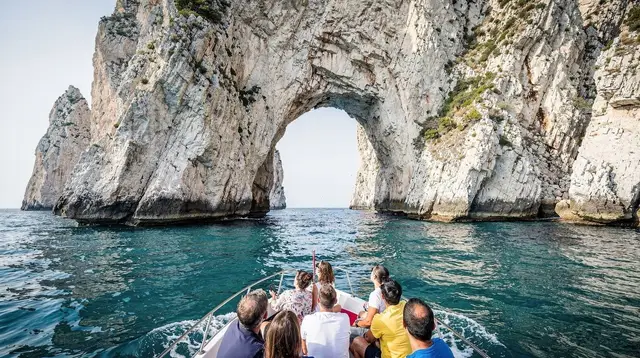
Capri by Yacht from Marina di Stabia Mochi Craft 33 8 Person Maximum

Private Cruise from Naples to Capri and Amalfi Coast - yacht 50'