Mount Vesuvius Crater Hike: The Rim Trail, Not a Descent
Can you hike down into the crater of Mount Vesuvius?
No. Vesuvius is an active volcano under permanent monitoring, and public access is limited to a marked trail along the crater rim, reached only with a numbered, limited-availability ticket. There is no descent into the crater itself, and no walk-up visit without a booked slot.
What the crater hike actually is
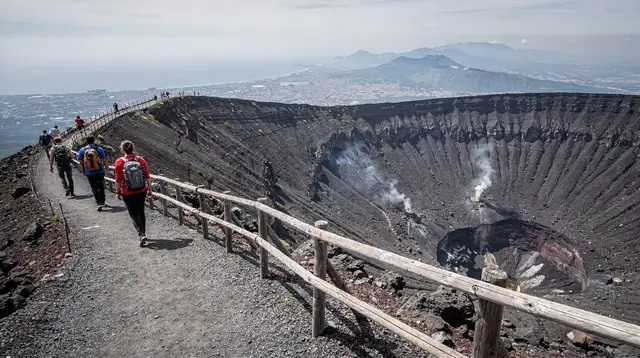
Every year, visitors arrive at the base of Mount Vesuvius expecting some version of a descent into the crater — a walk down toward the smoking depths they picture from documentaries. That is not what is on offer, and it never has been. What you can do at Vesuvius is walk a marked path along the outer rim of the crater, at a safe distance behind a barrier, looking down into the caldera from above. You do not enter the crater. You do not walk on its floor. The trail circles a section of the upper rim and then returns the same way, and that boundary is not a matter of park policy that might loosen with a better guide or a higher entrance fee — it is a fixed safety limit tied to the mountain’s active status.
Vesuvius last erupted in 1944, and it remains one of the most closely monitored volcanoes in the world today. The Osservatorio Vesuviano, part of Italy’s national institute for geophysics and volcanology, tracks seismic activity, ground deformation, and gas emissions around the clock. That monitoring is precisely why public access is possible at all: authorities allow a controlled number of visitors onto a specific, assessed section of the rim, while keeping everyone away from the crater interior and from areas judged less stable. This is not a trail you could reroute or extend informally. It is the entire visit.
Why the ticket is numbered, and what that means for your day
Access to the summit trail is capped through a numbered ticket system, and this cap is not a soft suggestion — it is how the site manages a genuinely limited safety perimeter around an active volcano. Tickets specify an entry time slot, and the number of visitors allowed onto the rim path within a given window is fixed. In July and August, slots for popular mid-morning windows can sell out days ahead, particularly for anyone also trying to combine the visit with Pompeii or Herculaneum on the same day.
Practically, this rules out the kind of spontaneous stop that works at, say, a museum with a walk-up counter. If you are driving up from Sorrento or the Amalfi Coast, or taking public transport from Naples, plan your ticket before you leave that morning, not once you arrive at the car park. Guided tours that include the entrance ticket remove this planning risk entirely, since the operator has already reserved the slot as part of the package — which is one of the reasons an organized visit is worth considering here even for travelers who normally prefer independent sightseeing.
| Booking style | Ticket handled by | Best for |
|---|---|---|
| Independent, self-booked ticket | You, in advance online | Confident planners comfortable with fixed time slots |
| Transfer + entrance ticket bundle | Tour operator | Visitors without a car, or short on planning time |
| Guided hiking tour | Tour operator | First-time visitors who want context on the geology and 1944 eruption |
| Combined Pompeii and Vesuvius tour | Tour operator | A single well-organized day covering both sites |
A straightforward way to remove the ticket-timing stress altogether is a transfer from Pompeii that already includes your numbered crater ticket, so the reservation is locked in before you set foot on the mountain.
The trail itself: moderate, not alpine
The walk from the upper car park to the crater rim path covers roughly 1.5 kilometers each way, gaining a few hundred meters of elevation on a wide, unpaved, volcanic gravel surface. There are no technical sections, no scrambling, no exposure requiring hands. It is best described as a steady, moderate uphill walk: comfortable closed shoes and a bit of stamina are enough for most adults and older children. It is not, however, a flat stroll, and it is not a groomed park path either — loose gravel underfoot and a genuine incline mean it takes longer than it looks from a photo.
Weather at this altitude changes the experience more than people expect, and this is not a rare inconvenience — it is a normal part of visiting an exposed summit above the Bay of Naples. Wind picks up noticeably near the rim, cloud can roll in and cut visibility over the crater and the bay view within minutes, and there is essentially no shade along the entire route. A layer for wind, sun protection, and water are worth carrying even on a day that looks clear from Naples or the coast, since conditions at the summit run independently of the weather at sea level.
Where Vesuvius sits, geographically and logistically
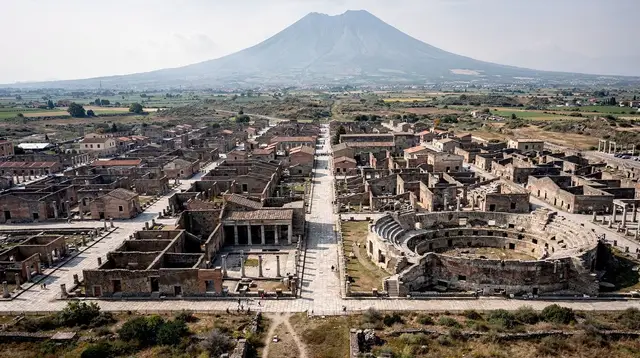
Mount Vesuvius rises over the Bay of Naples, close to both Pompeii and Herculaneum, the two archaeological sites destroyed in the 79 AD eruption — by different mechanisms, worth noting, since Pompeii was buried under ash and pumice fall while Herculaneum was overrun by a pyroclastic flow that preserved organic material like wood and carbonized food. Vesuvius, Pompeii, and Herculaneum form a natural day-trip cluster, but none of them are part of the Amalfi Coast itself. The coast’s cliffside villages lie well to the south, across the Sorrentine Peninsula, and reaching Vesuvius from there always means a transfer through Naples, Pompei, or Sorrento first.
Public transport reaches part of the way there: the Circumvesuviana train connects Naples to Sorrento, stopping at Pompei and Ercolano (Herculaneum) along the route, but it does not climb the mountain itself. From the Pompei or Ercolano station, a connecting shuttle bus makes the ascent to the car park near the trailhead. Travelers relying on this route should budget real transfer time between train and shuttle, rather than assuming a single seamless connection.
| From | Typical route to Vesuvius |
|---|---|
| Naples | Circumvesuviana train to Ercolano or Pompei, then shuttle bus up the mountain |
| Sorrento | Circumvesuviana train toward Naples, change at Pompei or Ercolano, then shuttle |
| Amalfi Coast | Bus or ferry to Sorrento or Naples first, then train and shuttle, or a direct organized tour |
| Pompeii site | Short transfer by shuttle bus or organized tour directly to the crater car park |
For travelers based on the coast, a day built entirely around public transport connections can eat into the time actually spent on the mountain, which is one reason a direct guided tour departing straight from Pompeii tends to suit visitors who are also touring the ruins that same day.
Pairing the visit with Pompeii, wine, or a guided hike
Because Vesuvius, Pompeii, and Herculaneum sit so close together, most itineraries combine the volcano with at least one archaeological site rather than treating it as a standalone destination. The volcanic soil around the mountain’s lower slopes also supports several small wineries, since mineral-rich volcanic ground has long been prized for grape growing here, which gives the area a secondary identity beyond archaeology and geology.
For visitors who want the full context, a small-group option combining the Pompeii ruins, the crater hike, and a stop at a Vesuvius vineyard compresses a lot into one organized day without requiring any of the train or shuttle logistics described above. Travelers who prefer a private pace, or want a guide who can explain the 1944 eruption and the monitoring network in more depth, are usually better served by a private guided hike paired with the Pompeii ruins, which allows more time on the rim path itself rather than following a fixed group schedule.
A smaller number of specialist tours go further into the geology, following recent lava flows lower on the mountain’s flanks with an official park guide explaining the rock formations up close — a different, complementary angle from the crater rim walk itself, and one worth considering for anyone with a second day free near Naples or Pompeii.
What to skip if you only have one day
If your time near Naples, Pompeii, and Vesuvius is limited to a single day, resist the urge to add too many stops. The crater hike, transfer time, and ticket entry queue alone can take three to four hours round trip from a base near Pompei, before adding time at the ruins themselves. Trying to fit Pompeii, Herculaneum, and Vesuvius into one day from a base on the Amalfi Coast, in particular, usually means a very early departure and a late return, given the additional transfer time back to villages like Amalfi or Positano, which have no direct train link at all.
A more realistic one-day plan pairs Vesuvius with just Pompeii, and leaves Herculaneum, which is smaller but no less significant, for a separate visit or a different day of the trip. Travelers based on the Amalfi Coast without their own car may also want to weigh a fully organized transfer over a self-arranged public transport chain, simply to protect the numbered ticket window from being missed due to a late train.
Practical notes before you go
Wear closed, comfortable walking shoes rather than sandals; the gravel surface is not sandal-friendly on a sustained incline. Bring water, since there is no reliable vendor at the summit itself and none along the trail. Sun protection matters even on a hazy day, given the lack of shade on the entire rim path. Check your ticket’s exact time slot before leaving your accommodation, since arriving late can mean being turned away from that window entirely, particularly during the July-August peak.
Finally, treat the “walk to the crater” framing literally: this is a walk to and along the rim of the crater, not into it. No package, no guide, and no higher-tier ticket changes that boundary, because it is set by the mountain’s active status and its ongoing monitoring, not by ticket price or group size. Anyone selling a “descent into the crater” of Vesuvius is describing something that does not exist as a public visitor experience.
Frequently asked questions about the Vesuvius crater hike
Can you go inside the crater of Mount Vesuvius?
No. The public trail runs along the rim at a safe distance from the crater edge barrier. There is no access to the crater floor at any point of the visit.
Do you need a ticket in advance for Mount Vesuvius?
Yes. Access is capped by a numbered ticket system with a limited daily allocation, so a spontaneous, unbooked visit is not possible, especially in high season.
When did Mount Vesuvius last erupt?
- It remains an active volcano under continuous monitoring by Italian civil protection authorities, which is why access is restricted and regulated rather than freely open.
Is the Vesuvius crater hike difficult?
It is a moderate uphill walk on a gravel path, not an alpine trek. Most visitors in reasonable fitness complete it in under an hour each way, though altitude wind and sun exposure can make it feel more demanding.
How do you get to Mount Vesuvius from Naples without a car?
Take the Circumvesuviana train from Naples toward Sorrento or Pompei, then connect to a shuttle bus that climbs to the car park near the trailhead. The train does not go to the volcano itself.
Is Mount Vesuvius part of the Amalfi Coast?
No. Vesuvius sits inland on the Bay of Naples, near Pompeii and Herculaneum, and is entirely outside the Amalfi Coast itself. It is usually visited as a day trip from Naples, Sorrento, or the coast.
Can Mount Vesuvius and Pompeii be visited on the same day?
Yes, this is the most common pairing, since both sites sit within a short drive or transfer of each other near Naples, but it makes for a full day given ticket timing and transfer waits.
Related planning for this area
Anyone building this into a wider trip should also read the complete guide to the Pompeii ruins before deciding how to split time between the two sites, since Pompeii alone can fill half a day. For visitors unsure which ancient site to prioritize, Herculaneum versus Pompeii lays out the practical differences between the two. Coast-based travelers should check the day trip from the Amalfi Coast to Pompeii for realistic transfer timing before committing to a single-day combination with Vesuvius.
For the train leg of the journey, the Circumvesuviana train guide explains the Naples-Sorrento line and its Pompei and Ercolano stops in detail, while the Naples airport to Amalfi Coast guide is useful if you are arriving the same day you plan to visit the volcano. Drivers should also look at the guide to driving the SS163 if continuing on to the coast afterward, since that road is a different kind of driving from the approach roads near Vesuvius.
More general trip planning is covered in how many days you need on the Amalfi Coast, and the best time to visit the Amalfi Coast, both useful for deciding where a Vesuvius day fits into a longer itinerary. If ticket queues and crowds are a concern, avoiding crowds on the Amalfi Coast has relevant seasonal timing advice that applies just as well to Vesuvius and Pompeii. Families traveling with children should also check Amalfi Coast with kids before committing to the crater walk, since the incline and lack of shade are worth weighing against nap schedules and stroller limits.
Those touring the wider archaeological area may also want practical tips for visiting Pompeii, which cover ticket entry points and timing that apply to a combined Pompeii and Vesuvius day. Anyone planning to base themselves in Naples rather than on the coast should browse the destinations page for Naples and the wider Pompeii and Herculaneum destination overview for accommodation and access context. The day trips hub also lists other options worth comparing before locking in your Vesuvius date.
For visitors who want a deeper look at the volcanic geology beyond the standard rim walk, the lava river hike with an official park guide is a specialist alternative worth considering on a second visit to the area, once the standard crater rim walk has been done.
Pompeii & Vesuvius Tours on GetYourGuide
Verified deep-linked GetYourGuide tours. Book through these links and we earn a small commission at no cost to you.
GetYourGuide does not provide a product photo for this activity — the image shows the meeting point, photographed by us.