Sunset Cruise from Positano: What to Actually Expect
Does a sunset cruise leave from Positano every day, year-round, at the same time?
No. Sunset cruises from Positano are a seasonal offer, running densely from Easter to late October and shrinking sharply in winter, when many operators pause entirely. Departure times shift with the actual sunset hour through the season rather than sitting on one fixed clock time, and every sailing depends on the sea conditions of the day.
A seasonal sailing, not a fixed daily departure
It’s tempting to picture a sunset cruise from Positano as something that runs every evening of the year at the same advertised hour, the way a ferry timetable might list a 6:00 PM crossing twelve months a year. That isn’t how it works here. Sunset cruises along this stretch of coast are a seasonal offer, dense from Easter through late October and considerably thinner — sometimes absent — from November to March. If you’re planning a trip for December or a shoulder week in early April, don’t assume the sunset cruise you saw mentioned in a summer travel piece will be waiting for you.
The reason is straightforward. Positano’s boat traffic in general follows the same rhythm as the ferries connecting the coast to Sorrento and Capri: a full, competitive schedule in high season, and a skeleton service — or none at all — once the weather turns and demand drops. Operators that run several sunset departures a week in July may run one a fortnight in November, weather and bookings permitting, or simply pause the product until spring. If you’re traveling in the off season, treat a sunset cruise as a maybe, not a given, and confirm directly with an operator rather than relying on a summer listing.
The departure time follows the sun, not the clock
The second thing that trips people up is the idea of a fixed departure time. A sunset cruise, by definition, is timed to the sunset itself, and sunset in this part of the Mediterranean shifts by more than two hours across the season. A cruise boarding around 6:00 PM in early May might board closer to 7:30 or even 8:00 PM in the middle of August, then slide back toward 5:30 PM by late September. There is no single “the sunset cruise leaves at 7 PM” answer that holds across the year.
In practice, most operators set boarding roughly 45 minutes to an hour and a half before the actual sunset time for that date, so the boat is out on the water as the light starts to change and back at anchor or docked as it fades. If you’re checking what time of year to visit and want to fit a sunset cruise into a specific evening, look up the departure time when you book that particular date rather than assuming it matches what a friend was told the month before.
What the view from the water actually adds
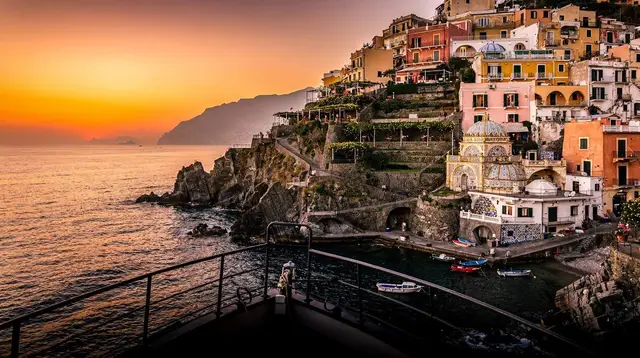
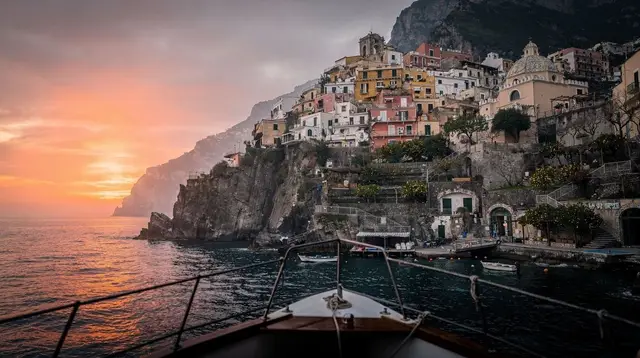
Positano is usually experienced from above and from within: the switchback stairways, the terraces stacked up the hillside, the narrow lanes threading between them. A sunset cruise flips that entirely. From offshore, the village reads as a single continuous composition — the pastel buildings climbing the cliff, the dome of the parish church, the whole tiered shape of the town — seen the way it appears on postcards, but live and changing color as the light drops.
It also removes you from the crowd. The viewpoints along the upper paths and the terraces of restaurants get busy at exactly the hour the light is best, and the beach itself is at its most crowded in the late afternoon. Out on the water, that density disappears. You’re looking back at a town full of people from a boat that, depending on the operator, might carry a dozen passengers or fewer. It’s a genuinely different vantage point, not just the same view at a different angle.
Depending on the specific itinerary, some cruises don’t stay parked in front of Positano the whole time. A number of routes head west along the coast toward Praiano and the narrow inlet of the Fiordo di Furore, giving a longer look at the cliffs, coves, and villages beyond Positano itself before turning back as the light fades. Others keep a tighter loop just offshore from Positano and Spiaggia Grande. If seeing that stretch of coast matters to you, check the route description before booking — the difference between a cruise that stays local and one that runs toward Praiano can be significant.
Why boarding feels different here
One detail surprises first-time visitors more than almost anything else about a Positano boat trip: there’s no real port. Compare it to Salerno, which has a proper harbor and ferry terminal, or even Sorrento’s Marina Piccola with its dedicated jetties. Positano has neither. Boats board from the beach — Spiaggia Grande, the main strand in the village center — or from a modest pier, often by wading a short distance or stepping from a tender onto a larger boat anchored just offshore.
This isn’t a flaw in the product; it’s a structural fact about the village that shapes how the whole experience runs. Because the boarding point is narrow and shared across every operator working that evening, only so many boats can load passengers at once in peak season. Groups get staggered, boarding can take longer than expected, and arriving at the meeting point in good time — rather than right at the stated hour — makes the difference between an unhurried start and a rushed one. If you’re used to boarding a ferry from a proper dock elsewhere on the coast, Positano’s beach-launch setup is worth expecting in advance rather than discovering on the spot.
No promise of a calm sea
It’s worth saying plainly: nobody can guarantee flat water for your evening out. Sunset cruises, like every other boat departure along this coast — the scheduled ferries, the day-trip boats to Capri, the water taxis between villages — sail subject to the actual conditions of the day. Most summer evenings here are genuinely calm, which is part of why the sunset cruise product exists and sells well from Easter onward. But a stretch of wind, a swell rolling in from the south, or an unsettled forecast can lead an operator to shorten a route, cancel a swim stop, move the departure earlier or later, or cancel the sailing outright.
This is standard practice, not a red flag on a specific operator, and it mirrors how driving the SS163 or catching a coastal ferry both depend on daily conditions rather than a fixed guarantee. Build a little flexibility into your evening, especially if the cruise is the centerpiece of a special occasion, and avoid stacking it directly before a tight dinner reservation or an early departure the next morning.
Dressing for an evening on the water
The temperature on a boat after sunset drops faster than it feels like it should while you’re still standing on a warm beach. Even in the middle of summer, a breeze picks up once the boat is moving and the sun is off the water, and the difference between a warm evening in town and a chilly half hour offshore catches people out more often than any other detail of the trip. A light layer — a shirt or a thin jacket — is worth having even in August, and it becomes closer to essential by September and October when the evening air cools faster after the light fades; the month-by-month patterns in the weather guide are a reasonable way to gauge how much of a layer a given week calls for.
Footwear matters too, in a smaller way. Boarding from the beach or a tender rather than a fixed dock means wet sand, a wobbly step, or a splash of seawater is a real possibility, so shoes that can get damp — rather than the pair you’re saving for dinner afterward — make the boarding process less stressful. If you’re building a full Amalfi Coast packing list around trips like this one, the general packing guide covers the same logic for boat days elsewhere on the coast.
Fitting a sunset cruise into a first visit
For travelers on their first trip to this coast, a sunset cruise is usually an add-on to a day already built around walking Positano itself rather than a full evening in its own right, and it slots naturally into the kind of pacing covered in the first-time visitor guide. Because the cruise itself typically runs one and a half to three hours depending on the format, most travelers treat it as the transition between an afternoon in town and dinner afterward, rather than the entire evening.
That timing also opens up what comes after. Positano’s restaurants and bars along the beach and the lower town pick up once cruises return and the light is gone, and pairing the boat with a look at what Positano’s evening scene actually offers is a natural way to close out the day. For anyone hoping to bring back more than a memory, the classic shots of the tiered village from offshore are hard to beat, and the broader rundown of where those photo opportunities cluster around town is worth a glance before you go, since the same principles — golden hour, avoiding backlight, shooting from a stable spot on the boat — apply on the water as well as from land.
What a typical sunset cruise includes
Offerings vary by operator, but most sunset departures from Positano fall into a few recognizable formats. A shared, no-frills sailing — such as the Positano shared sunset cruise — groups passengers who don’t know each other onto one boat for a straightforward outing along the coast as the light changes. It’s usually the most affordable route into the experience and a reasonable pick if the view matters more to you than an intimate, small-group feel.
Several operators build in food and drink rather than leaving you to watch the sunset with nothing in hand. A cruise that pairs the sailing with an aperitivo spread served on board turns the outing into something closer to a floating happy hour, with drinks and small bites timed to the changing light. Others lean further into a full evening out, combining the sunset sailing with a fuller spread of drinks and snacks across a longer route.
If avoiding crowds is your priority rather than food and drink, look at cruises pitched specifically around smaller groups, such as one built to get away from the busiest stretches of coast in a smaller boat. And for travelers who’d rather combine a swim earlier in the day with the sunset itself, some itineraries fold both into one outing, like a bay cruise that includes a swim stop and a lemon sorbet break before the light starts to turn — worth checking if you want the water time as well as the view.
Sunset cruise formats compared
| Format | Focus | Typical length | Good for |
|---|---|---|---|
| Shared sunset cruise | Simple sailing, no extras | ~1.5–2 hours | Budget-conscious travelers, first-timers |
| Cruise with aperitivo | Drinks and light bites on board | ~2–2.5 hours | A relaxed evening out, couples |
| Drinks-and-snacks day trip | Longer route, fuller food service | ~3 hours+ | Groups wanting more time on the water |
| Small-group / escape-the-crowds cruise | Fewer passengers, quieter pace | ~2 hours | Travelers prioritizing space and calm |
| Bay cruise with swim stop | Swim break plus sunset | ~2.5–3 hours | Combining a swim with the evening light |
Beyond a boat: other ways to catch the same light
A boat isn’t the only way to watch the sun go down over this coastline. Some visitors prefer a route on land that ends at a high viewpoint rather than at sea level — an option covered in the guide to a romantic hike on the Path of the Gods timed to sunset, which looks down at Positano and the water from above rather than up at the village from a boat. If you’d rather stay on two wheels than on water, a guided Vespa tour timed to the evening light covers a stretch of coast road at sunset with stops for photos along the way.
For travelers based in Sorrento rather than Positano itself, note that boat access into this stretch of coast can also start from there: an itinerary such as the Sorrento-based cruise that takes in Positano and Amalfi covers similar water without requiring you to be based in Positano for the night. And for those weighing an entirely different island evening, a group cruise from Positano toward Capri and the Blue Grotto or the route via the Emerald Grotto at Conca dei Marini reach different landmarks than a straightforward sunset sailing does.
Planning around the cruise
Because the boarding point is small and departure times shift with the calendar, a little planning goes a long way. If you’re staying in Positano itself, you can walk to the beach with time to spare; if you’re coming from Praiano or Amalfi, factor in the SITA bus or a taxi, since the SS163 can be slow in the late afternoon exactly when you need to arrive. Travelers building a longer stop on this stretch of coast often pair a sunset cruise with a full day nearby — see the three-day Amalfi Coast itinerary for how it can fit around other stops like Ravello or a day trip toward Capri.
If you’re not staying in Positano at all, the cruise can still work as part of a base-town decision rather than a reason to change plans. Travelers weighing where to stay along the coast sometimes assume a Positano-based sunset cruise requires a Positano hotel, but a base in Praiano or Amalfi still leaves you close enough via the SITA bus or a short taxi ride, provided you build in the extra travel time on both ends of the evening. And for anyone who has already ruled out a rental car for the trip, the same reasoning behind getting around the coast without a car applies directly here: public transport and taxis handle the approach to the boarding point fine, and a car adds parking stress in Positano that a boat evening doesn’t need.
Whatever format you choose, go in expecting a seasonal product with a moving departure time, a modest beach-side boarding process rather than a formal terminal, and a sailing that depends on the sea that particular evening. Positano from the water, with the village catching the last light and the crowds left behind on shore, tends to live up to the description regardless — it’s the logistics around it, not the view itself, that call for some flexibility.
Sunset Cruises on the Amalfi Coast on GetYourGuide
Verified deep-linked GetYourGuide tours. Book through these links and we earn a small commission at no cost to you.
GetYourGuide does not provide a product photo for this activity — the image shows the meeting point, photographed by us.