Amalfi Coast Wheelchair Accessibility: What to Really Expect
Is the Amalfi Coast wheelchair accessible?
Only in patches. Amalfi's seafront and a handful of Ravello terraces reached by private lift are genuinely flat, but Positano and most cliffside villages are built on stepped lanes with no ramps, and the SS163 coast road has no continuous sidewalks. Wheelchair users need a pre-planned route, accessible transfers, and realistic expectations rather than a single accessible itinerary covering the whole coast.
The postcard view hides a cliff
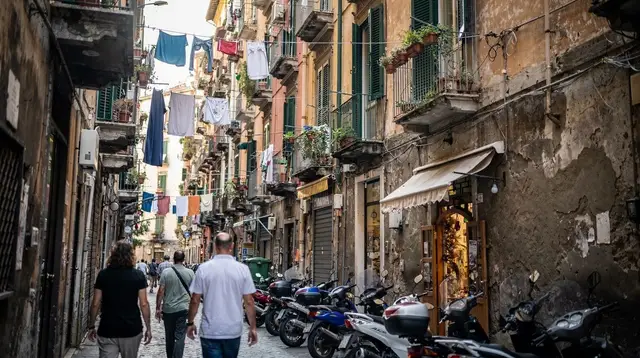
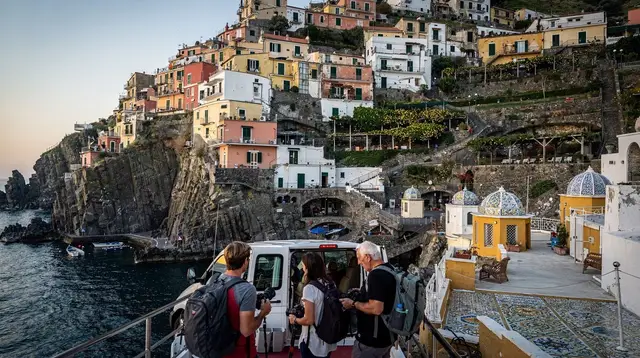
Photographs of the Amalfi Coast tend to flatten it: pastel houses stacked above a blue sea, a road curving gently along the water. In person, the region is a coastline carved into a limestone cliff face, and the towns are built vertically rather than horizontally. Amalfi, Positano, and Ravello are connected internally by stepped lanes, covered staircases, and steep alleys rather than level streets, and the main road linking them, the SS163, is a narrow, winding corridor without continuous sidewalks in most stretches. None of this makes the coast impossible for wheelchair users, but it does make it a destination that punishes improvisation. A trip that would take a few clicks to plan on a flat itinerary requires real groundwork here: knowing which few streets are level, which transport options are only sometimes accessible, and which towns should be approached differently, or skipped, depending on the type of chair and the level of assistance available.
This guide does not promise a fully accessible Amalfi Coast, because that destination does not exist. What follows is a realistic, town-by-town account of where wheelchair users can move independently, where a companion and planning are required, and where the terrain simply does not allow for wheeled access without carrying assistance.
No train, and no uniform standard on buses or ferries
One fact shapes almost everything else: no town on the Amalfi Coast itself has a railway station. The nearest stations are in Salerno and in Sorrento, on the Circumvesuviana line, and reaching the coast from either requires a further leg by road or water. For most travelers this means choosing between a rental car, a private driver, the SITA bus network, or seasonal ferries, and each of these options has a very different accessibility profile.
SITA buses run the length of the SS163 and are the coast’s only scheduled public transport along the corniche, but the fleet is mixed. Some vehicles have low floors and a ramp; others do not, and there is no way to request a specific accessible bus for a specific departure. Relying on the SITA network as a dependable accessible transport option is not realistic; it can work, but only as a matter of which vehicle happens to be assigned that day.
Ferries between Amalfi, Positano, Salerno, Sorrento, and Capri are seasonal, generally running from spring through October, and are suspended or drastically reduced in winter. Accessibility again depends on the individual boat and operator: some vessels have a level gangway at calm moorings, while others require stepping down onto a lower deck, a maneuver that becomes harder, or impossible, when the sea is rough or the tide is low. No ferry route on this coast should be assumed step-free without confirming the specific boat in advance, ideally by contacting the operator directly rather than trusting a general description online.
A private driver, arranged in advance, removes much of this uncertainty. It cannot flatten the terrain inside a town, but it avoids the gamble of an inaccessible bus or ferry and allows a route built around the coast’s few accessible stretches, described below.
Amalfi: the most workable base
Of the coast’s main towns, Amalfi offers the longest stretch of usable, relatively flat ground. Its seafront promenade runs along the harbor at sea level, and the main piazza in front of the Duomo is reachable without stairs from the promenade, even though the cathedral’s own staircase itself is not accessible. A short walk along Amalfi’s town center covers shops, cafés, and the harbor without requiring the staircases found deeper into the town’s back lanes. The Museo della Carta, tracing the town’s papermaking tradition, sits a short distance up a gentle slope from the center and is more manageable than most inland attractions on this coast.
Amalfi’s relative flatness is also why it tends to be recommended as a base for visitors with mobility needs who still want to experience the coast directly, rather than only from a moving vehicle. It is not step-free everywhere, and side streets running away from the seafront rise quickly into stairs, but the core loop between the harbor, the piazza, and the promenade is workable for a manual or powered chair with some assistance.
Positano: mostly staircases, no way around it
Positano is the town where expectations most need adjusting. Built into a near-vertical hillside, its layout is defined by a network of stepped lanes rather than streets, and reaching most hotels, restaurants, and viewpoints from the main road above means descending, or climbing, long staircases with no ramp alternative. The town’s beaches, Spiaggia Grande and Fornillo, are reachable by paths that flatten out closer to the water, and Spiaggia Grande itself has a level stretch near the boat docks, but getting there from the upper town remains an obstacle for most wheelchair users without carrying assistance.
This does not mean Positano is entirely out of reach. Travelers who arrive by boat, landing directly at the town’s small harbor, avoid the steepest sections of road above, and a private driver can drop passengers close to the church steps near the beach rather than at the upper car parks. But presenting Positano as an easy accessible stop, the way it sometimes appears in general trip-planning content, is misleading. Anyone using a wheelchair should plan a Positano visit around the harbor and beachfront only, not the town’s upper lanes.
Ravello: partial access, thanks to a private lift
Ravello sits roughly 350 meters above the coast, perched on a ridge rather than at sea level, and the road up from Amalfi or Minori involves switchbacks with no flat pedestrian shortcut. Once in Ravello itself, though, accessibility improves in a few specific spots. Villa Rufolo has relatively level garden paths once past the entrance, and parts of Villa Cimbrone are manageable, though its famous Terrace of Infinity is reached via paths that are not uniformly flat. Some accommodations and venues in Ravello use a private lift connecting a lower parking or arrival point to their upper terraces, which is how a handful of visitors with limited mobility can reach viewpoints that would otherwise require stairs.
Ravello’s concert season and its cliffside terraces draw wheelchair users specifically because of these lifts, but access varies venue by venue, and there is no coast-wide standard. Confirming lift availability with a specific villa, hotel, or event venue ahead of time is necessary; assuming any Ravello terrace is reachable by chair without checking first is a mistake.
Smaller villages: case by case, mostly limited
Villages such as Praiano, Minori, Maiori, Vietri sul Mare, Cetara, and Atrani vary in their terrain but share the coast’s general pattern: some flat ground near the water, and stairs almost everywhere else. Minori and Maiori have some of the coast’s flattest beachfronts, since both sit on a slightly wider stretch of shoreline than Positano or Amalfi, which makes them worth considering for visitors who want beach access without a steep approach. Praiano, by contrast, is spread across a hillside with limited level ground. Atrani, the coast’s smallest town, has a compact and largely flat central piazza just steps from Amalfi, making it an easy add-on rather than a destination requiring separate planning.
Capri and Sorrento: a different kind of obstacle
Capri adds a layer of complexity the mainland coast does not have: getting onto and off the island at all. Arriving by ferry or aliscafo from Naples, Sorrento, or the coast means boarding at Marina Grande, and from there the historic way up to Capri town is the funicular, which has stairs at both the lower and upper stations rather than a level boarding platform. A road also connects Marina Grande to Capri town and on to Anacapri, and this is the more realistic option for a wheelchair user, provided a taxi or private transfer is arranged in advance rather than assumed on arrival. Once in Capri town, the Piazzetta and the streets immediately around it are relatively level, but side lanes toward the Faraglioni viewpoints or the Gardens of Augustus involve steps. The Monte Solaro chairlift connecting Anacapri to the island’s summit is a single-seat open chair, not a wheelchair-accessible cabin, so it is not an option for most chair users.
Sorrento, by comparison, is one of the easier bases in the whole region. It sits on a plateau rather than a cliff face, and its old town has genuinely level streets connecting the main piazza, shops, and restaurants, even if the final stretch down to the marina below the cliffs still involves lifts or ramps rather than a gentle slope. Sorrento is also the only town in the area reached directly by train, the Circumvesuviana from Naples, which removes one layer of uncertainty from the journey in, and it is where most travelers arriving from Naples Airport end up transferring toward the coast. For a base that combines usable, level ground with reasonably good onward transport, Sorrento is worth weighing against Amalfi.
Comparing accessibility across the coast
| Town or area | Flat, usable ground | Main obstacle |
|---|---|---|
| Amalfi | Seafront promenade, main piazza | Back lanes and cathedral steps |
| Positano | Small stretch near Spiaggia Grande | Stepped lanes connecting upper town |
| Ravello | Villa gardens, lift-served terraces | Approach road, uneven paths beyond entrances |
| Minori / Maiori | Beachfront promenades | Limited beyond the immediate seafront |
| Atrani | Central piazza | Very small area overall |
| Praiano | Minimal | Hillside layout throughout |
Naples, Pompeii, and day trips: often easier than the coast itself
Somewhat counterintuitively, several of the region’s most popular day trips are more wheelchair accessible than the coast towns themselves. Naples is a large, mostly flat city with wider, if uneven, sidewalks in its historic center, and dedicated accessible city tours exist there. Pompeii has made significant accessibility improvements in recent years, with a marked accessible route covering many of its main structures, though its ancient stone paving remains uneven in places. Paestum, with its open, flat archaeological park, is one of the more manageable ancient sites in the region. Herculaneum, by contrast, sits below modern street level and is reached by ramps and walkways that are more limited than Pompeii’s. Mount Vesuvius, with its numbered-ticket crater path, is not wheelchair accessible; the trail is unpaved, sloped scree along a crater rim.
For a wheelchair user weighing where to spend limited time, a day built around Naples and Pompeii can, perversely, deliver a more comfortable and complete experience than a day spent trying to move between Positano’s staircases.
Booking around the terrain, not against it
Given how uneven access is across the coast, the most reliable approach for wheelchair users is a private, purpose-built itinerary rather than a self-assembled day of public buses and ferries. A wheelchair accessible private tour covering the Amalfi Coast’s highlights is built specifically around the coast’s workable stretches, such as Amalfi’s seafront and Ravello’s lift-served terraces, rather than assuming universal access. For the Naples side of a trip, a wheelchair-friendly city tour of Naples takes advantage of the city’s flatter historic core.
Travelers who want to see the coast road itself without driving, and without gambling on a specific SITA bus having a ramp, can also look at a guided coach tour along the Amalfi Coast, though it is worth confirming vehicle accessibility directly with the operator before booking, since not every coach on this route is equipped the same way. For a fully customizable route that skips staircase-heavy sections entirely, a private tour of the Amalfi Coast with a driver familiar with the region’s accessible pockets tends to be the most dependable option overall.
Planning checklist before you go
- Contact accommodation directly to confirm step-free access from the entrance to the room, not just an “accessible room” label; see where to stay on the Amalfi Coast for base options.
- Base yourself in Amalfi or Sorrento rather than Positano if independent movement matters; read Sorrento vs Amalfi Coast for where to stay for the tradeoffs.
- Treat SITA buses and seasonal ferries as possible, not guaranteed, accessible options, and always have a backup plan.
- Confirm lift or ramp access at specific Ravello venues before counting on a terrace visit.
- Consider a private driver for the SS163 itself, since the road has no continuous accessible pedestrian infrastructure.
- Build day trips around Naples, Pompeii, and Paestum, which generally offer flatter, more predictable terrain than the coast villages.
- Avoid visiting in peak summer if mobility is a concern; late spring or October bring lighter crowds on the coast’s narrow pedestrian sections.
A coast that rewards preparation, not spontaneity
None of this makes the Amalfi Coast an unreasonable destination for wheelchair users. Amalfi’s seafront, Ravello’s lift-served terraces, and the flatter beachfronts of Minori and Maiori all offer real, enjoyable access to this landscape. But the coast’s cliffside geography is not a minor inconvenience to be worked around at the last minute; it is the defining fact of the region, the same reason no town here has a railway station and the same reason the SS163 remains a narrow corniche rather than a modern highway. A visit planned around the coast’s genuine limitations, with accommodation, transport, and daily stops chosen in advance, can work well. A visit that assumes the coast will simply accommodate a wheelchair the way a flat city might is the one likely to end in frustration halfway up a staircase in Positano.
Accessible Tours on the Amalfi Coast on GetYourGuide
Verified deep-linked GetYourGuide tours. Book through these links and we earn a small commission at no cost to you.
GetYourGuide does not provide a product photo for this activity — the image shows the meeting point, photographed by us.