Kayaking the Amalfi Coast: Sea Caves, Coves and Cliffs by Paddle
Is kayaking a good way to see the Amalfi Coast?
Yes, for a specific slice of the coast: kayaking reaches small coves and sea caves that large excursion boats cannot enter, right beneath the cliffs. It only works in calm sea conditions, though, and the practical season runs roughly from Easter to autumn, similar to the coast's ferry schedule.
What kayaking actually shows you here
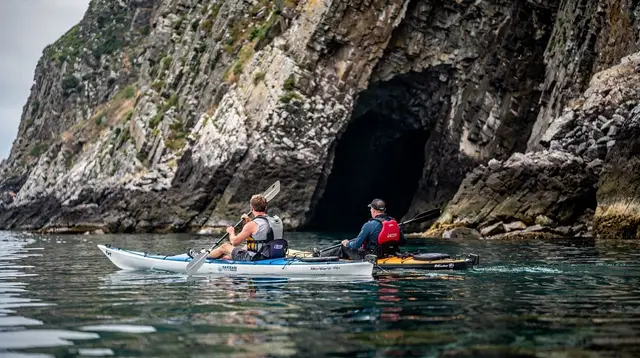
Most people experience the Amalfi Coast from a car window, a bus seat, or the deck of a ferry — all viewpoints that keep you a fixed distance from the cliffs. A kayak changes that distance. Paddling right along the base of the rock face, at eye level with the water, puts you close enough to see sea caves, narrow inlets and pocket coves that a standard boat tour from Amalfi simply cannot enter — the hulls are too wide, the draft too deep, or the operators unwilling to risk the rocks. This is the honest case for kayaking here: it opens up a genuinely different layer of the coastline, not a replacement for how most people get around, but an addition to it.
It helps to be specific about what that layer looks like. The Amalfi Coast’s shoreline is almost entirely cliff, dropping straight into the sea for long stretches with no beach at all. Where the rock does relent, it tends to open into small coves — a few dozen meters of pebble or a slot of calm water tucked behind an outcrop — rather than the long sandy runs you’d find elsewhere in Italy. A kayak fits into that geography in a way almost nothing else does: it can slip into a cove too small for a motorboat, hover at the mouth of a sea cave to let the light come through, and hug a cliff base for a stretch that a road or trail never touches. If you’ve already read what the Positano beaches actually are and understand this isn’t a Caribbean sand coast, kayaking is the logical next step: it lets you explore the parts of that same rocky geography that aren’t reachable on foot or by regular ferry.
The trade-off: weather, sea state and a short season
None of this comes free of constraints, and the constraints are worth stating plainly before you book anything. Kayaking on open sea along a cliff coast is far more sensitive to conditions than a ferry crossing or a bus ride. A stiff onshore wind, a swell running in from the open Tyrrhenian, or an afternoon squall can turn a calm morning cove into a rough, unsafe stretch of water within an hour. Reputable operators build a wide safety margin into this: outings are typically scheduled for the morning, when the sea is statistically calmer, and they are cancelled or rerouted at short notice if conditions don’t cooperate.
This is also why the kayaking season tracks so closely with the coast’s ferry season: roughly Easter through autumn, with the calmest, most reliable weeks generally falling in late spring and again in September and early October. Outside that window, the sea is colder, rougher, and far less predictable, and very few operators run kayak trips at all — much like the coast’s boat lines, which thin out or stop entirely once the shoulder season ends, as covered in why the Amalfi Coast’s ferries stop in winter. If you’re planning a trip for December through March, treat kayaking as unlikely to be available, and check the month-by-month weather guide before assuming otherwise. If you want the calmest water with the fewest crowds sharing it, cross-check dates against the coast’s best time to visit.
Where you actually launch from
One detail surprises first-timers: there is no long, obvious stretch of beach to launch a fleet of kayaks from, because the coast simply doesn’t have one. Put-in points are limited to the handful of small coves that exist near Amalfi itself and a few neighboring villages, where a narrow strip of pebble or a low stone landing gives just enough room to get kayaks into the water. Group sizes on guided outings tend to stay small partly for this reason — a cove that fits eight kayaks comfortably doesn’t fit twenty.
Because these launch points are so limited, almost all kayaking here is organized around a short there-and-back or loop route from one of these coves, rather than a long point-to-point paddle. A typical outing runs two to three hours: paddling out along the cliff base, a stop to snorkel or swim into a cave mouth, and a return leg, often finishing with time to towel off before lunch. This is a fundamentally different shape of activity from a coastal cruise that stops in three or four villages over a full day — kayaking stays local, and it stays slow, by design.
| Aspect | Kayaking | Standard boat tour |
|---|---|---|
| Distance covered | Short, local (single cove area) | Long, multiple villages/landmarks |
| Access to sea caves and tight coves | Yes, where sea allows | Limited to wider caves, larger boats |
| Physical effort | Moderate, ongoing paddling | Minimal, seated |
| Season | Roughly Easter–autumn, weather-dependent daily | Roughly Easter–autumn, more reliable scheduling |
| Best for | Close-up exploration of a cliff stretch | Covering ground, seeing several villages |
A landmark to know: the Fiordo di Furore
If you spend any time looking at maps or photos of this coastline, you’ll come across the Fiordo di Furore — a narrow, dramatic cut in the rock between Amalfi and Praiano, with a tiny pebble beach at its base and a high bridge spanning the gap above. It’s a useful geographic reference point for kayaking discussions because it’s exactly the kind of feature the activity is suited to: a slot too tight and too shallow-watered for a normal excursion boat, but visually striking from just offshore.
It would be a mistake, though, to assume the fjord is an easy or guaranteed kayak stop. Some guided routes pass near it when conditions allow, but reaching or entering the inlet by kayak depends entirely on the sea state on the day, and no operator can promise it in advance. Most visitors, in fact, reach the Fiordo di Furore’s small beach the more conventional way — on foot, via a steep staircase that drops from the coastal road down to the water. If the fjord itself is your main goal rather than a possible bonus sighting, read the dedicated Fiordo di Furore guide for how to get there reliably, and treat any kayak-based approach as a “if the sea allows it” extra rather than the plan itself. The same logic applies to other well-known caves along this stretch, including the Emerald Grotto near Conca dei Marini, which most visitors also reach by regular boat or on foot rather than by kayak.
What a typical guided outing includes
a guided kayak outing along the Amalfi cliffs that combines paddling with a snorkeling stop near sea caves is the most direct way to do this without arranging your own gear or route planning. These outings generally include kayaks, paddles and life jackets, a short briefing on paddling technique for anyone without experience, a guide who knows which coves and caves are worth the detour that day, and a stop to snorkel or swim once you reach a sheltered spot. Because routes are adjusted to the day’s sea conditions, the exact stops can vary — that flexibility is part of what keeps the activity safe rather than a shortcoming.
Kayaking works well as one component of a longer day rather than the whole plan. Many visitors pair a morning paddle with an afternoon on a wider-ranging boat tour that covers a longer stretch of the coastline by sea, since the two activities cover different distances and different kinds of terrain rather than duplicating each other. Others prefer to save the water entirely for late afternoon and take a sunset cruise along the coast to see the cliffs lit in evening light, which is a calmer, seated alternative once the paddling muscles have had enough for one day.
Kayaking versus a proper boat tour: know which one you need
It’s worth being direct about the limits of kayaking, because the two activities get lumped together in trip planning when they really answer different questions. A kayak is built for short distances, close contact with the cliff and caves, and a physically active couple of hours. It is not a way to get from Amalfi to Positano, from Positano to Praiano, or out to Capri — those are jobs for a proper boat, whether that’s a scheduled ferry, a private charter, or an organized cruise. If your goal for the day is to see several villages along the coast from the water, book a longer cruise that strings together multiple points along the shoreline in one outing rather than expecting a kayak to cover that ground.
The distinction matters because the coast’s transport picture is unusual to begin with. As explained in the guide to getting around the Amalfi Coast without a car, there’s no railway along this stretch, and the coastal road, the SS163, is a narrow, switchback route rather than anything resembling a highway — background covered in the SS163 driving guide. Ferries and buses do the heavy lifting of actually moving people between villages; kayaking sits alongside that system as a niche, weather-dependent add-on for a specific kind of close-up sightseeing, not a substitute for it.
Planning a kayak session around the rest of your trip
If you’re building a multi-day visit and want to fit kayaking in, treat it as a half-day activity that needs a backup slot. Because outings depend on the sea being calm, it’s worth giving yourself at least two mornings during your stay when a kayak session could plausibly happen, rather than pinning it to a single day with no flexibility — especially if you’re visiting in the shoulder months of the season rather than peak summer. An itinerary such as the Amalfi Coast in 3 days has enough breathing room to swap a kayak morning for a land-based activity if the sea doesn’t cooperate.
For visitors who want a longer, more strenuous alternative to paddling — one that also gets you away from the crowds along the cliffs, just on foot instead of on water — the Path of the Gods hike covers a comparable idea of reaching parts of this coastline that most visitors never see, using a completely different set of muscles. Between the two, you get a fuller picture of the coast’s terrain: one from the water looking in at the cliffs, one from the trail looking down at the sea. For more water-based options in the same category, browse kayaking and paddling activities or the broader list of things to do around Amalfi.
Frequently asked questions about kayaking the Amalfi Coast
Is kayaking a good way to see the Amalfi Coast?
Yes, for a specific slice of the coast: kayaking reaches small coves and sea caves that large excursion boats cannot enter, right beneath the cliffs. It only works in calm sea conditions, though, and the practical season runs roughly from Easter to autumn, similar to the coast’s ferry schedule.
Can beginners go kayaking on the Amalfi Coast?
Yes, most guided outings are designed for beginners and include basic paddling instruction on shore before setting out. The routes stay close to the cliffs in sheltered stretches, and a guide adjusts the plan if the sea is choppier than expected.
What is the best time of year to kayak here?
Late spring through early autumn offers the calmest, warmest conditions and the longest daylight for a morning or late-afternoon paddle. Winter kayaking is rarely offered commercially because the sea is rougher and few operators run trips outside the main season.
Can you kayak to the Fiordo di Furore?
Some guided routes pass near the Fiordo di Furore, but reaching its narrow inlet by kayak depends entirely on sea conditions on the day, and it is never guaranteed. Most visitors instead reach the fjord’s small pebble beach on foot, via the steep staircase from the coastal road.
Do you need swimming experience to kayak on the Amalfi Coast?
Being comfortable in open water is recommended, since most trips include a snorkeling stop where you swim away from the kayak. Life jackets are provided and required, and guides brief participants on safety before departure.
Where do kayak tours on the Amalfi Coast launch from?
Most launch points are small coves near Amalfi or neighboring villages, since the coast has very few beaches and even fewer spots where a kayak can be launched directly from shore. Exact meeting points are confirmed by the operator ahead of time.
Is kayaking better than a boat tour for seeing the coast?
They serve different purposes: a boat tour covers long stretches of coastline and multiple villages in one outing, while kayaking is slower and limited to a short radius but gets closer to cliffs, coves and sea caves a motorboat cannot approach. Many visitors do both on separate days, sometimes adding a private tour of the coast departing from Sorrento for a more flexible full-day route to cover the villages a kayak can’t reach.
Kayaking Tours on the Amalfi Coast on GetYourGuide
Verified deep-linked GetYourGuide tours. Book through these links and we earn a small commission at no cost to you.
GetYourGuide does not provide a product photo for this activity — the image shows the meeting point, photographed by us.