Cycling the Sorrentine Peninsula: Roads, E-Bikes, and What to Expect
Is cycling the Sorrentine Peninsula the same as cycling the Amalfi Coast road?
No. The Amalfi Coast's SS163 is a narrow corniche road with heavy seasonal traffic, while the Sorrentine Peninsula's secondary roads between Sorrento, Massa Lubrense, Sant'Agata sui Due Golfi, and Nerano carry far less traffic. The peninsula is still hilly, with sustained climbs, which is why many riders choose an e-bike.
Two Very Different Rides, One Peninsula
Ask anyone who has driven the Amalfi Coast in August whether they would want to cycle it, and the answer is usually a fast no. The SS163 that links Positano, Amalfi, and Praiano is a narrow corniche road cut into the cliffside, with blind curves, seasonal ZTL restrictions, and a steady stream of buses, taxis, and rental cars squeezing past each other. It is not a road most cyclists choose to share, and few local operators build tours around it.
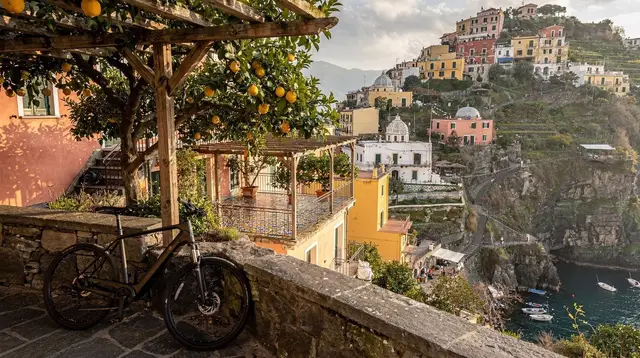
The Sorrentine Peninsula is a different proposition. The secondary roads connecting Sorrento, Sant’Agnello, Massa Lubrense, Sant’Agata sui Due Golfi, and Nerano see far less through-traffic. These are roads used by residents, farm vehicles, and local buses rather than the tour-bus corridor that defines the Amalfi Coast side. That does not make them flat or effortless, but it does make them rideable in a way the SS163 generally is not.
This page treats the two terrains separately, because conflating them leads to bad expectations: riders who imagine a Sorrentine Peninsula ride will resemble a mellow coastal cruise, or that it will feel like the SS163 but calmer, are working from the wrong mental model either way.
Why the Sorrentine Peninsula Roads Are Calmer
The difference comes down to geography and function. The SS163 is the only road connecting the Amalfi Coast’s string of villages, so every car, bus, and delivery truck moving between Positano, Amalfi, and points east funnels onto the same narrow strip of asphalt. There is no alternative route, which is why traffic backs up for kilometers in July and August.
The Sorrentine Peninsula, by contrast, has a looser road network. Routes between Sorrento, Massa Lubrense, Sant’Agata sui Due Golfi, and Nerano do not carry the same concentrated tourist traffic, partly because the peninsula’s main appeal — Sorrento’s old town, the lemon groves, and the coves around Nerano and the Bay of Ieranto — does not depend on a single through-road the way the Amalfi villages do. Traffic exists, but it is distributed rather than funneled, and drivers here are more accustomed to sharing the road with cyclists heading toward Marina del Cantone or the trailheads near Nerano.
The Terrain Is Still Hilly — Don’t Expect a Flat Coastal Cruise
It is tempting to picture cycling near the Mediterranean as a flat, breezy ride along a promenade. The Sorrentine Peninsula does not match that image. The land rises steeply from both coastlines toward a central ridge, and roads between towns climb and descend repeatedly rather than tracing a level shoreline.
A ride from Sorrento to Sant’Agata sui Due Golfi, for instance, involves a sustained climb well inland and uphill from the water, since Sant’Agata sits near the peninsula’s high point. Continuing toward Nerano means descending again toward the coast, then climbing back out. None of this is dangerous the way the SS163’s blind curves can be, but it is physically demanding, and riders who show up expecting a leisurely spin often find themselves underprepared for the elevation.
This is the core reason e-bikes have become the practical choice for most visitors tackling these routes, rather than a marketing add-on.
Why an E-Bike Makes Sense Here
An e-bike does not change the geography, but it changes what the climbs cost a rider physically. On a standard bike, the repeated ascents between Sorrento, Massa Lubrense, and Sant’Agata sui Due Golfi can turn a half-day outing into an exhausting one, especially in summer heat. Pedal-assist power lets a rider maintain a steady pace on the climbs without draining their legs before they have even reached the scenic stretches near Nerano or the viewpoints over the Bay of Ieranto.
This is a different calculation from the Amalfi Coast side, where the limiting factor is not fitness but traffic exposure. An e-bike does nothing to make the SS163 safer to ride — the road’s width and curve geometry are the problem there, not the effort required to pedal it. On the Sorrentine Peninsula, though, where the roads are already calmer, an e-bike removes the main remaining obstacle, which is the hill profile.
| Terrain | Traffic level | Typical challenge | E-bike value |
|---|---|---|---|
| SS163 (Amalfi Coast) | Heavy in season, narrow lanes | Traffic exposure, blind curves | Does not solve the core risk |
| Sorrento–Massa Lubrense–Nerano roads | Light to moderate, local use | Sustained climbs, elevation change | High — manages fatigue on climbs |
Sorrento as the Only Practical Base
Any route planning on the peninsula has to account for one fixed fact: Sorrento is the only town in the area served by a train station, reached from Naples via the Circumvesuviana line through Pompeii and Herculaneum. Massa Lubrense, Sant’Agata sui Due Golfi, and Nerano have no rail connection at all.
This matters directly for cycling logistics. A rider arriving by train has to start and end their ride in Sorrento, which shapes route design as an out-and-back or a loop rather than a point-to-point journey ending somewhere without transport back. Bike rental operators are concentrated in Sorrento for the same reason — it is the only town where a rented bike or e-bike can realistically be picked up and returned by someone relying on public transport rather than a rental car.
Riders staying elsewhere on the peninsula, such as in Massa Lubrense or Sant’Agata sui Due Golfi, have more flexibility to start rides from their accommodation, but anyone day-tripping from Naples, Capri, or the Amalfi Coast side should plan around Sorrento as the entry and exit point.
Two Gulfs, One Ridge: The Peninsula’s Signature View
One feature sets Sorrentine Peninsula cycling apart from a standard Amalfi Coast itinerary: the chance to see both the Gulf of Naples and the Gulf of Salerno within a single ride. The peninsula sits as a spine of land between the two gulfs, and roads that cross from the Sorrento side toward Massa Lubrense and Nerano pass over this ridge.
Riding out from Sorrento along the northern flank keeps the Gulf of Naples in view, with Capri often visible offshore and Vesuvius across the water. Crossing toward Sant’Agata sui Due Golfi or continuing down to Nerano and the Bay of Ieranto area shifts the perspective to the Gulf of Salerno, with the Amalfi Coast’s cliffs visible in the distance. A classic Amalfi Coast drive or ride along the SS163 offers only the Salerno-side view; the Sorrentine Peninsula’s cross-ridge routes are what make the double outlook possible.
A Sample Route Structure
There is no single official cycling route on the peninsula, but a common structure looks like this:
- Start in Sorrento, riding through the lemon-grove terraces on the town’s outskirts.
- Climb toward Sant’Agata sui Due Golfi, the peninsula’s high point, where both gulfs come into view on a clear day.
- Descend toward Nerano and the area near Marina del Cantone, close to the trailhead for the Bay of Ieranto.
- Return via Massa Lubrense along the coastal-facing side before dropping back into Sorrento.
This structure covers roughly the full range of terrain the peninsula offers — climbs, descents, and both gulf views — without venturing onto the Amalfi Coast’s SS163 at any point.
What to Bring and What to Skip
Riders should treat this as a genuine cycling outing rather than a casual excursion. Sun protection matters more than most visitors expect, since much of the climbing happens away from tree cover, and water is essential given the exertion involved on the ascents toward Sant’Agata sui Due Golfi. A basic repair kit is worth carrying, since bike shops are concentrated in Sorrento and not available along the more rural stretches near Nerano or Massa Lubrense.
What to skip: any assumption that this replaces a beach day or a relaxed coastal stroll. Cycling here is closer to a moderate hiking day in terms of physical output, just distributed across a bike ride instead of a trail. Riders looking for the sea-level, low-effort version of the peninsula are better served by a boat trip or a walk through Sorrento’s old town instead.
Pairing a Ride With Time on the Water
Because Nerano and the coves near the Bay of Ieranto sit at the end of several cycling routes, many riders combine the ride with time in the water once they arrive. A short scuba diving outing near Nerano is one way to make use of the coastal access at the end of a ride, while a kayaking trip from Nerano toward the Bay of Ieranto offers a lower-effort way to see the same coastline from the water rather than the saddle.
For visitors who prefer to explore the peninsula’s coastal towns without cycling at all, a private coastal tour departing from Sorrento covers similar ground by road without the physical demands of an e-bike route. And after a day of climbing between Sorrento and Sant’Agata sui Due Golfi, many riders round things off with a limoncello tasting in the heart of the Sorrentine Peninsula, a fitting way to end a day spent moving through the region’s lemon-grove terraces.
Cycling the Peninsula vs. the Amalfi Coast: A Quick Comparison
Visitors planning a trip that spans both areas often ask whether they should attempt any cycling on the Amalfi Coast side as well. In most cases, the answer is to keep cycling to the Sorrentine Peninsula and use SITA buses, a private driver, or seasonal ferries to move along the coast itself. The SS163 was not designed with cyclists in mind, and the traffic density between Positano and Amalfi in high season makes it a poor match even for confident riders.
The peninsula, with its quieter secondary roads and rideable elevation profile — especially on an e-bike — remains the more realistic place to cycle on this stretch of southern Italy’s coastline.
Frequently Asked Questions About Cycling the Sorrentine Peninsula
Is the Sorrentine Peninsula good for cycling beginners?
It suits confident beginners on an e-bike more than casual riders on a standard bike. The roads are quieter than the SS163, but the terrain between Sorrento, Massa Lubrense, and Nerano is consistently hilly, with climbs that surprise people expecting a flat coastal ride.
Should I cycle the SS163 on the Amalfi Coast itself?
Most cyclists avoid it in high season. The SS163 is a narrow corniche road with blind curves, ZTL traffic restrictions, and heavy bus and car traffic between Easter and October, which makes it a poor comparison to the calmer roads of the Sorrentine Peninsula.
Do I need an e-bike for the Sorrentine Peninsula?
It is not mandatory, but it is strongly recommended. The terrain between Sorrento, Sant’Agata sui Due Golfi, and Nerano involves sustained climbs, and an e-bike lets riders manage the elevation without the fatigue a standard bike would require.
Where does a typical cycling route on the peninsula start and finish?
Most routes start and end in Sorrento, since it is the only town on the peninsula served by a railway station, the Circumvesuviana line from Naples. This makes Sorrento the practical anchor point for any loop or point-to-point ride.
Can I see both the Gulf of Naples and the Gulf of Salerno on one ride?
Yes, and this is one of the peninsula’s distinctive features. Riding from Sorrento toward Massa Lubrense and Nerano crosses the ridge of the peninsula, so a single route can alternate between views of the Gulf of Naples and the Gulf of Salerno depending on which side of the ridge the road follows.
Is the Sorrentine Peninsula ride flat since it follows the coast?
No, this is a common misconception. Although the roads run near the coastline in places, the terrain is hilly throughout, with repeated climbs and descents rather than the flat waterfront cycling often associated with Mediterranean seaside towns.
What is the traffic like compared to the Amalfi Coast road?
Noticeably calmer. The secondary roads around Massa Lubrense, Sant’Agata sui Due Golfi, and Nerano carry local and tourist traffic but nothing close to the volume or narrowness of the SS163 between Positano, Amalfi, and Praiano in high season.
When is the best time of year to cycle here?
Spring and autumn offer the most comfortable conditions, with cooler temperatures for climbing and less midday traffic. High summer brings heat that makes the sustained climbs harder, particularly on a standard bike rather than an e-bike.
Cycling & E-Bike Tours on the Amalfi Coast on GetYourGuide
Verified deep-linked GetYourGuide tours. Book through these links and we earn a small commission at no cost to you.
GetYourGuide does not provide a product photo for this activity — the image shows the meeting point, photographed by us.